When Should You NOT Take a Home Loan?
A home loan is one of the biggest financial decisions of your life — and there are situations where taking one is clearly the wrong move. If your income is unstable, your debt is high, or your credit score is poor, a home loan can create serious financial stress. This guide tells you exactly when to wait before borrowing.
Quick Summary
- Avoid a home loan if your total EMI will exceed 50% of your monthly income
- Do not apply with a CIBIL score below 700 — you will pay higher rates or get rejected
- If your job or income is unstable, a 15–25-year EMI commitment is dangerous
- A home loan is not the right choice if the property has legal or title issues
- Wait if you do not have at least 20–30% of the property value as a down payment
What Is This Decision About?
What does it mean?
Deciding when NOT to take a home loan is about recognising that homeownership has a price beyond the EMI. Legal complications, unstable income, high existing debt, or poor market timing can turn a dream home into a financial burden. The decision requires an honest assessment of your current financial health and future income reliability.
How does it work?
A home loan is a 15–25-year obligation. Defaulting has serious consequences: damaged credit score, legal action, and potential loss of the property. Banks can recover the property through the SARFAESI Act if you default. Understanding the full commitment before signing helps you make a decision that is financially sustainable for the long term.
Key Situations Where a Home Loan Is Risky
What are the important factors to consider?
Several financial and life circumstances make a home loan a poor choice at a given point in time. These are not permanent barriers — most can be resolved with 6–24 months of preparation. Identifying which of these applies to you helps you decide whether to proceed now or wait until you are in a stronger position.
How do these situations impact your loan outcome?
Here are the most common situations where a home loan is inadvisable:
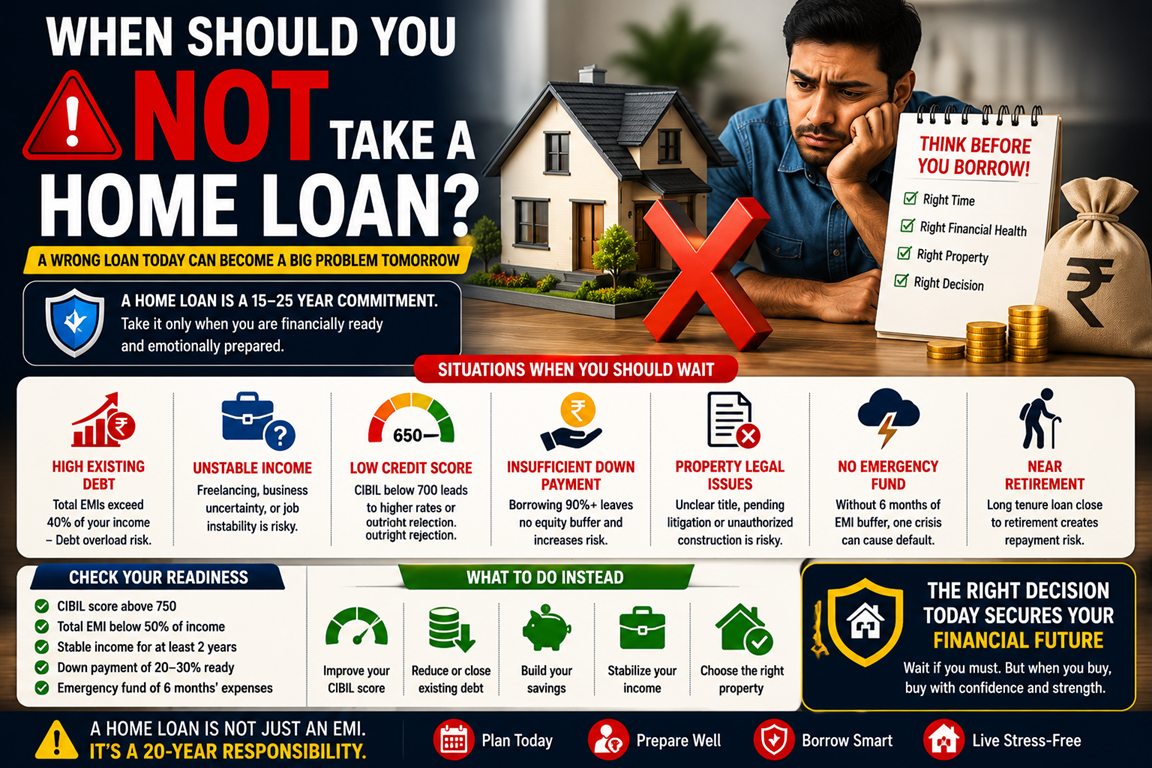
- High Existing Debt: If total EMIs already exceed 40% of income, adding a home loan creates dangerous debt overload
- Unstable Income: Freelancers, early-stage business owners, or recently switched employees face high default risk
- Low Credit Score: Below 700 means higher rates, lower loan amounts, or outright rejection
- Insufficient Down Payment: Borrowing 90%+ of property value leaves no equity buffer
- Property Legal Issues: Unclear title, pending litigation, or unapproved construction increases your risk significantly
- Job Insecurity: No emergency fund + volatile industry + large EMI = a recipe for financial stress
- Near Retirement: Taking a long-term loan close to retirement age creates repayment risk post-income
If your income or plans may change, compare the flexibility of renting with the long-term financial commitment of buying in Is It Better to Rent or Buy a House? before deciding when to purchase.
Scenarios When You Should Wait
What are the available scenarios?
Here are specific situations and the recommended action for each:
| Situation | Risk | Recommended Action |
| CIBIL score below 700 | High rate or rejection | Wait 6–12 months, improve score |
| Existing EMIs >40% of salary | Debt overload | Close existing loans first |
| Less than 1 year at current job | Employment risk concern | Wait for 2-year stability mark |
| Down payment <15% | High LTV, high EMI burden | Save for 12–18 months more |
| Property has legal disputes | Financial and legal loss risk | Choose a different property |
| No emergency fund | One crisis = default | Build 6-month EMI buffer first |
How do different scenarios affect outcomes?
Taking a home loan with a low CIBIL score results in paying lakhs more in extra interest over the tenure. Borrowing with unstable income creates constant EMI anxiety and default risk. Proceeding with a legally disputed property can result in losing both the property and the money paid. Waiting 6–18 months to fix each issue is almost always the better financial decision.
Because a home loan is a long-term commitment, it is also worth understanding What Happens If You Miss a Home Loan EMI Payment? and the potential consequences of falling behind on repayments.
Which Situation Applies to You?
When should you wait and prepare?
Wait if any of the following are true: your CIBIL score is below 700, your existing EMIs already exceed 40% of your income, you have been in your current job for less than 2 years, or you have no emergency fund. Use the waiting period to fix each issue systematically — your loan terms will be significantly better and the financial stress significantly lower.
When is it safe to proceed?
Proceed with a home loan if your CIBIL score is above 750, your total EMI (including the new home loan) will stay below 50% of your salary, you have a stable job with at least 2 years of tenure, you have 20–30% ready for the down payment, and you have a 6-month emergency fund separate from your down payment savings.
Practical Tips Before Taking a Home Loan
- Run a full financial health check: CIBIL score, FOIR, emergency fund, and job stability
- Verify the property’s legal title through an independent lawyer before signing anything
- Get pre-approved by a bank to understand your exact eligibility before committing to a property
- Calculate the total cost of ownership — EMI is not your only expense (maintenance, taxes, insurance)
- Have a clear plan for what happens to your EMI if your income drops or stops for 3–6 months
Common Mistakes to Avoid
- Buying a house because of social pressure or the fear of missing out on rising prices
- Using the home loan as the primary investment strategy without considering market risk
- Not reading the fine print on prepayment penalties, floating rate reset clauses, and foreclosure terms
- Underestimating how a rising interest rate environment can increase your floating rate EMI
Conclusion
A home loan at the right time is a powerful tool for building wealth. At the wrong time, it becomes a source of chronic financial stress. Be honest about your financial readiness before committing to a 20-year obligation. Fix your credit, build your savings, stabilise your income — then buy your home from a position of strength, not desperation.
Frequently Asked Questions
Is it better to wait for lower interest rates before taking a home loan?
Timing the market for interest rates is unreliable — rates can move in either direction. A more practical approach is to take the loan when your personal financial readiness is strong (good CIBIL, low debt, stable income). If rates drop later, you can refinance through a home loan balance transfer to reduce your interest burden.
What happens if I default on my home loan?
Defaulting on a home loan triggers a series of escalating consequences. After 90 days of non-payment, the account is classified as an NPA. The bank issues a notice under the SARFAESI Act and can auction the property to recover dues. Your CIBIL score drops severely and remains impacted for 7 years, making future credit extremely difficult to access.
Is renting always better than buying if the EMI is too high?
Not always, but in specific situations, yes. If the EMI is more than 1.5–2 times the equivalent rent for the same property, renting may be financially superior in the short to medium term. However, renting does not build equity or offer tax benefits. The right answer depends on your city, income trajectory, and long-term plans.
Can taking a home loan hurt my credit score?
Initially, a new home loan causes a slight dip in your CIBIL score due to the hard enquiry and new liability. However, consistent on-time EMI payments over 12–24 months improve your score significantly. A well-managed home loan is one of the most positive contributors to long-term credit health in India.
Should I pay off other loans before taking a home loan?
Yes, if those loans are creating significant FOIR pressure. Closing a personal loan or vehicle loan before applying can increase your home loan eligibility by ₹8–15 lakhs depending on the EMI amount. It also reduces your total financial stress. However, if the existing loans have very low interest rates or small EMIs, the impact on FOIR may be minimal.