What Is Loan Against Property (LAP) and How Does It Work?
A Loan Against Property (LAP) is a secured loan where you mortgage your residential or commercial property to borrow funds for any purpose — business, education, marriage, or medical needs. In this guide, you’ll learn how LAP works, how much you can borrow, how it compares to a personal loan, and when it’s the smarter financing choice — so you can unlock your property’s value without selling it.
Quick Summary
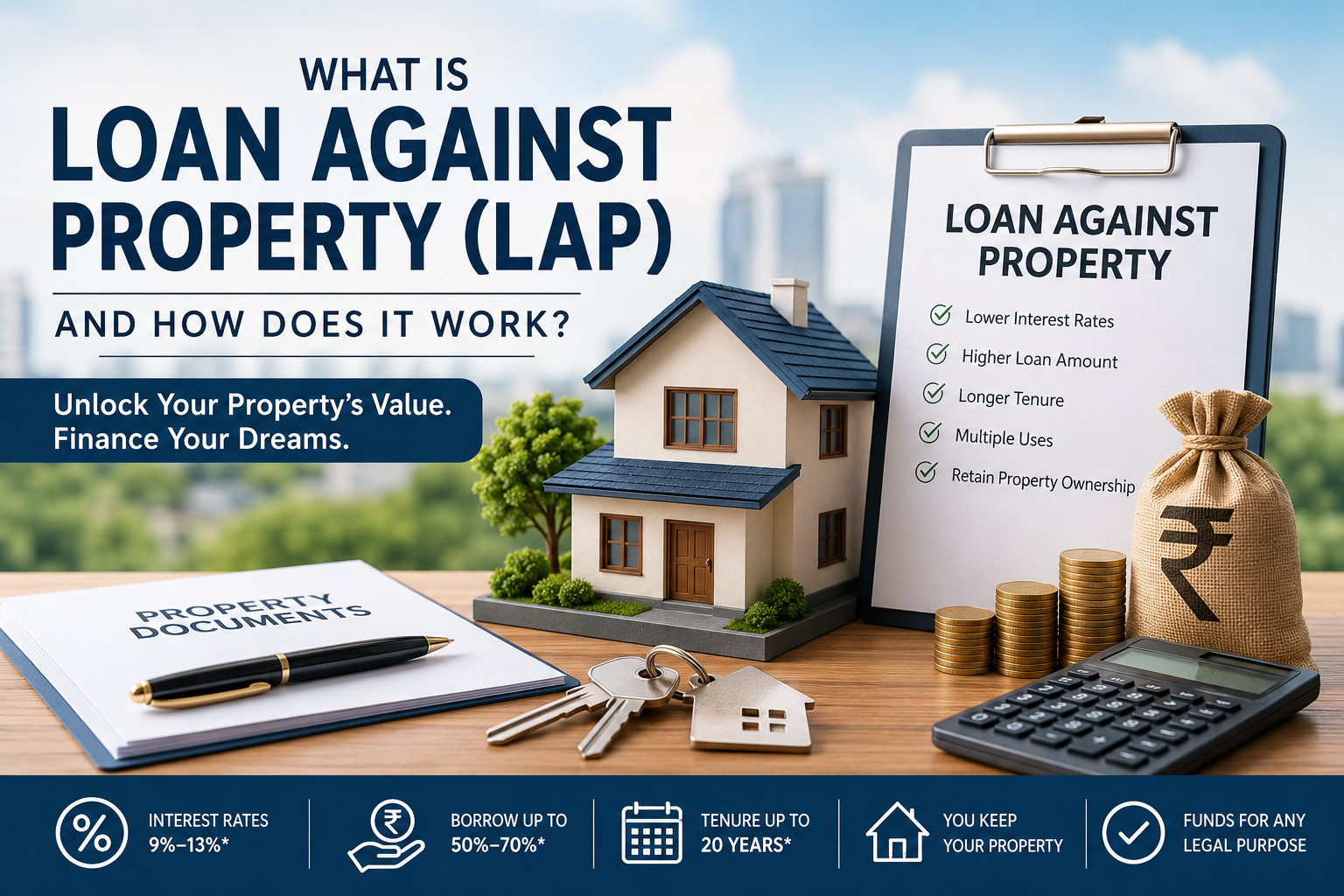
- LAP lets you borrow 50–70% of your property’s market value at lower interest rates than personal loans.
- Interest rates for LAP in India typically range from 9%–13%, much lower than personal loans (12%–24%).
- Tenure can extend up to 15–20 years, making EMI manageable for large amounts.
- The property continues to remain in your possession; you only mortgage the title.
- Funds can be used for any legal purpose — business, education, weddings, medical, debt consolidation.
What Is Loan Against Property?
What does it mean?
LAP is a secured loan where you pledge a residential, commercial, or industrial property you own as collateral to borrow money from a bank or NBFC. Unlike a home loan (which is for buying property), LAP uses an existing property to raise funds. The lender holds the property documents until the loan is fully repaid. You continue to live in or rent out the property normally — only the title is mortgaged, not the physical possession.
How does it work?
When you apply for LAP, the lender evaluates the property’s market value through a registered valuer and assesses your repayment capacity (income, credit score, existing EMIs). If approved, the lender disburses 50–70% of the property’s value as a loan, with monthly EMIs spread over up to 20 years. The mortgage is registered, and the original property documents are held by the lender. Once the loan is fully repaid, the documents are returned and the mortgage is released.
Key Factors You Should Know
What are the important factors to consider?
Five key factors decide your LAP terms: the property’s type and location (residential gets better LTV than commercial; metros get higher valuations), your income and credit score, the property’s clear legal title, the lender’s LAP policy, and your end-use of the funds. The interest rate, processing fee, and tenure also vary significantly between banks and NBFCs — comparison is critical.
How do these factors impact your decision?
These factors decide both the loan amount and total cost. A residential property in a Tier 1 city with clear title can fetch up to 70% LTV at the lowest LAP rate. The same property in a Tier 3 town might get only 50% LTV at a higher rate. Self-employed borrowers usually get slightly lower LTV than salaried. Choosing a 20-year tenure cuts EMI but doubles total interest compared to 10 years.
- Property Type — Residential > Commercial > Industrial in LTV terms
- Property Location — Metros and Tier 1 cities get higher valuations
- LTV Ratio — 50–70% of market value, varies by lender
- Borrower Profile — Income, CIBIL, employment stability
- Tenure — Up to 15–20 years
Options / Scenarios Explained
What are the available options?
LAP comes in several variants: standard LAP (lump-sum disbursement), LAP overdraft (drop-line OD where you draw and pay interest only on the used amount), LAP for self-employed (with flexible income proof), LAP for business owners (often combined with working capital lines), and lease rental discounting (where rental income from the property is the repayment source). Each suits different cash flow needs.
How do different scenarios affect outcomes?
Standard LAP works best for one-time large needs like business expansion or medical emergencies. LAP-OD suits ongoing or recurring needs (working capital, education over years) since you pay interest only on what you actually use. Lease rental discounting works for borrowers with rental properties — the EMI is serviced from rental income, reducing personal cash flow stress. The choice changes both cost structure and flexibility.
| Variant | Best For | Key Benefit |
| Standard LAP | Lump-sum needs (business, wedding, medical) | Simple, predictable EMI |
| LAP Overdraft | Recurring or uncertain needs | Pay interest only on used amount |
| Lease Rental Discounting | Rental property owners | Rental income services EMI |
| Top-up LAP | Existing home loan borrowers | Faster approval, lower rate |
Which Option Is Right for You?
When should you choose LAP over a personal loan?
Choose LAP when you need a large amount (₹15 lakh+), can wait 2–3 weeks for processing, and want a long tenure to keep EMIs low. LAP rates are typically 5–10% lower than personal loans, which on a ₹30 lakh, 10-year loan can save ₹15–20 lakh in total interest. You also get longer tenure (up to 20 years vs 5 years for personal loans), making EMIs much more manageable.
When should you avoid LAP and use other options?
Avoid LAP if you only need a small amount (under ₹10 lakh) where the processing fees, valuation, and legal costs make it less efficient — a personal loan may be faster and cheaper net of fees. Also avoid if your income is unstable and you risk default — losing your home or commercial property to recovery is a much bigger consequence than a personal loan default. Top-up home loans are a faster alternative if you already have a running home loan.
Practical Tips to Make the Best Decision
- Get your property valued by 2–3 lenders to find the highest LTV offer — valuations vary significantly between banks.
- Ensure all property documents (title deed, sale deed, NOC, occupancy certificate) are clear and ready before applying.
- Compare the all-in cost: interest rate + processing fee (0.5–2%) + legal/valuation charges + GST.
- If you already have a home loan, ask your existing lender for a top-up — it’s usually faster and cheaper than a fresh LAP.
Common Mistakes to Avoid
- Borrowing the maximum LTV when you don’t need to — bigger loans mean bigger EMIs and more risk to your property.
- Ignoring the foreclosure terms — many LAPs (especially fixed-rate) have prepayment penalties that limit flexibility.
- Using LAP for speculative investments (stocks, crypto, business ventures with no income) — you risk your home for a return that may never come.
Conclusion
LAP is one of the most cost-effective ways to raise large funds in India when you own property. With rates significantly lower than personal loans and tenures up to 20 years, it can fund business expansion, children’s education, or major medical needs without forcing a property sale. But the trade-off is real — defaulting puts your property at risk. Borrow only what you can comfortably repay, compare 3–4 lenders, and make sure the end-use generates returns or value worth the risk.
FAQ Section
What is the maximum amount I can borrow against my property?
Most lenders offer 50%–70% of the property’s current market value as LAP. For a property valued at ₹1 crore, you can typically borrow ₹50–70 lakh. Residential properties in metros usually get the highest LTV (up to 70%), while commercial and industrial properties get 50–60%. The exact amount also depends on your income, credit score, and the lender’s policy.
What is the interest rate on LAP in India?
LAP interest rates in India typically range from 9% to 13% per annum, depending on the lender, property type, borrower profile, and loan amount. Banks generally offer lower rates (9–11%) than NBFCs (10–13%). Rates are higher than home loans (8.5–10%) because the funds are not used for property purchase, but much lower than personal loans (12–24%) because the loan is secured by collateral.
Can I take a Loan Against Property if I’m self-employed?
Yes, self-employed professionals and business owners are eligible for LAP. In fact, LAP is one of the most popular financing options for the self-employed because lenders can verify repayment capacity through both income (ITR, business proof) and collateral (the property). You’ll need 2–3 years of ITR, business proof, bank statements, and clear property documents. The eligibility may be slightly lower than for salaried borrowers.
What happens if I default on a Loan Against Property?
If you default on LAP EMIs for 90+ days, the lender classifies the loan as a Non-Performing Asset (NPA) and initiates recovery under the SARFAESI Act. The lender can issue a 60-day notice and then auction the property to recover dues. Your CIBIL score also takes a major hit (drops by 100+ points), affecting future borrowing. Always maintain a buffer and communicate early with the lender if you face payment trouble.
How long does it take to get a LAP approved?
LAP processing typically takes 2–4 weeks from application to disbursement. The timeline includes property valuation (3–7 days), legal verification of title documents (5–10 days), credit and income assessment (3–5 days), and final loan agreement signing. Top-up LAP from your existing home loan lender can be processed in 7–10 days, since they already have your KYC and property documents on file.