Why Do Banks Reject Salaried Applicants Despite Stable Income?
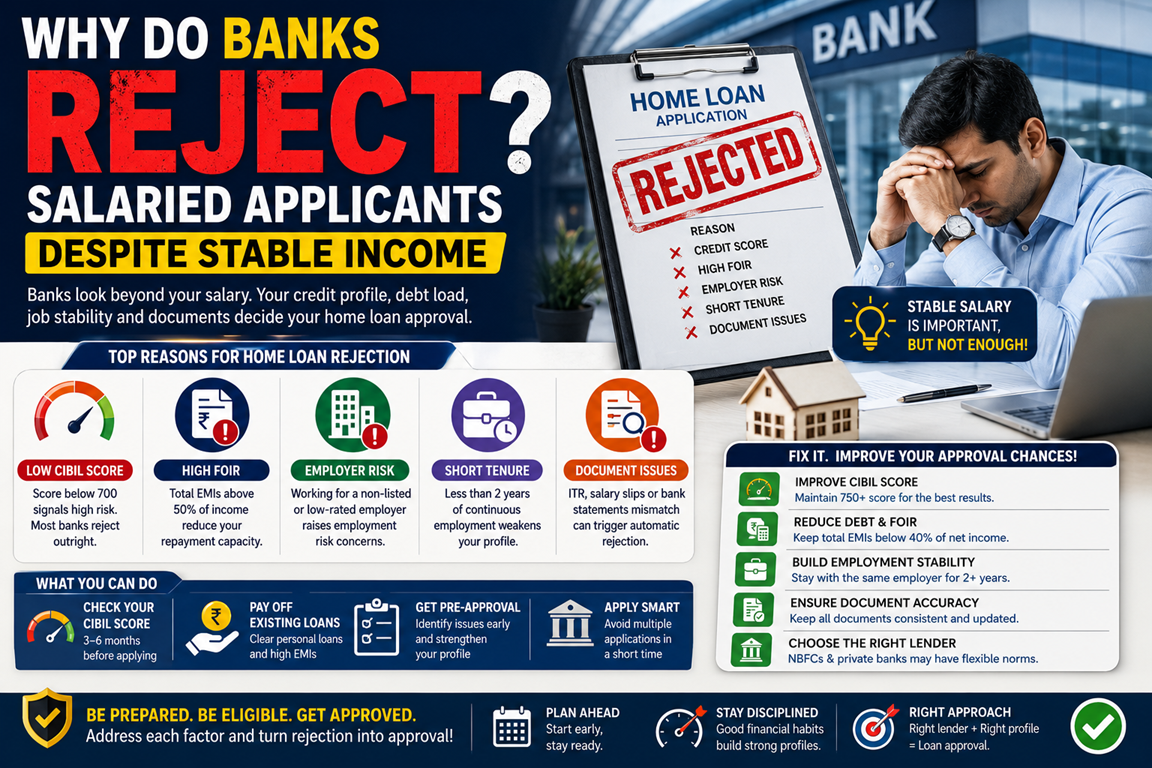
Having a stable salary is important, but it does not guarantee home loan approval. Banks look beyond your payslip — your CIBIL score, FOIR, employer profile, job tenure, and document accuracy all play a critical role. This guide explains exactly why salaried applicants get rejected and what you can do about it.
Quick Summary
- Low CIBIL score (below 700) is the most common rejection reason, even for salaried applicants
- High FOIR due to existing EMIs reduces your repayment capacity in the bank’s assessment
- Working for a non-listed or low-rated employer raises employment risk concerns
- Less than 2 years of continuous employment weakens your application profile
- Document discrepancies or ITR-salary mismatches can trigger automatic rejection
What Is This Problem?
What does it mean?
Home loan rejection for salaried applicants despite stable income occurs when non-income factors raise red flags for lenders. Banks do not just verify that you earn a salary — they assess the risk of you defaulting over a 15–25-year period. Even one weak area in your financial or professional profile can result in a rejected application.
How does it work?
Banks run a multi-parameter risk assessment on every application. They check credit bureau reports, verify employer credentials, calculate FOIR with all existing obligations, and cross-check submitted documents with ITR and bank statements. An issue in any one of these areas — not just income — can lead to outright rejection or reduced loan sanction.
Key Reasons Salaried Applicants Get Rejected
What are the important factors to consider?
Understanding the specific triggers for rejection helps you proactively fix them before applying. The most common reasons salaried applicants face rejection are related to credit profile, debt load, employment credentials, and documentation quality.
To understand how your existing loan commitments affect your borrowing capacity and how much of your income you can safely allocate to repayments, read What EMI Is Safe for Your Salary?.
How do these factors impact your application?
Here is how each key reason affects your home loan:
- Low CIBIL Score: Below 700 signals poor repayment history; most banks decline outright
- High FOIR: Total EMIs above 50% of income leave no room for a new home loan EMI
- Employer Not on Approved List: Startups or unlisted private firms may not meet lender criteria
- Short Job Tenure: Less than 1–2 years at current employer signals employment instability
- Frequent Job Changes: More than 2–3 switches in 3 years is seen as high risk
- Document Mismatch: Salary slip income not matching ITR raises fraud concerns
- Negative Property Report: Legal or technical issues with the property also trigger rejection
If your employer’s classification may be affecting your application, read What Makes an “Approved Employer List” — and How to Check Yours Before Applying to understand how lender-specific employer criteria work and what you can check before applying.
Common Rejection Scenarios Explained
What are the available scenarios?
Different rejection triggers call for different solutions. Here are the most common situations faced by salaried applicants and what typically happens in each case:
| Rejection Reason | Impact | Fix Timeline |
| Low CIBIL Score (<700) | Outright rejection by most banks | 6–12 months to improve |
| High FOIR (>50%) | Reduced loan amount or rejection | 3–6 months (close loans) |
| Unlisted Employer | Rejection by PSU/major banks | Apply to NBFCs or private banks |
| Short Job Tenure (<2 yrs) | Rejection pending stability proof | Wait for 2-year mark |
| Document Mismatch | Immediate rejection + blacklisting risk | Correct and reapply |
How do different scenarios affect outcomes?
A CIBIL-related rejection requires the most patience — 6–12 months of disciplined credit behaviour to recover. An employer-related rejection can be resolved faster by switching to an NBFC or a private bank that accepts a broader employer list. Document mismatches are the most serious as they can lead to blacklisting across lenders.
Which Fix Is Right for You?
When should you improve credit before reapplying?
If your rejection was due to a low CIBIL score or missed payments, wait and improve before reapplying. Spend 6–12 months paying all dues on time, reducing credit card utilisation below 30%, and avoiding any new loan applications. A score above 750 significantly improves your approval odds and the interest rate offered.
When should you switch lenders instead?
If your rejection was due to employer profile or specific bank policies, applying to a different lender is the smarter move. NBFCs like LIC HFL, PNB Housing, and Bajaj Finserv accept a wider range of employers and have more flexible eligibility norms. Private banks may also evaluate your case differently from public sector banks.
Practical Tips to Avoid Rejection
- Check your CIBIL score and report for errors 3–6 months before applying
- Keep total EMI obligations below 40% of your net salary before adding a home loan
- Stay with the same employer for at least 2 years before applying
- Ensure all documents — salary slips, Form 16, ITR, and bank statements — are consistent
- Ask your bank for a pre-approval to identify any issues before formal submission
For a fuller checklist of the income, employment, banking and identity documents lenders may request, see Documents Required for a Home Loan Application in India (2026 Checklist) before submitting your application.
Common Mistakes to Avoid
- Applying immediately after a job change without waiting for the stability threshold
- Not checking the lender’s approved employer list before applying
- Submitting different income figures across different documents
- Ignoring errors in your CIBIL report that can be disputed and corrected for free
Conclusion
A stable salary is a necessary but not sufficient condition for home loan approval. Banks evaluate your complete financial and professional profile. Fix your credit score, manage existing debt, ensure document consistency, and choose the right lender for your employer type. Address each rejection reason systematically and your approval chances improve dramatically.
Frequently Asked Questions
Can I reapply for a home loan after rejection?
Yes, but wait at least 3–6 months before reapplying. Each application creates a hard enquiry on your CIBIL report. Multiple rejections in quick succession further lower your credit score. Use the waiting period to address the rejection reason — improve your score, reduce debt, or correct documents before your next application.
Does the employer matter for home loan approval?
Yes, significantly. Banks maintain an internal list of approved employers. PSU employees, government workers, and MNC staff get the most favourable terms. Employees of smaller private companies, startups, or proprietorships may face additional scrutiny. NBFCs are generally more flexible on employer criteria than nationalised banks.
Can a rejection due to FOIR be fixed?
Yes. Close existing personal loans or vehicle loans before reapplying. Every ₹1,000 reduction in monthly EMI obligations increases your home loan eligibility by approximately ₹8–9 lakhs. You can also consider a joint application to increase the combined income pool and improve your overall FOIR position.
What if the property I chose was rejected by the bank?
Banks reject properties that have pending litigation, unclear title deeds, unauthorised constructions, or valuation lower than the required LTV ratio. If the property is rejected, you can either choose a different property or get the legal issues resolved. Always do a legal and technical due diligence before finalising any property.
Will a past default permanently affect my home loan eligibility?
A past default stays on your CIBIL report for 7 years. However, its impact reduces significantly over time if you rebuild a consistent repayment track record. Settling the default (even with a write-off) and then 12–24 months of clean credit behaviour can make you eligible for a home loan, particularly from NBFCs.