How a Co-Applicant’s Credit Score Affects a Joint Home Loan
A co-applicant’s credit score can affect a joint home loan because lenders assess the credit profiles of both applicants, along with income, existing EMIs, age and repayment capacity. A strong primary applicant’s score does not automatically cancel out concerns arising from a co-applicant’s weak credit history.
If you are considering a joint application to increase your borrowing capacity, check both applicants’ financial profiles before applying. Nestara’s New Home Loan eligibility checker can help you understand your potential eligibility and explore suitable lender options before you submit multiple formal applications.
Does a Co-Applicant’s Credit Score Affect Joint Home Loan Eligibility?
Yes, a co-applicant’s credit score and credit history can influence how a lender assesses a joint home loan application. The lender generally looks at the combined financial picture rather than considering only the primary applicant’s score.
For example, suppose:
| Applicant | CIBIL profile | Monthly income |
|---|---|---|
| Applicant A | Strong | ₹80,000 |
| Applicant B | Weak | ₹50,000 |
Although the combined income may improve repayment capacity, Applicant B’s credit history could lead the lender to assess the application more cautiously.
The exact impact depends on the lender’s credit policy. There is no universal rule saying that a particular co-applicant score automatically means approval or rejection.
Why Does the Co-Applicant’s Credit History Matter?
The co-applicant’s credit history matters because joint borrowers share responsibility for repaying the loan. Lenders therefore have a reason to examine both applicants’ past borrowing behaviour.
A credit report can show information such as:
- Existing and past loans
- Repayment history
- Outstanding balances
- Credit-card accounts
- Recent credit enquiries
- Defaults or other adverse information
CIBIL specifically advises borrowers to understand each other’s credit scores and financial obligations before applying jointly. It also notes that borrowers on joint, co-signed or guaranteed accounts can be equally liable for missed payments.
This means a co-applicant is not simply a way to add another salary to the application. Their liabilities and credit behaviour also become relevant to the lender’s assessment.
Can a Good Primary Applicant Score Offset a Low Co-Applicant Score?
A strong primary applicant’s credit profile can help the overall application, but it does not guarantee that a lender will overlook a weak co-applicant profile.
Consider this example:
Applicant A: CIBIL Score 800, stable income, no existing EMI
Applicant B: CIBIL Score 650, stable income, ₹20,000 existing EMI
The application has positive factors, such as a strong primary applicant and additional income. However, the lender may also consider Applicant B’s lower score and existing obligation when deciding the loan amount, pricing or whether to approve the application.
A lender may reach a different decision if Applicant B’s lower score is caused by a reporting error that has since been corrected, compared with a history of repeated missed repayments.
So, the right question is not simply, “Is my co-applicant’s score low?” It is, “Why is the score low, and what does the complete credit profile look like?”
How Do Existing EMIs and Credit Score Work Together?
Existing EMIs can make the effect of a co-applicant’s credit profile more significant because lenders assess both creditworthiness and repayment capacity.
For example, imagine a couple earns ₹1.30 lakh per month together. One applicant has a strong credit history, while the other has a weaker profile and already pays ₹25,000 in personal-loan and credit-card obligations.
The second applicant contributes income, but also brings existing financial commitments into the assessment.
| Co-applicant profile | Potential effect |
|---|---|
| Strong credit + stable income + low EMIs | Generally supportive |
| Strong credit + high existing EMIs | Income benefit may be reduced |
| Weak credit + stable income | May require closer assessment |
| Weak credit + high existing EMIs | Can make the application more challenging |
| No eligible income + weak credit | May provide little eligibility benefit |
There is no fixed formula that applies to every lender. The final assessment depends on the lender’s policies and the complete application.
Should You Add a Co-Applicant With a Low Credit Score?
You should add a co-applicant with a low credit score only after understanding whether their income benefit outweighs the potential concerns in their credit profile.
Before applying jointly, check:
- Both applicants’ credit reports and scores.
- Existing EMIs and outstanding credit-card balances.
- Any overdue payments or defaults.
- Recent credit enquiries.
- Whether the co-applicant’s income is eligible for consideration.
- Whether the additional borrowing is actually affordable.
If the co-applicant has significant credit issues, applying individually may sometimes be worth considering if the primary applicant can independently qualify for the required loan. However, this is lender-specific and should be assessed against the actual loan requirement.
How Can a Co-Applicant Improve Their Credit Profile Before Applying?
A co-applicant can strengthen their position by correcting credit-report errors, paying existing dues on time and reducing excessive outstanding balances before a joint application.
Focus on the underlying issue rather than trying to improve the score through quick fixes.
For example:
- Missed payments: Bring overdue accounts up to date and maintain timely payments.
- High credit utilisation: Reduce outstanding revolving balances where possible.
- Incorrect information: Raise a dispute with the relevant credit bureau or lender.
- Too many recent applications: Avoid unnecessary new credit applications.
- High existing debt: Reduce liabilities where financially practical.
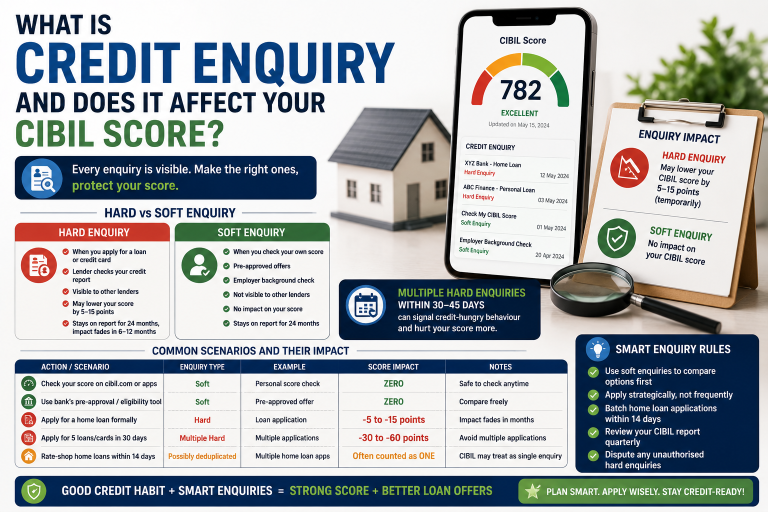
Checking your own CIBIL report does not itself lower your score. However, formal applications can generate lender enquiries, and multiple enquiries within a short period can affect the credit profile.
For this reason, it is sensible to understand both applicants’ profiles before submitting applications to several lenders.
How Should Couples Check Joint Home Loan Eligibility Before Applying?
Couples should compare their individual and joint eligibility before deciding who should be on the home-loan application.
A practical approach is:
- Check both credit profiles.
- Add both incomes and existing EMIs.
- Consider age and preferred tenure.
- Estimate the required loan amount.
- Compare individual versus joint eligibility.
- Review lender-specific requirements before making a formal application.
A joint loan can increase eligibility when the co-applicant contributes stable, acceptable income and has a manageable financial profile. But adding a co-applicant does not automatically double your borrowing capacity.
Our New Home Loan eligibility checker can help you assess your profile before taking the next step, rather than relying on a generic assumption about how much you can borrow.
What Should You Check Before Taking a Joint Home Loan?
You should check both applicants’ credit, income, liabilities and repayment comfort before signing up for a joint home loan.
Use this checklist:
- Credit: Are both reports accurate and free from unresolved issues?
- Income: Is each applicant’s income stable and acceptable to the lender?
- Existing debt: What EMIs does each person already have?
- Affordability: Can you comfortably manage the proposed EMI?
- Tenure: Does the older applicant’s age affect the available tenure?
- Ownership: Does the property ownership structure match the loan arrangement?
- Lender fit: Does the lender accept both applicants and their income profiles?
Conclusion
A co-applicant’s credit score can influence a joint home loan because lenders assess both borrowers’ credit histories, liabilities and repayment capacity. A strong primary applicant can strengthen the application, but it does not automatically eliminate concerns about a co-applicant’s weak credit profile.
Before applying, check both credit reports, understand existing EMIs and compare individual versus joint eligibility. This can help you avoid adding a co-applicant simply for their income when their overall financial profile may not improve the application.
If you are ready to assess your borrowing capacity, use Nestara’s New Home Loan eligibility checker to check your profile and explore suitable lender options before making a formal application.
FAQs
Does a co-applicant’s CIBIL score affect a joint home loan?
Yes. A lender can consider the co-applicant’s CIBIL score and credit history when assessing a joint home loan. The effect depends on the lender’s credit policy and the applicant’s overall financial profile.
Can I get a joint home loan if my co-applicant has a low CIBIL score?
Yes, it may still be possible, but approval can be more difficult depending on the reason for the low score, existing debt, income and the lender’s criteria. A low score is not a universal automatic rejection rule.
Is it better to apply alone if my spouse has a low credit score?
It can be worth considering if you can independently qualify for the required loan amount. However, applying alone means the lender may assess eligibility using only your income and liabilities, so compare both scenarios before deciding.
Does my spouse’s CIBIL score affect my personal CIBIL score?
No. Each person has an individual CIBIL profile. Your spouse’s score does not directly become your score. However, when you take a joint loan, both borrowers’ credit profiles can be considered, and repayment problems on jointly held accounts can affect both borrowers’ access to credit.
Can a joint home loan increase my eligibility?
Yes, a joint home loan can increase eligibility when the co-applicant contributes eligible, stable income and has a suitable overall financial profile. However, existing EMIs, credit history, age and lender-specific criteria can reduce or limit the benefit.
Should both applicants check their credit reports before applying?
Yes. Checking both reports before applying can help identify overdue accounts, errors, outstanding debts or unfamiliar enquiries before a lender formally assesses the application. You can also check your own credit report without that self-check lowering your CIBIL Score.