How Do Banks Decide Your Home Loan Eligibility? (Explained Simply)
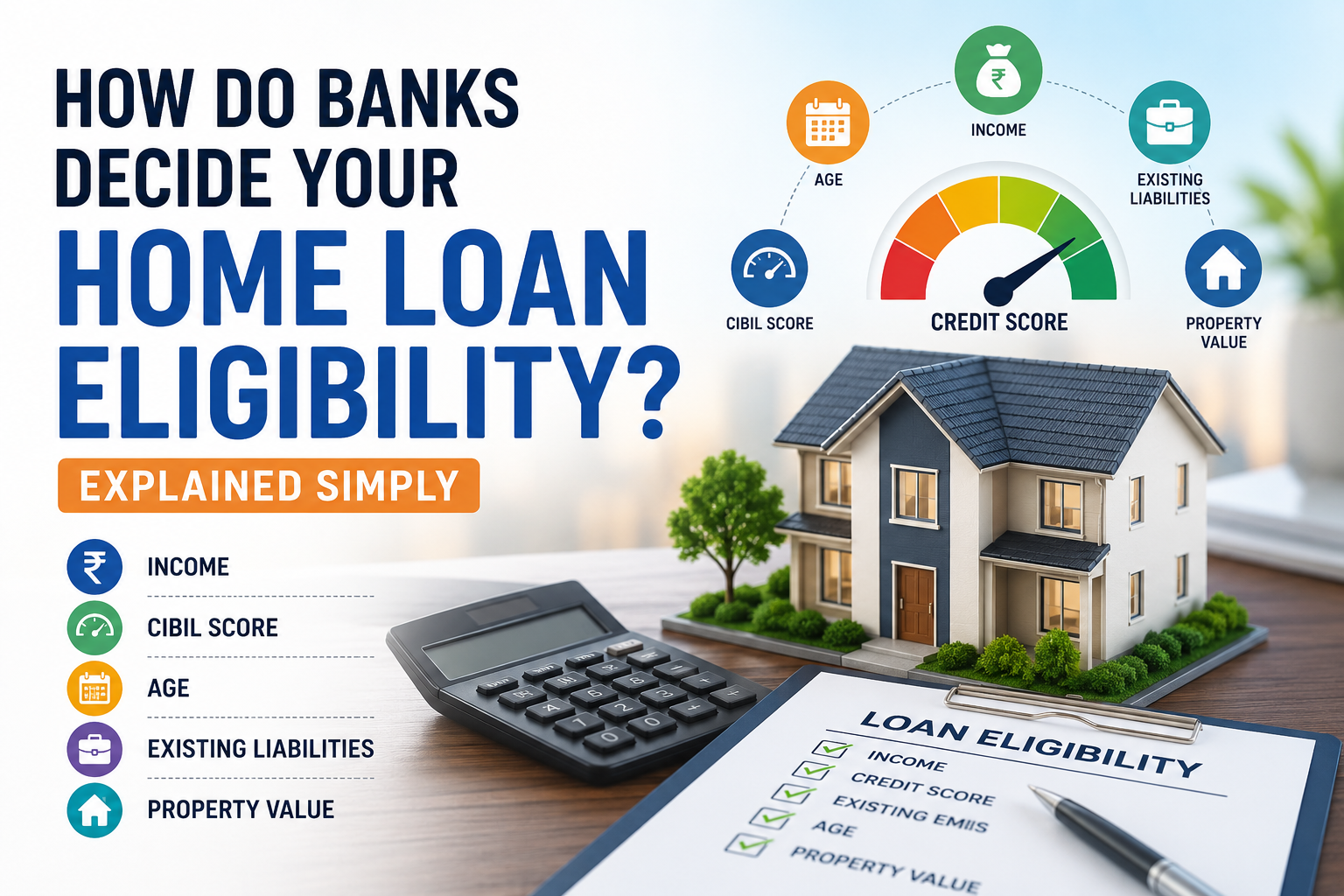
Banks decide your home loan eligibility based on five core factors: your income, credit score, age, existing liabilities, and the property’s value. In this guide, you’ll learn exactly how lenders assess each factor, what formulas they use, and how to maximise the loan amount you qualify for — so you can avoid surprises at the application stage and borrow what you actually need.
Quick Summary
- Lenders typically allow EMI to be 40–50% of your net monthly income (called FOIR — Fixed Obligation to Income Ratio).
- Your CIBIL score, age, employer profile, and job stability all influence the final loan amount.
- Existing EMIs (car, personal, credit cards) reduce your home loan eligibility proportionally.
- The property’s market value, location, and legal clearance determine the maximum LTV the bank will offer.
- Self-employed and salaried borrowers are evaluated using different documents and metrics.
What Is Home Loan Eligibility?
What does it mean?
Home loan eligibility is the maximum loan amount a lender is willing to sanction to you based on your repayment capacity and risk profile. It’s not a fixed number — it’s calculated dynamically using your income, debts, credit score, age, and the property you want to buy. Two borrowers with the same salary can have very different eligibility figures depending on their existing liabilities and credit history.
How does it work?
Lenders use proprietary scoring models that combine income, credit data, and property details into a single sanctioned amount. The most common rule is FOIR — your total EMI obligations (existing + new) cannot exceed 40–50% of your net monthly income. For example, if you take home ₹1 lakh/month and have no existing EMIs, your home loan EMI cap is roughly ₹40,000–50,000, which translates to a loan of around ₹45–55 lakh at current rates.
Key Factors You Should Know
What are the important factors to consider?
Five primary factors decide eligibility: your monthly income (gross and net), CIBIL score, age, employment type and stability, and existing financial obligations. Your income tells the bank how much EMI you can absorb. CIBIL score signals risk. Age affects tenure (banks want loans repaid before retirement). Employment stability — government, MNC, salaried, self-employed — is graded differently. Existing EMIs and credit card minimum dues directly reduce how much new debt you can carry.
How do these factors impact your decision?
These factors don’t just affect approval — they decide the loan amount, interest rate, and tenure offered. A salaried 30-year-old with ₹1 lakh income, 800 CIBIL score, and zero existing EMIs may be offered ₹70 lakh at the lowest rate. The same income with a ₹15,000 car EMI and a 690 CIBIL score might get only ₹40 lakh at a higher rate. Knowing this lets you prepare in advance — clear small loans, fix your score, or add a co-applicant.
- Income — Net monthly take-home is the base
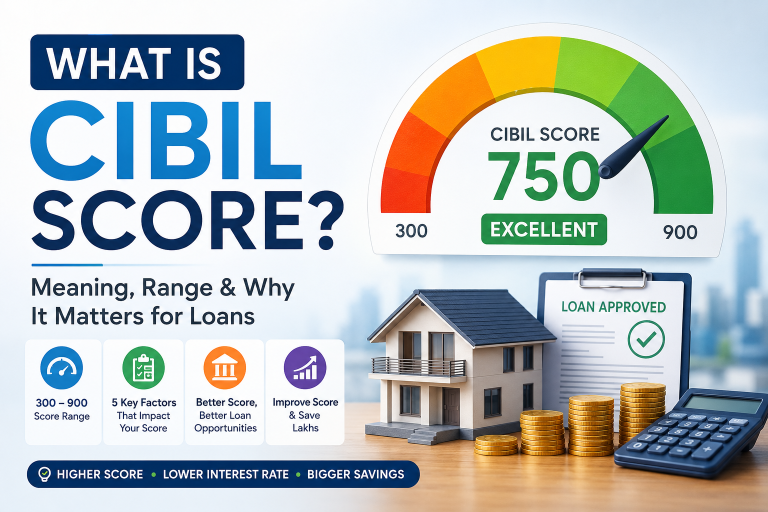
- CIBIL Score — 750+ unlocks best terms
- Age — Younger borrowers get longer tenure
- Employment Type — Salaried > Self-employed in most banks’ eyes
- Existing EMIs — Each ₹10,000 of EMI cuts ~₹10 lakh from eligibility
Options / Scenarios Explained
What are the available options?
You can boost your eligibility through several strategies: adding a co-applicant (spouse, parent, sibling) to combine incomes; opting for a longer tenure to reduce EMI; including bonus, rental income, or variable pay in income proof; or choosing a lender with a more lenient FOIR (some allow 55–60%). Different lenders use different formulas — government banks tend to be conservative, while private banks and HFCs often offer higher amounts.
How do different scenarios affect outcomes?
Each strategy has trade-offs. Adding a co-applicant doubles eligibility but also makes them legally liable. Longer tenure reduces EMI but increases total interest paid significantly. Including variable pay may inflate eligibility on paper but stress your finances if the bonus drops. Switching to a more lenient lender can help — but check the rate carefully, as higher eligibility sometimes comes with a higher interest rate.
| Strategy | Eligibility Impact | Trade-off |
| Add co-applicant | Up to 2x increase | Joint liability, both CIBIL scores matter |
| Extend tenure to 30 years | 25–35% increase | Significantly higher total interest paid |
| Pay off existing loans | 15–40% increase | Drains liquidity in the short term |
| Switch to lenient lender | 10–25% increase | May come with higher interest rate |
Which Option Is Right for You?
When should you add a co-applicant?
Add a co-applicant when your individual income is not enough to qualify for the loan amount you need, especially in metros where property prices are high. A working spouse is the most common choice — combined income increases eligibility, and joint home loans also unlock larger tax deductions for both partners. Make sure the co-applicant’s CIBIL score is also strong; a weak co-applicant can drag your application down.
When should you extend the tenure?
Extend tenure to 25–30 years if your goal is to maximise eligibility or keep monthly EMI low for cash flow reasons. This works well for younger borrowers (25–35) with long earning years ahead. Avoid maxing out tenure if you’re closer to retirement or if you can comfortably afford a higher EMI — a shorter tenure dramatically reduces the total interest you pay, often by 30–50%.
Practical Tips to Make the Best Decision
- Use your bank’s online eligibility calculator before applying — it gives a near-accurate estimate without triggering a hard enquiry.
- Pay off small personal loans, BNPL, or credit card balances 2–3 months before applying.
- Keep all your income documents updated — recent salary slips, Form 16, and ITRs ready.
- Avoid switching jobs in the 3–6 months leading up to your application; lenders prefer stable employment.
Common Mistakes to Avoid
- Applying to multiple banks simultaneously — each pulls your CIBIL report, dropping your score and signalling desperation.
- Hiding existing loans or credit cards — banks see your full liability profile via CIBIL and rejecting fudged applications is automatic.
- Targeting maximum eligibility instead of comfortable EMI — borrowing the cap leaves no buffer for emergencies, rate hikes, or income disruption.
Conclusion
Home loan eligibility is not a single number from a single formula — it’s the combined output of your income, debts, credit score, age, and the property itself. Understanding how each factor moves the needle puts you in control: clear small debts, fix your CIBIL score, add a co-applicant if needed, and pick a tenure that balances EMI with total interest. Apply prepared, and you’ll get the loan amount and rate you actually need.
FAQ Section
How much home loan can I get on a ₹50,000 monthly salary?
On a net salary of ₹50,000, most banks allow EMI of ₹20,000–25,000 (40–50% FOIR). At an interest rate of 8.75% over a 20-year tenure, this translates to a loan of approximately ₹22–28 lakh. If you have no existing EMIs, you may qualify on the higher end. Adding a co-applicant or stretching the tenure to 30 years could push eligibility to ₹30–35 lakh.
What documents are needed to check home loan eligibility?
For salaried applicants: latest 3 months’ salary slips, Form 16 or last 2 years’ ITR, 6 months’ bank statement, identity and address proof, and PAN. For self-employed: 2–3 years’ ITR with computation, profit & loss statement, balance sheet, business proof (GST, registration), and bank statements. Property documents are needed only at the formal application stage, not for the initial eligibility check.
Does my spouse’s income increase my home loan eligibility?
Yes — adding your spouse as a co-applicant combines both incomes for FOIR calculation, often nearly doubling your eligibility. Both your CIBIL scores will be checked, and both become legally liable for repayment. A joint loan also lets each partner claim tax deductions separately under Sections 80C and 24(b), potentially saving up to ₹3.5 lakh per year between you.
Why was my home loan eligibility lower than expected?
Common reasons include high existing EMIs (car loan, personal loan, credit card minimum dues), a CIBIL score below 750, recent job changes, irregular salary credits, or part of your salary being in cash or variable components that the bank doesn’t fully count. Self-employed applicants often see lower eligibility because banks consider only declared taxable income from ITR, not gross revenue.
Can I get a home loan if I’m self-employed?
Yes, self-employed professionals and business owners can absolutely get home loans, though the documentation is heavier. Lenders evaluate your last 2–3 years’ ITR, business stability, profit trends, and bank statements. The eligibility is typically calculated on average net annual income from ITR. Some lenders offer special “self-employed home loan” products with more flexible income proof and slightly higher rates.