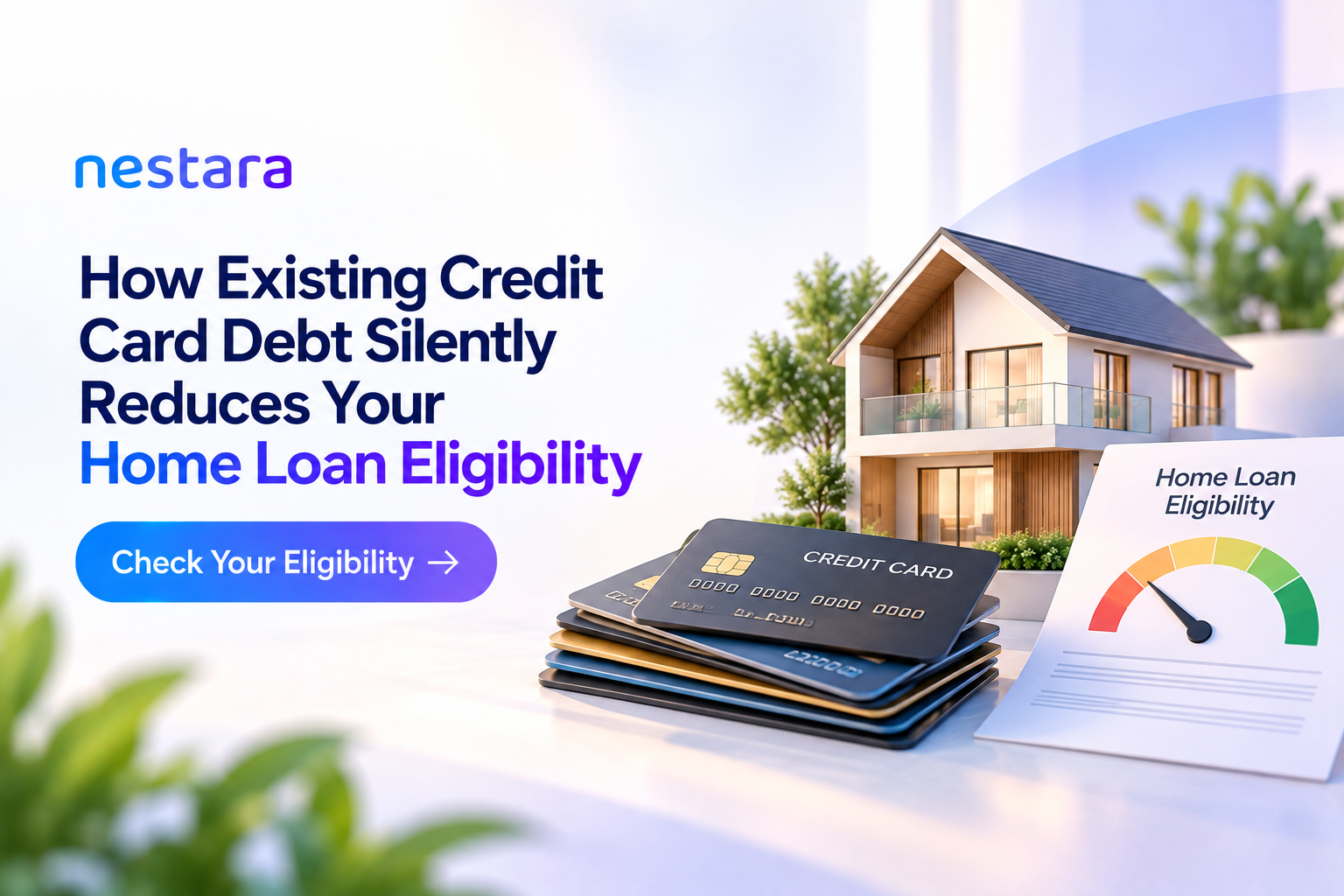
How Existing Credit Card Debt Silently Reduces Your Home Loan Eligibility
Credit card debt can reduce your home loan eligibility because lenders consider your existing repayment obligations when assessing how much additional EMI you can comfortably afford. Even when you have a good income and credit score, a large outstanding card balance or recurring card payments can reduce the loan amount a lender is willing to offer.
The impact is not always obvious because credit cards do not have a fixed EMI in the same way as a personal loan. That makes it especially important to understand your outstanding balances before applying for a home loan. You can use our New Home Loan eligibility checker to get an estimate of your borrowing capacity before making a formal application.
How Does Credit Card Debt Reduce Home Loan Eligibility?
Credit card debt can reduce home loan eligibility by increasing your existing financial obligations and reducing the portion of your income available for a new home-loan EMI.
Lenders generally assess factors such as:
- Monthly income
- Existing EMIs and debt obligations
- Credit score and repayment history
- Age and expected loan tenure
- Employment or business stability
- Property and loan-related factors
Credit information is also part of the home-loan assessment. CIBIL notes that lenders check the CIBIL Score and Report when evaluating loan applications, while eligibility criteria vary from one lender to another.
So, ₹20,000 sitting on a credit card is not necessarily treated the same way as ₹20,000 of available monthly income. Your lender is looking at how your existing obligations affect your overall repayment capacity.
Why Is Credit Card Debt Different From a Regular EMI?
Credit card debt can be harder to evaluate because the balance can revolve and the amount you pay each month can vary.
For a regular personal loan, you may have a clearly defined EMI. With a credit card, you might:
- Pay the full statement balance
- Pay more than the minimum amount
- Pay only the minimum amount due
- Carry the remaining balance into the next billing cycle
RBI requires card issuers to warn customers that paying only the minimum amount every month can stretch repayment over months or years and result in consequential interest payments.
This matters when planning for a home loan. A card balance that looks manageable today can become expensive if it continues revolving.
How Much Can Credit Card Debt Reduce Your Home Loan Amount?
The reduction depends on how the lender treats your outstanding card obligations and your overall financial profile, so there is no universal rupee-for-rupee formula.
Consider a simplified illustration:
Monthly income: ₹1,00,000
Existing loan EMI: ₹15,000
Credit-card-related obligation: ₹10,000
Potential amount available for a new EMI: lower than if there were no existing obligations
If the borrower clears or substantially reduces the existing debt, more monthly cash flow may become available for the proposed home-loan EMI. That can improve potential eligibility, subject to the lender’s criteria.
This is why two people earning the same ₹1 lakh per month can qualify for different home-loan amounts.
| Financial position | Potential effect on eligibility |
|---|---|
| ₹1 lakh income, no existing debt | More repayment capacity available |
| ₹1 lakh income, moderate loan EMI | Lower capacity for a new EMI |
| ₹1 lakh income, loan EMI + revolving card debt | Further reduction in available capacity |
| ₹1 lakh income, high card debt and missed payments | Repayment-capacity and credit-profile concerns |
These are illustrative comparisons, not lender approval rules.
Does Paying Only the Minimum Credit Card Amount Hurt Home Loan Eligibility?
Paying only the minimum amount can make your home-loan application less attractive because it allows outstanding debt to continue and may increase your interest burden over time.
RBI states that when the total credit-card amount due is not cleared, the interest-free credit period can be lost and interest may be charged on the outstanding amount under the card’s applicable terms.
More importantly, consistently carrying a large balance can signal that part of your income is already committed to servicing revolving debt.
Before applying for a home loan, look beyond the minimum amount shown on your credit-card statement. Consider the total outstanding balance, repayment history and recurring monthly obligation.
Can Credit Card Debt Affect Your CIBIL Score Too?
Yes, credit-card debt can affect your credit profile, particularly when it is accompanied by missed payments or other signs of repayment stress.
Your credit profile can contain information about credit accounts and repayment behaviour. Lenders use credit reports and scores as one part of their assessment when deciding whether to approve a loan.
However, simply having a credit card balance does not automatically mean you have a poor CIBIL Score. Someone who uses a card and pays the full amount on time can have a very different credit profile from someone who repeatedly carries large balances or misses payments.
That distinction is important: debt level and repayment behaviour are related, but they are not the same thing.
Should You Clear Credit Card Debt Before Applying for a Home Loan?
Clearing or reducing expensive revolving credit-card debt before applying can be sensible if you can do so without exhausting the funds needed for your down payment and emergency reserves.
Before applying, consider these steps:
- Check every card balance. Include outstanding amounts across all cards.
- Clear overdue amounts first. Avoid applying while payments are past due.
- Reduce expensive revolving balances. Do not focus only on the minimum payment.
- Avoid unnecessary new credit applications. Multiple formal applications can create additional enquiries on your credit report.
- Keep your home-loan down payment separate. Do not use all your savings to clear debt and leave yourself without adequate reserves.
- Recheck your eligibility. Your potential borrowing capacity may change after your existing obligations fall.
Do not close every credit card automatically just before applying. The right approach depends on your broader credit profile and financial needs.
What If You Have Credit Card Debt but Need a Home Loan Soon?
If you need a home loan soon, compare your existing debt with the loan amount you actually need rather than assuming you must eliminate every rupee of card usage.
For example, if your desired home loan is already comfortably affordable after accounting for your card obligations, immediate full repayment may not be necessary. But if existing debt is preventing you from qualifying for the required amount, reducing those obligations could make a meaningful difference.
Nestara’s home loan eligibility calculator lets you estimate eligibility using factors such as income, existing EMIs, interest rate and tenure. Because lender policies differ, treat the result as an estimate rather than a guaranteed sanction.
What Should You Check Before Applying for a Home Loan?
You should review your complete debt position, not just your salary, before applying for a home loan.
Use this quick checklist:
- Total credit-card outstanding across all cards
- Any overdue or missed payments
- Existing personal, vehicle or other loan EMIs
- Monthly income after regular obligations
- Credit score and credit report
- Proposed home-loan EMI
- Down payment and emergency savings
- Number of recent formal credit applications
The goal is not simply to have zero credit-card debt. It is to enter the home-loan application with a repayment profile that comfortably supports the new EMI.
Conclusion
Credit card debt can quietly reduce home loan eligibility because it takes up part of your repayment capacity and may also affect how lenders view your overall credit profile. The impact is particularly important when you carry revolving balances, make only minimum payments or have existing overdue amounts.
Before applying, review your card balances alongside your income, existing EMIs and credit history. If you are unsure how much you may qualify for, use our New Home Loan eligibility checker to estimate your eligibility and understand what you may need to improve before approaching a lender.
FAQs
Does credit card outstanding affect home loan eligibility?
Yes. Credit card outstanding can affect home loan eligibility because lenders assess existing financial obligations and repayment capacity. The exact treatment varies by lender.
Can I get a home loan if I have credit card debt?
Yes. Having credit card debt does not automatically disqualify you from a home loan. Lenders consider your income, existing obligations, credit history, score, age, tenure and other application factors.
Does paying only the minimum amount on a credit card affect home loan eligibility?
It can. Paying only the minimum allows the outstanding balance to continue and can increase the overall interest burden. RBI specifically requires card issuers to warn customers about the consequences of making only minimum payments.
Should I pay off my credit card before applying for a home loan?
Reducing revolving credit-card debt can improve your repayment capacity, but you should not use all your savings to clear the balance if that leaves you without adequate funds for your down payment or emergency needs.
Does credit card debt lower my CIBIL Score?
Credit card debt by itself does not automatically mean a lower CIBIL Score. Your repayment behaviour and overall credit profile matter. Missed or overdue payments can negatively affect your credit history, while responsible use and timely repayment can support a healthy profile.
How does credit card debt affect my home loan EMI?
Credit card debt can reduce the amount of monthly income available for a new home-loan EMI. If existing obligations are high, the lender may determine that a smaller home-loan EMI—and therefore potentially a smaller loan amount—is more appropriate.