Can Self-Employed People Get Home Loans Easily?
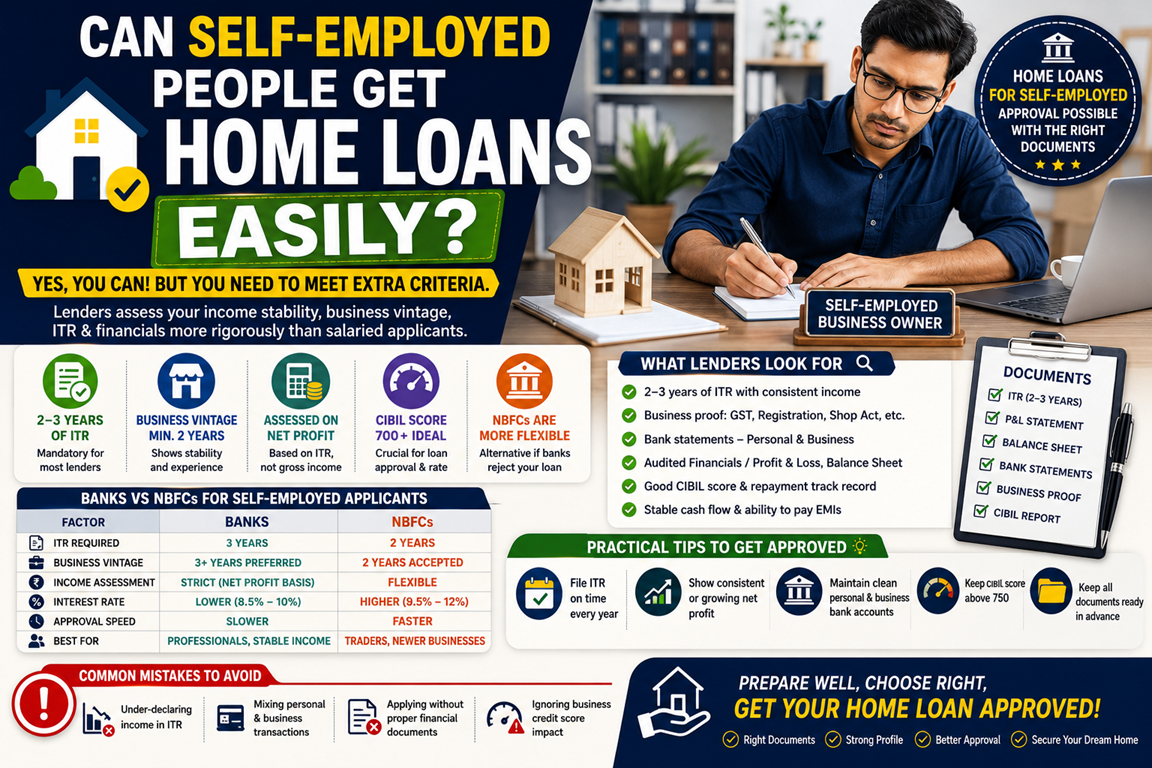
Yes, self-employed individuals can get home loans in India, but the process is more rigorous than for salaried applicants. Lenders require 2–3 years of ITR, business proof, and a consistent income track record. This guide explains what banks look for, what challenges you will face, and how to improve your approval odds as a self-employed borrower.
Quick Summary
- Self-employed applicants must provide 2–3 years of ITR and financial statements
- Business vintage of at least 2 years is typically required
- Income is assessed on net profit shown in ITR, not gross earnings
- NBFCs are more flexible than banks for self-employed applicants
- A CIBIL score of 700–750+ is equally important for self-employed borrowers
What Is a Self-Employed Home Loan?
What does it mean?
A self-employed home loan is a housing finance product designed for individuals who do not receive a fixed monthly salary. This includes business owners, freelancers, consultants, doctors, chartered accountants, and traders. Unlike salaried loans, eligibility is assessed based on business income documents rather than payslips and Form 16.
If you earn through freelance projects or gig work rather than a traditional business, read Freelancer or Gig Worker? How to Prove Income for a Home Loan Without a Salary Slip for guidance on demonstrating your earnings to lenders.
How does it work?
Lenders evaluate your loan eligibility based on the net profit declared in your Income Tax Returns (ITR) over the last 2–3 years. They may also assess bank statements, audited Profit & Loss accounts, and business vintage. The eligible loan amount is calculated as a multiple of your average annual net profit, adjusted for business sustainability and income trend.
Key Factors That Affect Self-Employed Home Loan Approval
What are the important factors to consider?
Self-employed applicants face a higher documentation burden and stricter income verification compared to salaried borrowers. The key factors lenders scrutinise are business vintage, ITR consistency, bank statement health, personal CIBIL score, and the nature of the business. Both the personal and business credit profiles are assessed.
For a closer look at why these checks differ between employment types, read Salaried vs Self-Employed: How Lenders Score Risk Differently to understand how lenders evaluate income stability, financial records and repayment risk.
How do these factors impact your application?
Here is how each factor affects your self-employed home loan application:
- Business Vintage: Less than 2 years of operations is typically a dealbreaker for banks
- ITR Net Profit: Income declared must be sufficient to support EMI after FOIR calculation
- ITR Consistency: Declining income year-on-year raises red flags for lenders
- Bank Statements: Irregular or cash-heavy transactions reduce lender confidence
- CIBIL Score: 700+ is required; same rules as salaried applicants apply
- Type of Business: Professionals (CA, doctors) get better terms than traders or manufacturers
Scenarios: Banks vs. NBFCs for Self-Employed Borrowers
What are the available options?
Self-employed applicants have two main routes: applying through a traditional bank or through an NBFC. Each has different eligibility norms, documentation requirements, and interest rate structures. The right choice depends on your income documentation, business type, and CIBIL score.
| Factor | Banks | NBFCs |
| ITR Required | 3 years | 2 years |
| Business Vintage | 3+ years preferred | 2 years accepted |
| Income Assessment | Strict net profit basis | More flexible |
| Interest Rate | Lower (8.5–10%) | Higher (9.5–12%) |
| Approval Speed | Slower | Faster |
| Best For | Professionals with clean ITR | Traders, newer businesses |
How do different scenarios affect outcomes?
A CA or doctor with 3 years of clean ITR, consistent income growth, and a CIBIL score above 750 will have no trouble getting a bank home loan at prime rates. A trader with irregular income or 2 years of business vintage should start with an NBFC, establish a strong repayment record, and then refinance to a bank later for a better rate.
Which Option Is Right for You?
When should you apply directly to a bank?
Apply to a bank if you are a self-employed professional (doctor, CA, lawyer, architect) with at least 3 years of growing net income in your ITR, a CIBIL score above 750, and a business that is well-documented. Banks like SBI, HDFC, and ICICI have dedicated self-employed home loan products with competitive rates for this profile.
When should you choose an NBFC?
Choose an NBFC if your business is less than 3 years old, you show variable income in your ITR, or if your CIBIL score is between 650 and 700. NBFCs like LIC HFL, PNB Housing Finance, Bajaj Finserv, and Tata Capital are significantly more flexible. Once you build a clean 24-month EMI repayment record, you can transfer to a bank for a lower rate.
Practical Tips for Self-Employed Home Loan Applicants
- File ITR every year on time — missing ITR filings is an automatic disqualifier
- Show consistent or growing net profit across the last 2–3 years in your returns
- Maintain a clean personal savings account separate from business accounts
- Keep your personal CIBIL score above 750 even if business credit is separate
- Prepare all documentation in advance: ITR, P&L, balance sheet, GST returns, and bank statements
- Work with a home loan advisor who specialises in self-employed cases
To see how these requirements compare with the documents needed by salaried borrowers, use the Home Loan Documents Checklist for Salaried vs Self-Employed, Side-by-Side before preparing your application.
Common Mistakes to Avoid
- Under-declaring income in ITR to save on taxes — it directly reduces your loan eligibility
- Mixing personal and business transactions in the same bank account
- Applying without preparing financials — lenders can spot unprepared applications quickly
- Ignoring your business credit score if applicable — it can affect your overall credit profile
Conclusion
Self-employed borrowers can absolutely get home loans in India — the process simply requires more preparation. File your ITR diligently, maintain a strong CIBIL score, and choose the right lender for your business profile. If you are not ready for a bank today, start with an NBFC and work your way towards better terms over time.
Frequently Asked Questions
How many years of ITR is required for a self-employed home loan?
Most banks require 2–3 years of ITR for self-employed applicants. Public sector banks and major private banks typically insist on 3 years with audited financials. NBFCs may accept 2 years. All ITRs must be filed on time and show consistent or growing net income to strengthen your application.
Can a freelancer get a home loan in India?
Yes, freelancers can get home loans but face the same documentation challenges as other self-employed borrowers. You will need 2–3 years of ITR, consistent bank statement credits, and a CIBIL score of 700+. NBFCs are generally more accommodating for freelancers than traditional banks. Showing consistent, growing income is the key to approval.
How is income calculated for a self-employed home loan?
Lenders typically calculate income based on the net profit declared in your ITR, not your gross business revenue. Some banks add back depreciation to arrive at an adjusted income figure. The eligible loan amount is usually 3–5 times your average annual net income. Consistent income across years carries more weight than a single high-income year.
Is the interest rate higher for self-employed home loans?
Interest rates for self-employed applicants are generally 0.25–0.5% higher than rates offered to salaried applicants from banks. NBFCs charge more — typically 0.5–2% higher. The best way to access lower rates is to apply to a bank with a strong ITR track record and a CIBIL score above 750, similar to a salaried applicant.
Can I include rental income to boost my home loan eligibility?
Yes. Most lenders accept rental income as an additional income source if it is declared in your ITR. You will need to provide rental agreements and bank statements showing rent credits. Typically, 70–80% of annual rental income is considered for eligibility purposes. This can meaningfully boost your eligible loan amount alongside business income.