What Is Floating Rate Reset and How Often Does It Change?
A floating rate reset is when your home loan’s interest rate is recalculated and updated based on changes in the underlying benchmark — usually the RBI repo rate. In this guide, you’ll learn how often floating rates reset, what triggers the change, and how to plan for rate movements.
Quick Summary
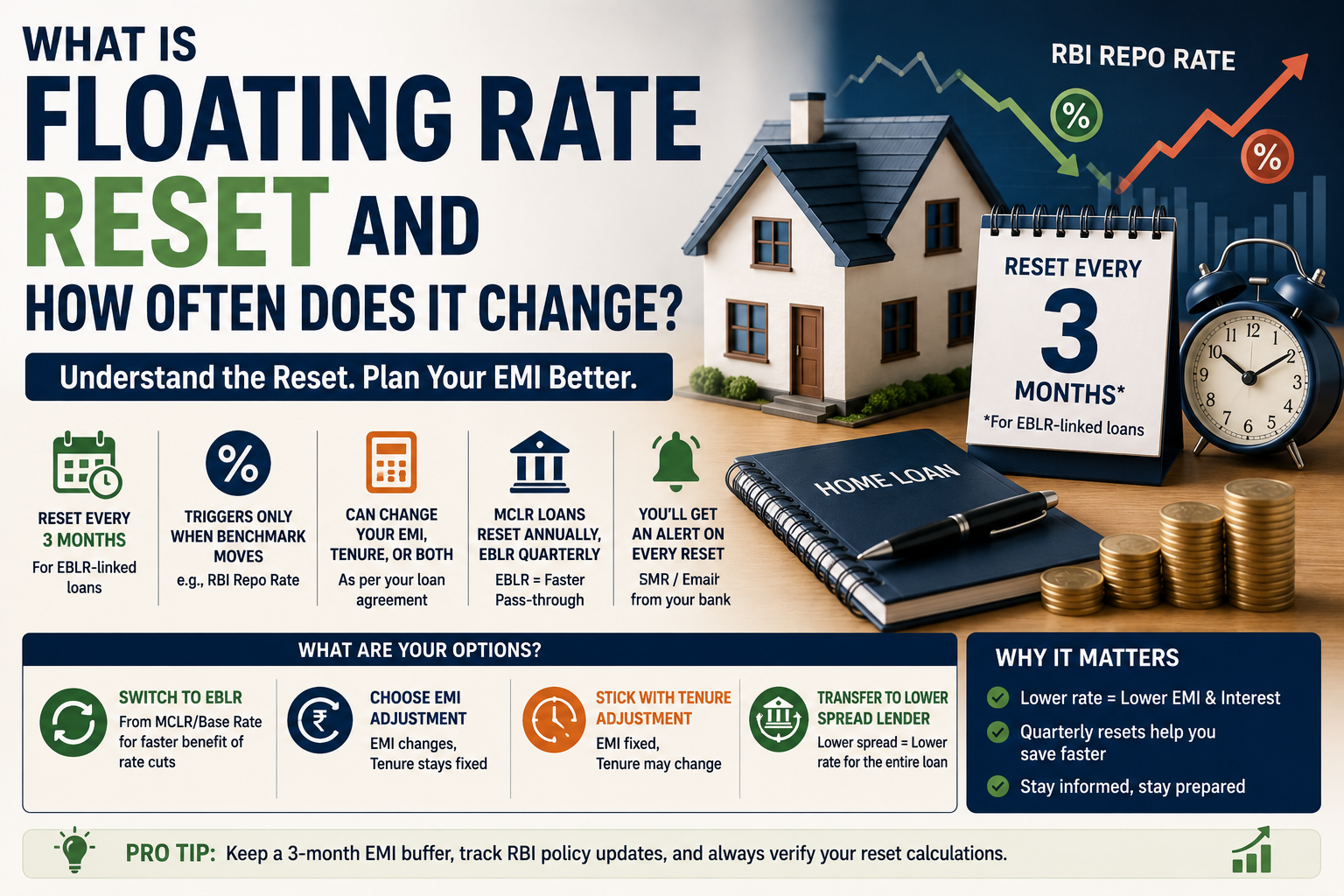
- Floating rate home loans linked to RBI’s external benchmark (EBLR) reset every 3 months.
- A reset can change your EMI, your tenure, or both — depending on your loan agreement.
- The reset only triggers when the underlying benchmark actually moves.
- MCLR-linked loans typically reset annually, while EBLR-linked loans reset quarterly.
- You can request your bank to convert from MCLR to EBLR for faster pass-through of rate cuts.
What Is Floating Rate Reset?
What does it mean?
A floating rate reset is the periodic recalculation of your home loan interest rate based on movements in the linked benchmark. When RBI changes the repo rate, banks adjust their lending rates at the next reset date defined in your loan agreement.
How does it work?
For EBLR-linked loans, the bank’s lending rate is fixed at “Repo Rate + Spread.” When RBI changes the repo rate, the bank’s lending rate moves accordingly at the next reset date. The bank then either changes your EMI or your tenure.
Strategies Around Rate Resets
| Strategy | Best For | Outcome |
|---|---|---|
| Switch MCLR to EBLR | Borrowers in falling-rate cycle | Faster pass-through of rate cuts |
| Request EMI adjustment | Borrowers wanting fixed tenure | EMI moves; loan ends on schedule |
| Default tenure adjustment | Borrowers wanting stable EMI | EMI fixed; tenure moves |
| Balance transfer to lower spread | All borrowers with high spread | Lower rate throughout loan life |
When to Request EMI vs Tenure Adjustment
Request EMI adjustment if: You want certainty about when your loan ends and don’t mind small EMI swings every few months.
Stick with tenure adjustment if: Your monthly cash flow is tight and you can’t absorb sudden EMI increases.
Practical Tips
- Check your loan agreement to confirm the benchmark, reset frequency, and spread.
- After every RBI policy meeting, look out for the reset notification from your bank.
- If on MCLR or base rate, ask your bank about converting to EBLR.
- Keep a 3-month EMI buffer to absorb potential EMI hikes after a reset.
Common Mistakes to Avoid
- Assuming all floating loans reset at the same time — the reset frequency depends on your benchmark.
- Not noticing tenure extensions silently increasing your total interest.
- Ignoring RBI policy updates — they directly affect your EMI.
FAQ
How often does a floating home loan rate change?
For EBLR-linked loans (most banks since October 2019), the rate is reset every 3 months — but only changes if the benchmark has actually moved.
What’s the difference between EBLR, MCLR, and base rate?
EBLR (2019) ties retail loans to the RBI repo rate — faster and more transparent. MCLR (2016) was internally calculated. Base rate (2010) was the original, slow-changing benchmark.
Can I choose between EMI change and tenure change after a reset?
Yes, most banks allow you to choose. By default, banks adjust the tenure; you can request EMI adjustment in writing.
Does my bank inform me when the floating rate changes?
Yes, banks are required to inform you of any rate change via SMS, email, or letter.
Should I switch from an MCLR loan to an EBLR loan?
If the prevailing EBLR rate is lower than your current rate, switching is usually worthwhile for a one-time fee of 0.25–0.5% of outstanding.