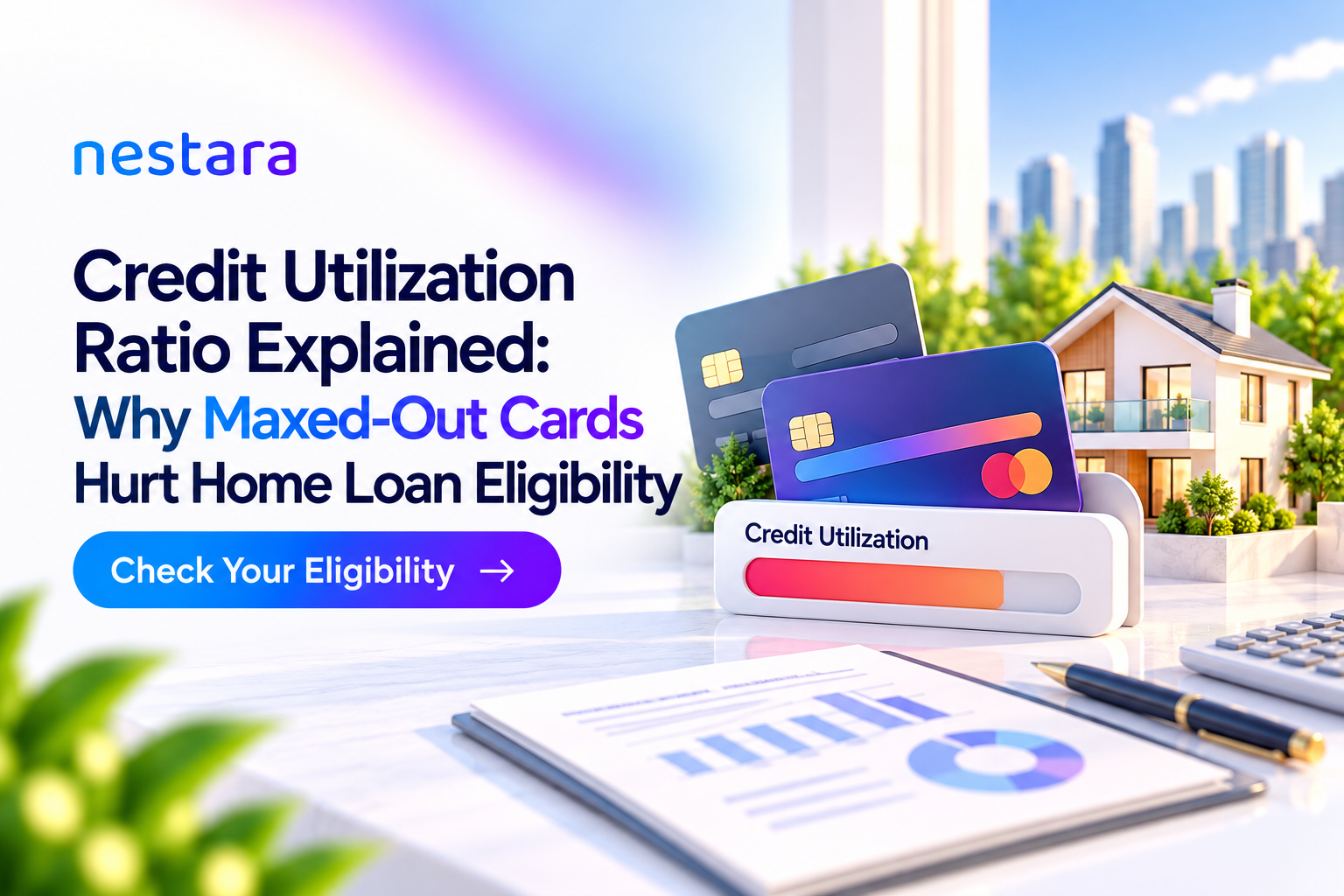
Credit Utilization Ratio Explained: Why Maxed-Out Cards Hurt Home Loan Eligibility
Your credit utilization ratio can affect your CIBIL Score and, indirectly, your home loan eligibility. A high utilization level can signal that you are relying heavily on available revolving credit, which may make your credit profile look riskier to lenders.
If you’re planning to apply for a home loan, maxing out your credit cards—even if you pay every bill on time—can therefore work against you.
What Is Credit Utilization Ratio?
Credit utilization ratio is the percentage of your available credit-card limit that you are currently using. CIBIL describes credit utilization as the ratio between your current credit-card balances and your credit limits.
The basic calculation is:
Credit Utilization Ratio = Credit Card Outstanding ÷ Total Credit Limit × 100
For example, suppose you have:
- Credit-card limit: ₹2,00,000
- Current balance: ₹80,000
Your utilization ratio is:
₹80,000 ÷ ₹2,00,000 × 100 = 40%
If you have multiple cards, lenders and credit bureaus can consider your overall credit exposure as well as individual card balances.
Why Does High Credit Utilization Hurt Your CIBIL Score?
High credit utilization can negatively affect your CIBIL Score because it may suggest that you are becoming heavily dependent on available credit. CIBIL specifically notes that higher utilization can make you appear to be at greater credit risk.
Consider two borrowers with the same ₹2 lakh credit limit:
| Borrower | Card balance | Utilization | What it signals |
|---|---|---|---|
| A | ₹20,000 | 10% | Relatively low use of available credit |
| B | ₹1,80,000 | 90% | Heavy reliance on available credit |
| C | ₹2,00,000 | 100% | Credit limit fully utilised |
Borrower C may pay the bill on time, but a consistently maxed-out card can still indicate greater dependence on credit.
Importantly, CIBIL does not prescribe a universal percentage at which utilization suddenly becomes “bad.” So rules such as “anything above exactly 30% will reduce your score” should not be treated as a guaranteed CIBIL rule.
The practical principle is simpler: lower utilization is generally better for maintaining a healthy credit profile.
Does Credit Utilization Affect Home Loan Eligibility?
Credit utilization can affect home loan eligibility indirectly because it can influence your credit profile, while lenders also assess your existing financial obligations when deciding how much you can borrow.
CIBIL identifies credit utilization as one of the main factors affecting the CIBIL Score. CIBIL also states that lenders consider the CIBIL Score and Report when evaluating loan applications.
A lender assessing your home loan application may therefore see a borrower with heavily utilised credit cards differently from someone with similar income but much lower revolving credit balances.
High card balances can also matter from a cash-flow perspective. If you are already carrying substantial credit-card obligations, the lender may need to consider how those obligations fit alongside the proposed home loan repayment.
That means credit utilization and home loan eligibility are connected, but they are not the same thing. There is no universal rule that says a particular utilization percentage automatically reduces your eligible home loan amount by a specific amount.
Can You Have a Good CIBIL Score but Still Have High Credit Utilization?
Yes, you can have a good CIBIL Score while currently carrying relatively high credit-card utilization. Your score reflects your broader credit behaviour rather than one number in isolation.
CIBIL’s current consumer material identifies several important factors, including payment history, credit utilization, age of credit and enquiries.
This means a borrower who always pays on time may still have a reasonably healthy credit profile despite occasionally using more of their available limit.
However, consistently high balances are still worth addressing, especially before a major borrowing decision such as a home loan.
Your objective should not be to maintain a particular percentage merely because you have heard it online. Instead, focus on reducing unnecessary revolving debt and keeping your overall credit profile healthy.
Does Maxing Out One Credit Card Hurt More Than Using Several Cards?
Maxing out one card can be a warning sign even when your overall utilization is lower, so it is better not to focus only on the combined percentage.
For example:
- Card A limit: ₹1,00,000
- Card A balance: ₹95,000
- Card B limit: ₹2,00,000
- Card B balance: ₹10,000
Your total utilization is ₹1,05,000 out of ₹3,00,000, or 35%.
But one card is almost completely utilized.
CIBIL’s guidance focuses on keeping utilization low rather than providing a guaranteed safe percentage for every individual card.
So when reviewing your credit profile, look at both your overall utilization and individual card balances.
Does Paying the Full Credit Card Bill Improve Your Home Loan Profile?
Paying your credit-card bill in full and on time is an important credit habit, but it does not necessarily mean your reported utilization will always be low.
The balance that is reported to a credit information company can depend on when the card issuer reports the account information. Therefore, a borrower can pay the entire bill by the due date and still have a relatively high balance reflected in a particular reporting cycle.
This is why borrowers preparing for a home loan should monitor their credit report rather than assuming that paying the bill on time automatically means their reported utilization is low.
RBI requires credit institutions to report credit information to credit information companies at least fortnightly, or at a shorter interval where agreed, under its August 2024 directions.
How Can You Reduce Credit Utilization Before Applying for a Home Loan?
You can reduce credit utilization by lowering outstanding card balances and avoiding unnecessary new spending on already heavily utilised cards.
If you are preparing for a home loan, consider these steps:
- Pay down existing card balances. Reducing the outstanding balance directly reduces utilization.
- Avoid adding unnecessary purchases to maxed-out cards. This prevents the balance from remaining elevated.
- Pay dues on time. Low utilization cannot compensate for repeated late payments.
- Avoid unnecessary new credit applications. CIBIL recommends applying for new credit in moderation.
- Check your CIBIL Report before applying. Look for incorrect balances, unfamiliar accounts or other reporting errors.
Do not close old credit cards simply to reduce the number of accounts without considering the broader effect on your credit history. The right approach depends on your individual profile.
Should You Pay Off Credit Cards Before Applying for a Home Loan?
Paying down high credit-card balances before a home loan application can be sensible because it can reduce your utilization and your existing financial burden.
However, you do not necessarily need to eliminate every credit card or stop using credit altogether.
A better approach is to:
- Bring high outstanding balances down.
- Keep all payments on time.
- Avoid unnecessary borrowing immediately before applying.
- Review your credit report.
- Understand how your existing obligations affect your borrowing capacity.
You can use our Free Credit Score Check to review your credit position before approaching lenders.
Once you know your credit position, our EMI Calculator can help you compare different loan amounts, rates and tenures and understand what repayment level may fit your budget.
Can Increasing Your Credit Limit Improve Your Utilization Ratio?
Increasing your credit limit can reduce your utilization percentage if your outstanding balance remains unchanged, but you should not request a higher limit simply to make your utilization ratio look better.
For example, a ₹50,000 balance on a ₹1,00,000 limit represents 50% utilization. If the limit increases to ₹2,00,000 while the balance stays at ₹50,000, the ratio becomes 25%.
But a higher limit does not reduce the actual debt you owe. If you use the additional limit to increase your spending, the benefit can disappear.
For someone preparing for a home loan, reducing outstanding debt is generally a more straightforward strategy than borrowing more simply to create additional available credit.
How Does Credit Utilization Fit Into Home Loan Eligibility?
Credit utilization is one piece of your home loan profile, not a standalone eligibility formula.
Lenders can assess your CIBIL Score and Report alongside factors such as income, employment, existing obligations and the property being financed. CIBIL’s home-loan guidance also notes that lenders consider multiple aspects of an applicant’s profile rather than relying only on the score.
So a high utilization ratio does not automatically mean your home loan will be rejected. It means there is a credit-profile issue worth addressing before you apply.
Conclusion
A high credit utilization ratio can hurt your CIBIL Score and may indirectly make your home loan application less attractive to lenders. Maxing out a credit card can signal heavy reliance on revolving credit even when you are making payments on time.
The good news is that utilization is an area you can actively manage. Reduce outstanding balances, keep payments on time, avoid unnecessary new credit and check your credit report before applying.
If a home loan is your next major financial decision, start by understanding your current credit position. Use our Free Credit Score Check to review your profile, then explore your home loan options with a clearer picture of where you stand.
FAQs
What is a good credit utilization ratio for a home loan?
There is no universal CIBIL-prescribed percentage that guarantees a good or bad home loan outcome. CIBIL advises borrowers to keep credit utilization low because high utilization can negatively affect the score.
Does using 100% of my credit-card limit hurt my CIBIL Score?
Using the full available limit can negatively affect your credit profile because high utilization can signal greater reliance on credit. CIBIL specifically advises borrowers to control utilization and keep balances low.
Does paying my credit-card bill in full avoid the impact of high utilization?
Paying your bill in full and on time is important, but the balance reported during a credit-reporting cycle can still affect the utilization reflected in your credit information. Paying on time and maintaining low balances are both important.
Can high credit-card utilization reduce my home loan eligibility?
It can indirectly affect your application because utilization can influence your CIBIL Score and high existing credit obligations can form part of a lender’s overall assessment. There is no universal formula linking a particular utilization percentage to a specific home loan amount.
Should I stop using my credit card before applying for a home loan?
Not necessarily. The goal is not to stop using credit completely but to avoid carrying unnecessarily high balances, make payments on time and maintain a healthy credit profile.
Will increasing my credit-card limit improve my CIBIL Score?
A higher credit limit can lower your utilization percentage if your outstanding balance stays unchanged, but it does not reduce the debt you owe. Increasing your limit solely to manipulate utilization is therefore not a substitute for managing your outstanding balance.
How can I check my credit utilization before applying for a home loan?
Review the outstanding balances and limits reported for your credit cards in your CIBIL Report. You can also use our Free Credit Score Check to understand your current credit position before making a home loan application.