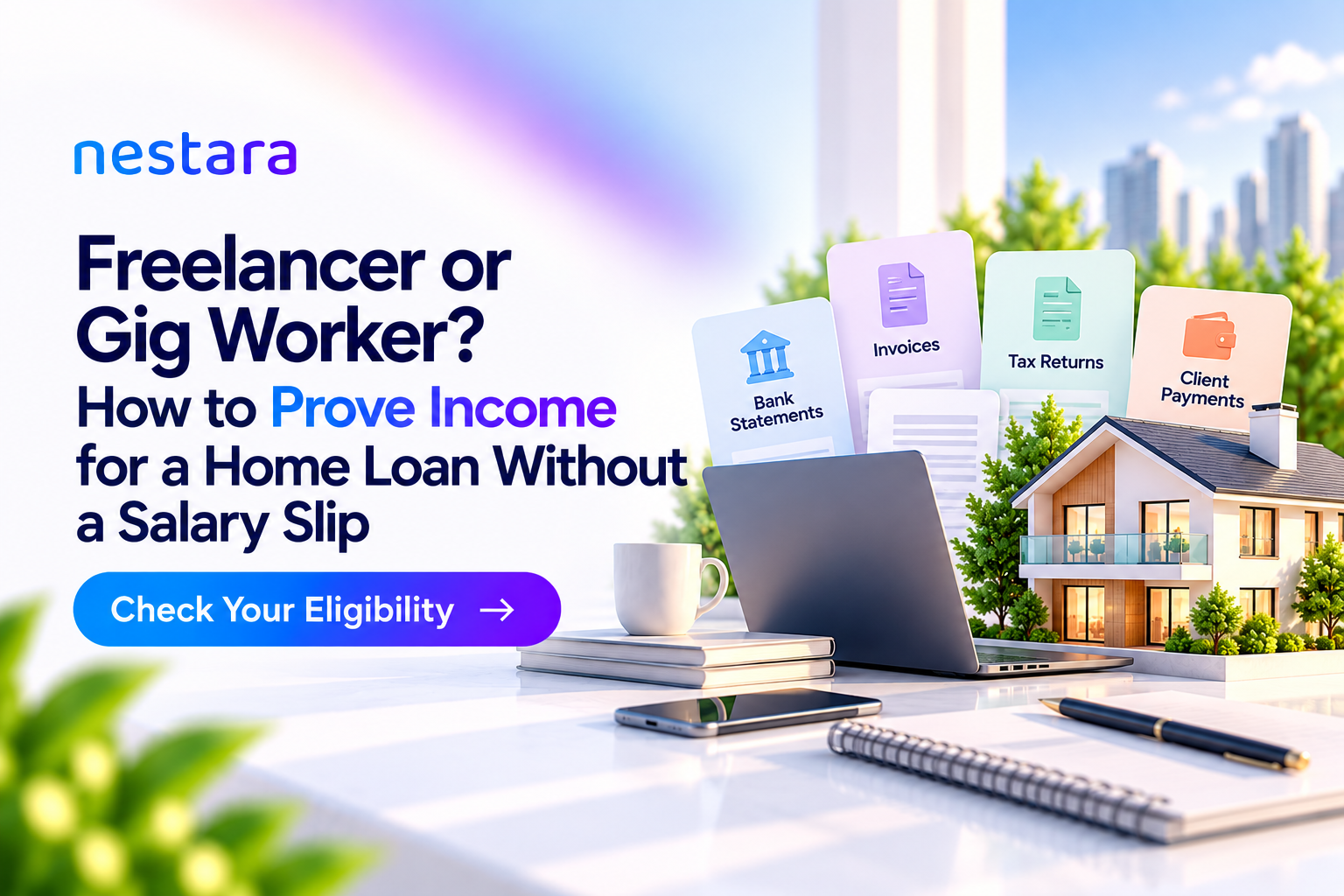
Freelancer or Gig Worker? How to Prove Income for a Home Loan Without a Salary Slip
Yes, freelancers and gig workers can apply for a home loan without a traditional salary slip. Instead, lenders typically assess income through documents such as Income Tax Returns (ITRs), bank statements, financial records and other evidence that demonstrates consistent earnings and repayment capacity. The exact documents vary by lender and borrower profile.
If your income comes from freelance projects, consulting, online platforms, commissions or multiple clients, the key is to make that income visible, traceable and consistent.
Can Freelancers Get a Home Loan Without a Salary Slip?
Freelancers can get a home loan without a salary slip if they can provide sufficient evidence of stable and verifiable income. Lenders generally assess self-employed applicants differently from salaried applicants because there is no employer-issued salary structure to rely on.
Instead of asking, “Where is your salary slip?”, the lender is effectively asking:
Can you prove how much you earn, where the money comes from and whether you can comfortably repay the proposed EMI?
For self-employed applicants, lender documentation commonly includes ITRs, income computation, financial statements and bank statements. For example, Axis Bank’s current home-loan documentation lists ITRs and bank statements for self-employed applicants, while HDFC Bank’s home-loan application documentation also includes ITRs, computation of income and financial records.
What Documents Can Replace a Salary Slip for a Freelancer?
For a freelancer, ITRs and bank statements are usually among the most important ways to establish income, supported by additional business or professional documents where applicable.
A lender may ask for some combination of:
| Document | What it helps establish |
|---|---|
| Income Tax Returns (ITRs) | Declared annual income |
| Computation of income | How taxable income was calculated |
| Bank statements | Actual income credits and financial behaviour |
| Profit & Loss statement | Business/professional earnings, where applicable |
| Balance sheet | Financial position, where applicable |
| GST returns | Business turnover/tax records, if applicable |
| Business or professional proof | Nature and continuity of work |
| Client contracts/invoices | Source and continuity of freelance income |
Not every applicant needs every document. Requirements vary by lender, profession, loan amount and individual circumstances.
For example, Axis Bank’s current home-loan checklist specifies ITRs, income computation and bank statements for self-employed applicants, while its documentation also distinguishes between self-employed professionals and non-professionals.
How Do ITRs Help a Freelancer Prove Income?
ITRs help establish your income because they provide a formal record of income reported to the Income Tax Department.
The Income Tax Department currently provides ITR-3 for individuals and HUFs having income from profits and gains of business or profession. ITR-4 is available for eligible resident individuals, HUFs and firms using specified presumptive taxation provisions, subject to the applicable conditions.
This matters for freelancers because your earnings may not arrive as a fixed monthly salary.
For example, imagine a freelance designer receives ₹70,000 in one month, ₹45,000 the next and ₹90,000 in another. A salary slip cannot capture that pattern. A properly filed tax return, supported by bank records and other documents, can provide a much clearer picture of the person’s overall income.
The lender may assess the income that can be reasonably considered for repayment, not simply the highest amount credited in a particular month.
How Do Bank Statements Prove Freelance Income?
Bank statements help lenders see whether the income reported by a freelancer is actually flowing through their accounts.
A consistent banking trail can make variable income easier to assess. Lenders may look at credits from clients, platforms or business activity alongside withdrawals, existing EMIs and other financial commitments.
For example, Axis Bank’s current home-loan documentation asks self-employed applicants for bank statements, while its Empower Home Loan documentation specifies six months of bank statements for operative personal and business accounts.
However, six months is not a universal requirement for every lender. Another lender may ask for a different period or additional documentation.
This is why freelancers should keep their financial records organised rather than relying on one document to prove income.
What If Your Freelance Income Comes From Multiple Clients?
Multiple clients do not automatically prevent you from getting a home loan; in fact, a diversified client base can help demonstrate that your income is not dependent on a single source.
Keep records of:
- Client invoices
- Payment receipts
- Contracts or engagement letters
- Bank credits corresponding to payments
- Tax filings
- Platform statements, where relevant
The objective is to create a clear trail from work performed → invoice/payment → bank credit → reported income.
If you receive payments through freelance platforms, retain downloadable payment statements or transaction records wherever available.
Can Gig Workers Get a Home Loan?
Gig workers can apply for home loans, but their eligibility depends on how consistently and verifiably their income can be established.
A gig worker may earn through several platforms or activities—for example, delivery services, ride-hailing, online services, content work or independent assignments. Because earnings can fluctuate, the lender may examine the applicant’s financial history more closely.
The same basic principle applies:
The absence of a salary slip is not the same as the absence of income proof.
Your ITRs, bank statements, business records and other relevant documents can collectively demonstrate your earning capacity.
What Documents Should a Gig Worker Keep Ready?
A gig worker should maintain tax records, bank statements and platform earnings records before applying for a home loan.
A practical document folder could include:
- Recent ITRs and computation of income
- Recent bank statements
- Platform earnings statements
- Payment receipts or transaction records
- GST records, if applicable
- Business or professional registration documents, if applicable
- Existing loan or EMI statements
- KYC and address documents
Some lenders may request additional documents depending on the applicant’s profile. Official lender checklists also make clear that document requirements can vary from case to case.
How Can a Freelancer Improve Home Loan Eligibility Before Applying?
A freelancer can improve the strength of a home loan application by making income easier to verify and reducing financial uncertainty.
Before applying, focus on these areas:
1. File your ITRs properly
Your tax returns should accurately reflect your income. Avoid relying only on informal records or cash-flow estimates.
2. Maintain a clean banking trail
Where possible, receive professional income through identifiable bank transactions and maintain organised statements.
3. Keep existing EMIs under control
Existing loan obligations reduce the income available for a new home-loan EMI. Paying down unnecessary debt can strengthen your repayment profile.
4. Maintain a healthy credit profile
Lenders consider your credit history alongside income and other application details. Avoid unnecessary new borrowing immediately before a home-loan application.
5. Keep your documentation consistent
Your ITR, bank statements, invoices and other financial records should tell the same overall story about your income.
How Much Income Will a Lender Consider?
The income considered for a home loan is lender-specific and depends on how the lender assesses self-employed or variable income.
A freelancer should therefore not assume that every rupee credited to a bank account will automatically be treated as eligible monthly income.
For example, a ₹10 lakh annual bank inflow does not necessarily mean a lender will simply divide ₹10 lakh by 12 and treat that amount as your eligible monthly income. The lender may consider the nature of receipts, business expenses, reported income, continuity and other obligations.
This is particularly important for freelancers using presumptive taxation or having significant business expenses.
How Can You Check Your Home Loan Eligibility Without a Salary Slip?
You can start by estimating your eligibility using your actual income, existing EMIs and other financial details rather than trying to convert freelance earnings into a fictional salary.
With our New Home Loan eligibility checker, you can get an initial view of your potential eligibility and understand what information may matter before you begin approaching lenders.
The result is an estimate, not a guaranteed sanction. Final eligibility, documentation requirements, interest rate and approval remain subject to the lender’s assessment.
Conclusion
You do not need a salary slip to apply for a home loan as a freelancer or gig worker. What you need is credible evidence that your income is genuine, traceable and sufficient to support the proposed repayment.
Keep your ITRs, bank statements, invoices, platform earnings and other relevant financial records organised. The stronger the documentation trail, the easier it is for a lender to understand a variable-income profile.
If you’re ready to explore buying a home, start with our New Home Loan eligibility checker to get an initial estimate based on your financial situation. It can help you understand your borrowing position before you move on to lender-specific documentation and applications.
FAQs
Can I get a home loan without a salary slip?
Yes. Freelancers and self-employed applicants can apply without salary slips by providing alternative income evidence such as ITRs, bank statements, financial statements and other relevant documents. Requirements vary by lender.
What is the best income proof for a freelancer applying for a home loan?
ITRs and bank statements are generally important because they provide evidence of declared income and actual financial transactions. Depending on your profile, lenders may also request financial statements, GST records, business proof or other documents.
How many years of ITRs are needed for a freelancer home loan?
There is no single requirement applicable to every lender. For example, current Axis Bank and ICICI Bank home-loan documentation references two years of ITRs for relevant self-employed applicants, while HDFC Bank’s application documentation asks for up to three years of ITRs with computation/certified financials.
Can a gig worker get a home loan?
Yes, a gig worker can apply for a home loan, provided the lender can adequately assess and verify the applicant’s income and repayment capacity. Platform earnings, bank statements, tax returns and other supporting records can help establish the income profile.
Can I get a home loan if my freelance income changes every month?
Yes, variable monthly income does not automatically disqualify you. Lenders can assess the broader income pattern and supporting financial documentation rather than relying on a fixed monthly salary.
Do freelancers need GST registration to get a home loan?
Not necessarily. GST registration depends on the nature and applicable rules for the freelancer’s activity. It should not be treated as a universal home-loan requirement. A lender may request GST returns where applicable.
What if I have only one or two years of freelance income?
You may still be able to apply, but the lender’s assessment will depend on its eligibility criteria and how it evaluates income continuity. A shorter income history can make documentation and lender selection more important.
Can I use my spouse’s income for a home loan if my freelance income is variable?
A spouse can potentially be included as a co-applicant, subject to the lender’s rules. If the lender considers both applicants’ income, the combined financial profile may improve borrowing capacity.