
Why Is My Home Loan Rejected Due to a Low CIBIL Score?
A home loan may be rejected due to a low CIBIL score because lenders use your credit history to assess how reliably you have handled borrowed money in the past. A low score can indicate higher repayment risk, which may make a lender less willing to approve a large, long-term loan such as a home loan.
If your application has been rejected, however, a low CIBIL score does not mean you cannot get a home loan in the future. The first step is to understand what is pulling your score down and address it before applying again. You can start by checking your credit score and report for free with Nestara.
What CIBIL Score Is Needed for a Home Loan?
There is no single CIBIL score that guarantees home loan approval, because each lender has its own credit policy and considers several factors alongside your score. Generally, a higher score can improve your chances of approval and may help you qualify for more competitive terms.
Your CIBIL score ranges from 300 to 900. A score closer to 900 generally represents a stronger credit profile.
| CIBIL score | What it generally indicates |
|---|---|
| 750–900 | Strong credit profile |
| 700–749 | Generally good, but lender criteria still apply |
| 650–699 | May require closer assessment |
| Below 650 | Approval can become more difficult |
These ranges are indicative rather than universal approval thresholds. A lender may approve or reject an application based on your income, existing debt, employment, property and other factors even if your score falls within a particular range.
Why Does a Low CIBIL Score Lead to Home Loan Rejection?
A low CIBIL score can lead to rejection because it may indicate past repayment problems or a higher level of credit risk.
Your score can be affected by factors such as:
- Missed or delayed EMI payments
- Credit-card payment defaults
- High credit utilisation
- Too many recent credit applications
- A short or limited credit history
- Accounts that remain unsettled or written off
- Errors in your credit report
For a home loan, this matters because the amount borrowed is usually substantial and repayment can continue for many years. A lender therefore looks closely at your past credit behaviour before taking on that risk.
Does a Low CIBIL Score Automatically Mean Rejection?
No. A low CIBIL score does not automatically mean every lender will reject your home loan application. Lenders typically consider your complete financial profile rather than relying on the score alone.
Other factors can include:
- Monthly income
- Existing EMIs and other liabilities
- Employment and income stability
- Age and remaining working years
- Loan amount requested
- Property value and documentation
- Down payment
- Co-applicant’s financial profile
For example, two borrowers with the same CIBIL score could receive different decisions because one has stable income and low existing debt while the other has several active loans.
What Causes a CIBIL Score to Become Low?
A low CIBIL score is usually the result of negative or high-risk credit behaviour reported over time, rather than one isolated event.
Missed or Late Payments
Payment history is one of the most important parts of your credit profile. Repeatedly paying EMIs or credit-card bills late can hurt your score.
High Credit Utilisation
Using a large portion of your available credit limit can indicate that you are heavily dependent on credit. For example, consistently using ₹90,000 of a ₹1 lakh credit-card limit can be viewed less favourably than maintaining a lower utilisation level.
Multiple Credit Applications
Every formal credit application can result in a lender inquiry. Applying to many lenders within a short period can create multiple inquiries and may signal increased credit-seeking behaviour.
Errors in Your Credit Report
Sometimes your score is affected by information that is inaccurate or outdated. You may find a payment marked as overdue even though you paid it on time, for example.
That is why checking your complete credit report, rather than looking only at the score, is important after a home loan rejection.
What Should You Do If Your Home Loan Is Rejected Due to Low CIBIL?
If your home loan is rejected because of a low CIBIL score, do not immediately submit applications to several other lenders. First identify the reason for the low score and work on the underlying issue.
Follow these steps:
- Check your CIBIL score and credit report. Look for overdue accounts, high balances and recent inquiries.
- Identify the specific problem. Determine whether the issue is late payments, high utilisation, outstanding debt or incorrect reporting.
- Correct genuine errors. Raise a dispute with the relevant credit bureau and lender if information is inaccurate.
- Pay outstanding dues on time. Consistent repayment behaviour is important for rebuilding your credit profile.
- Reduce unnecessary debt. Lower outstanding balances where financially possible.
- Avoid unnecessary loan applications. Give your profile time to improve instead of creating multiple new inquiries.
- Reassess your home-loan eligibility. Once the underlying issue is addressed, consider applying based on your updated financial position.
There is no universal number of days you must wait after a rejection. The appropriate time to apply again depends on what caused the rejection and whether that issue has actually been resolved.
How Can You Improve CIBIL Score Before Applying Again?
You can improve your credit profile by building a consistent record of timely payments and reducing signs of excessive credit dependence.
Focus on the areas that matter most:
| Problem | What you can do |
|---|---|
| Missed EMI payments | Pay all future EMIs on time |
| High credit-card utilisation | Reduce outstanding balances |
| Too many recent inquiries | Avoid unnecessary applications |
| Incorrect report information | Raise a dispute |
| High existing debt | Reduce liabilities where possible |
| Limited credit history | Build responsible repayment history over time |
Improvement is generally not instant. Credit information is reported periodically, so allow time for corrected or improved payment behaviour to appear in your credit profile.
Before making another home-loan application, you can use Nestara’s Free Credit Score Check to understand where your credit profile stands.
Can You Get a Home Loan With a Low CIBIL Score?
You may still be able to get a home loan with a low CIBIL score, but approval can be more difficult and the available terms may be less favourable. The outcome depends on the lender’s credit policy and your complete financial profile.
If your income is strong but your score has been affected by a specific historical issue, for example, your situation may be different from someone with both a low score and high existing debt.
Rather than assuming that one lender’s rejection applies everywhere, understand your profile first and then evaluate lenders whose eligibility requirements are appropriate for your circumstances.
What Should You Check Before Applying Again?
Before submitting another home-loan application, check your credit report, existing liabilities, income documents and loan eligibility so you are not repeating the same application mistake.
Use this quick checklist:
- CIBIL score and complete credit report
- Repayment history
- Credit-card utilisation
- Existing loans and EMIs
- Recent credit inquiries
- Income and employment documents
- Proposed loan amount
- Down payment available
- Property documentation
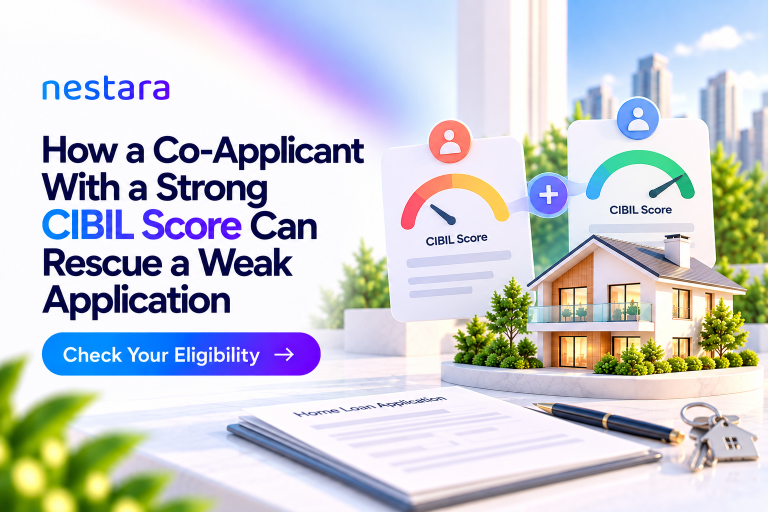
If the problem is affordability rather than credit history, reducing the requested loan amount or adding an eligible co-applicant may change the assessment. The right solution depends on the reason for rejection.
Conclusion
A home loan can be rejected due to a low CIBIL score because lenders use your credit history as an important indicator of repayment risk. But a rejection is not the end of your home-buying plans. Understanding what caused the low score and addressing it before applying again can put you in a stronger position.
Start with your credit report instead of another loan application. With Nestara’s Free Credit Score Check, you can see where your credit profile stands and take the next step with better information. Once you know what needs attention, you can work on improving your profile before approaching lenders again.
FAQs
Why is my home loan rejected due to a low CIBIL score?
A home loan may be rejected due to a low CIBIL score because the lender considers your past credit behaviour a higher repayment risk. Missed payments, defaults, high credit utilisation and other negative credit information can contribute to a low score.
What is the minimum CIBIL score required for a home loan?
There is no universal minimum CIBIL score for home loans. Lenders have their own eligibility criteria and also consider income, existing debt, employment stability, property details and other factors.
Can I get a home loan with a CIBIL score below 650?
It may be possible, but approval can be more difficult because lenders may consider a lower score a higher credit risk. Your income, liabilities, repayment history and other application details will also influence the decision.
How long does it take to improve a low CIBIL score?
There is no fixed timeframe for improving a CIBIL score. It depends on the reason for the low score and your subsequent credit behaviour. Consistently paying dues on time and reducing outstanding balances can help, but changes may take time to appear in your credit report.
Will applying for another home loan lower my CIBIL score?
A formal loan application can result in a hard inquiry on your credit report, which may have a small impact on your score. Making several applications within a short period can be more concerning, so it is better to understand why your first application was rejected before applying again.
How can I check my CIBIL score before applying for a home loan?
You can check your credit profile before applying by using a credit-score checking service. Checking your own score does not reduce your CIBIL score. Nestara’s Free Credit Score Check can help you understand your credit position before you approach a lender.
Does closing an old loan improve CIBIL score?
Closing a loan does not automatically increase your CIBIL score immediately. A successfully repaid loan can remain part of your credit history, while the effect of closing an account depends on your overall credit profile and other active accounts.





One Comment