20-Year vs 30-Year Home Loan Tenure: Which Actually Costs You Less?
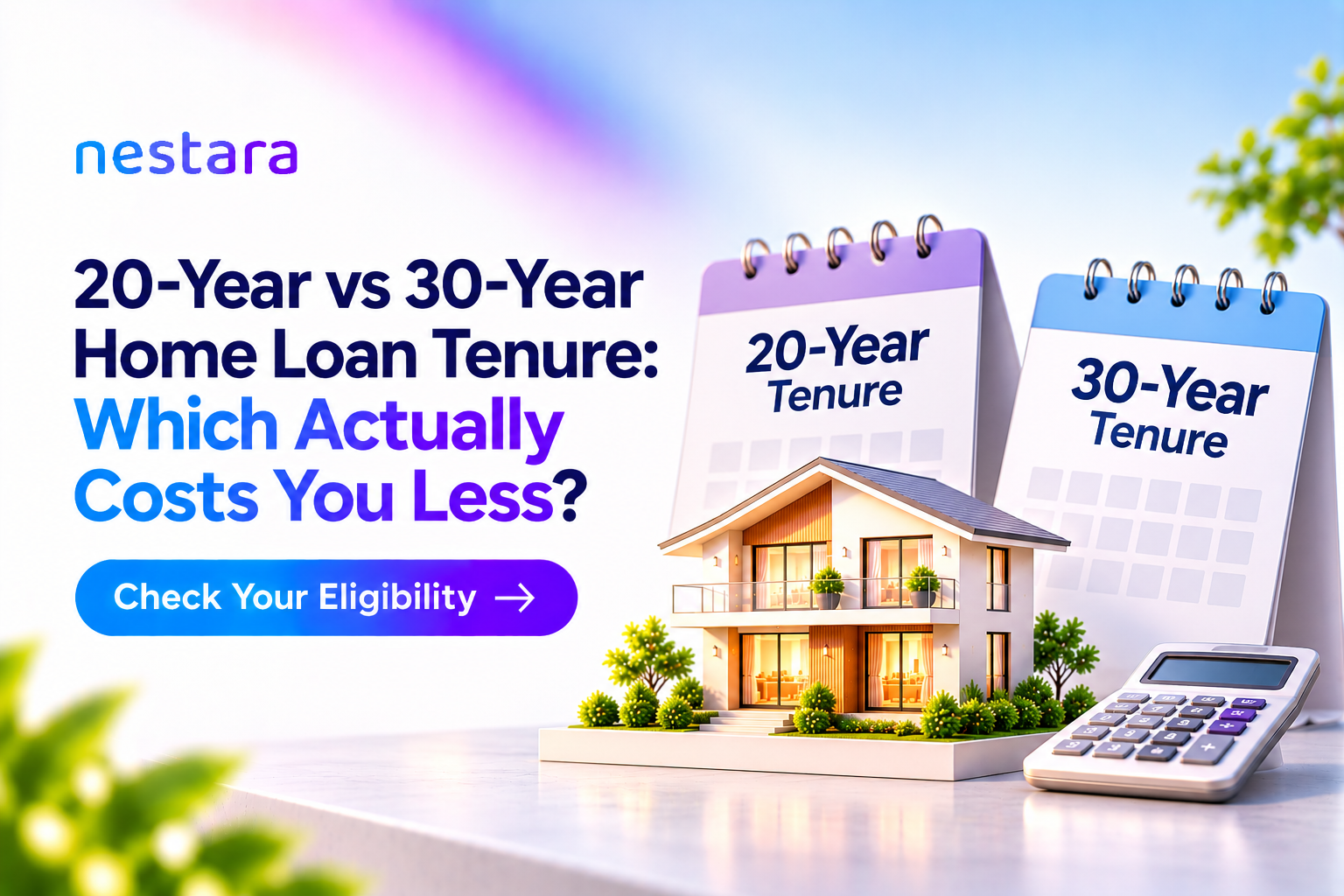
A 20-year home loan usually costs less in total interest than a 30-year loan, but its monthly EMI is higher. A 30-year tenure reduces the monthly payment and can make a loan easier to manage, but you pay interest for longer. The better choice depends on whether you prioritise lower overall borrowing costs or greater monthly cash-flow flexibility.
To compare the two properly, look beyond the EMI. Use Nestara’s EMI Calculator to compare the monthly instalment, total interest and total repayment for different tenures before deciding how much you can comfortably borrow.

Why does a 30-year tenure cost more?
A 30-year home loan costs more in total interest because you keep the outstanding principal for a longer period. Although the EMI is lower, a larger part of your repayment goes towards interest over the extended loan period.

In the early years of a home loan, the interest component of the EMI is generally higher than the principal component. As you continue making payments, the principal component gradually increases.
With a longer tenure:
- You make more monthly payments.
- You repay the principal more gradually.
- Interest continues accumulating over a longer period.
- Your total repayment can become significantly higher.
This is why comparing only the EMI can be misleading. Always compare the total interest payable before choosing a tenure.
When should you choose a 20-year home loan?
A 20-year tenure may be better if you have a stable income, manageable expenses and enough monthly surplus to afford the higher EMI.
Consider this option when:
- You want to minimise total interest.
- Your income comfortably supports the EMI.
- You have limited existing financial commitments.
- You want to become debt-free sooner.
- You expect your income to remain reasonably stable.
However, don’t choose a higher EMI simply to save interest if it leaves you with insufficient money for emergencies, healthcare, investments or other important expenses.
When does a 30-year home loan make more sense?
A 30-year tenure may be more suitable when a lower EMI is important for maintaining monthly financial flexibility.
It may help if:
- You are early in your career and expect your income to grow.
- You have other financial commitments.
- You need to preserve savings for emergencies.
- Your current monthly budget cannot comfortably support a shorter tenure’s EMI.
Remember that a 30-year tenure may not be available to every applicant. Lenders consider your age, income, employment profile and maximum permitted age at loan maturity. Read our guide on how age at loan maturity affects your maximum tenure and EMI before choosing a repayment period.
Can you choose 30 years and repay the loan earlier?
Yes. You may choose a longer tenure for a lower mandatory EMI and make additional principal repayments when your finances allow, subject to your loan terms and applicable prepayment rules.
This approach can offer flexibility: you retain a lower contractual EMI while using bonuses, salary increases or surplus savings to reduce the outstanding principal.
For example, if you receive a bonus, you could make a partial prepayment and ask your lender to reduce the remaining tenure rather than lowering your EMI. This can help reduce future interest costs.
Our guide on home loan prepayment and whether it reduces EMI or tenure explains how to compare both options.
For floating-rate loans, interest-rate changes can also affect your EMI or repayment period. RBI’s framework requires regulated lenders to communicate the impact of rate resets and provide applicable repayment options, including changes to EMI or tenure and part or full prepayment, subject to the relevant rules.
How should you decide between 20 and 30 years?
Choose a tenure based on your monthly affordability and total borrowing cost, not simply the lowest EMI offered.
Before deciding, compare:
- Monthly affordability: Can you comfortably pay the EMI after household expenses and existing obligations?
- Total interest: How much extra will the longer tenure cost?
- Income stability: Is your income predictable, or could it fluctuate?
- Emergency savings: Will you still have enough money for unexpected expenses?
- Prepayment flexibility: Can you make additional payments if your financial position improves?
Use Nestara’s EMI Calculator to test different loan amounts, interest rates and repayment periods. You can also compare the potential impact of changing your tenure or making additional repayments before committing to a loan.
Conclusion
A 20-year home loan generally costs less overall because you repay the principal faster and pay interest for fewer years. A 30-year loan offers a lower EMI, but that convenience comes with a higher total interest cost.
If you can comfortably afford the higher EMI, the shorter tenure may be financially more efficient. If you need greater monthly flexibility, a longer tenure with disciplined prepayments may be worth considering.
Before making your decision, compare both repayment schedules using Nestara’s EMI Calculator to understand your monthly commitment, total interest and overall repayment.
FAQs
1. Is a 20-year home loan better than a 30-year home loan?
A 20-year loan is generally better for reducing total interest, while a 30-year loan is better for keeping monthly EMIs lower. The right option depends on your income, expenses and repayment priorities.
2. How much interest can I save by choosing 20 years instead of 30 years?
The savings depend on the loan amount and interest rate. In our illustration of a ₹50 lakh loan at 8.5%, choosing 20 years instead of 30 years reduces the estimated interest by approximately ₹34.27 lakh.
3. Can I take a 30-year home loan and close it in 20 years?
Yes, if your lender permits additional principal repayments and you can afford them. Making regular partial prepayments can help shorten the repayment period, subject to applicable loan terms.
4. Does a longer home loan tenure improve eligibility?
It can improve eligibility because spreading repayment over more months generally reduces the EMI for the same loan amount and interest rate. However, lenders also consider age, income, existing obligations and their maximum tenure policies.
5. Can my bank increase my home loan tenure after interest rates rise?
For applicable floating-rate EMI-based loans, lenders may adjust the EMI, extend the tenure or use a combination, subject to regulatory requirements and loan terms. They must communicate relevant changes to borrowers.
6. Is it better to increase EMI or make a lump-sum prepayment?
Both can help reduce interest. Increasing your EMI accelerates principal repayment regularly, while lump-sum prepayment reduces the outstanding principal immediately when applied. The better option depends on your cash flow and savings.
7. Does a 30-year home loan always have a higher interest rate?
Not necessarily. The interest rate depends on the lender’s pricing, borrower profile, loan product and other factors. However, even at the same interest rate, a 30-year tenure generally results in higher total interest than a 20-year tenure.