Why Do Home Loan Applications Get Rejected? Top 10 Reasons
Home loan applications get rejected most commonly due to low CIBIL scores, insufficient income, high existing debt, employment issues, and property-related problems. In this guide, you’ll learn the top 10 reasons banks say no and how to fix each issue before reapplying.
Quick Summary
- The top reasons for rejection: low CIBIL score, low income, high FOIR, unstable employment, and property legal issues.
- Most rejections are recoverable in 3–12 months with focused fixes.
- Multiple recent loan applications, frequent job changes, and undisclosed liabilities are common silent killers.
- Self-employed applicants face unique challenges related to income proof and ITR consistency.
- Knowing the actual reason for rejection is the first step to fixing it.
What Causes Home Loan Rejection?
What does it mean?
Home loan rejection means the lender has decided not to approve your application based on their credit, income, employment, or property assessment. The rejection isn’t always permanent — most reasons can be addressed and the application reworked.
The Top 10 Rejection Reasons
- CIBIL score below 700
- Insufficient or unstable income
- High FOIR (existing EMIs eating into eligibility)
- Recent job change or short employment tenure
- Age too close to retirement
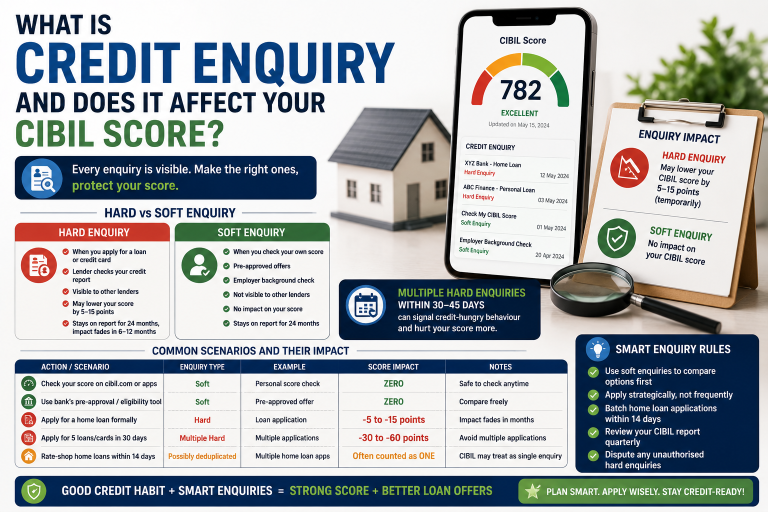
- Too many recent loan enquiries
- Discrepancies in documents
- Property legal or title issues
- Builder/project not approved by the bank
- Past loan defaults or settlements visible on CIBIL
Action Plan After Rejection
| Strategy | Timeline | Outcome |
|---|---|---|
| Fix root cause and reapply | 3–12 months | Better rate and terms |
| Apply to lenient NBFC/HFC | 2–4 weeks | Faster approval, higher rate |
| Add co-applicant | 1–4 weeks | Improved eligibility, joint liability |
| Switch property | Variable | Approval depends on new property |
When to Fix vs When to Switch Lender
Fix and reapply if: Your rejection reasons are CIBIL score, FOIR, or short employment tenure — clearly fixable in 3–12 months.
Switch to a more lenient NBFC/HFC if: You have urgent funding needs, or the rejection reasons are deeper structural issues.
Practical Tips
- Always request the rejection reason in writing — banks are obligated to provide it under RBI fair-practices code.
- Pull your latest CIBIL report after rejection.
- Don’t reapply to multiple banks immediately — each new hard enquiry compounds the problem.
- Use the rejection productively — fix the underlying issue rather than rushing to find a “yes.”
Common Mistakes to Avoid
- Reapplying to 5 banks within a month after rejection.
- Hiding existing loans or credit card debt.
- Ignoring property-related rejection reasons.
FAQ
What’s the most common reason for home loan rejection in India?
The most common reason is a low CIBIL score (below 700).
How long should I wait before reapplying after a rejection?
Wait at least 3–6 months, ideally 6–12 months if your rejection was credit-related.
Will a rejected home loan application affect my CIBIL score?
The application triggers a hard enquiry that may reduce your score by 5–15 points. The rejection itself isn’t reported to CIBIL.
Can I get a home loan if I was rejected by multiple banks?
Yes, but you need to address the root cause first, then reapply with strong documentation.
Do banks tell me why my home loan was rejected?
Yes, banks are required to provide the rejection reason under the RBI’s Fair Practices Code upon written request.