How to Write a Home Loan Foreclosure Letter (With Template)
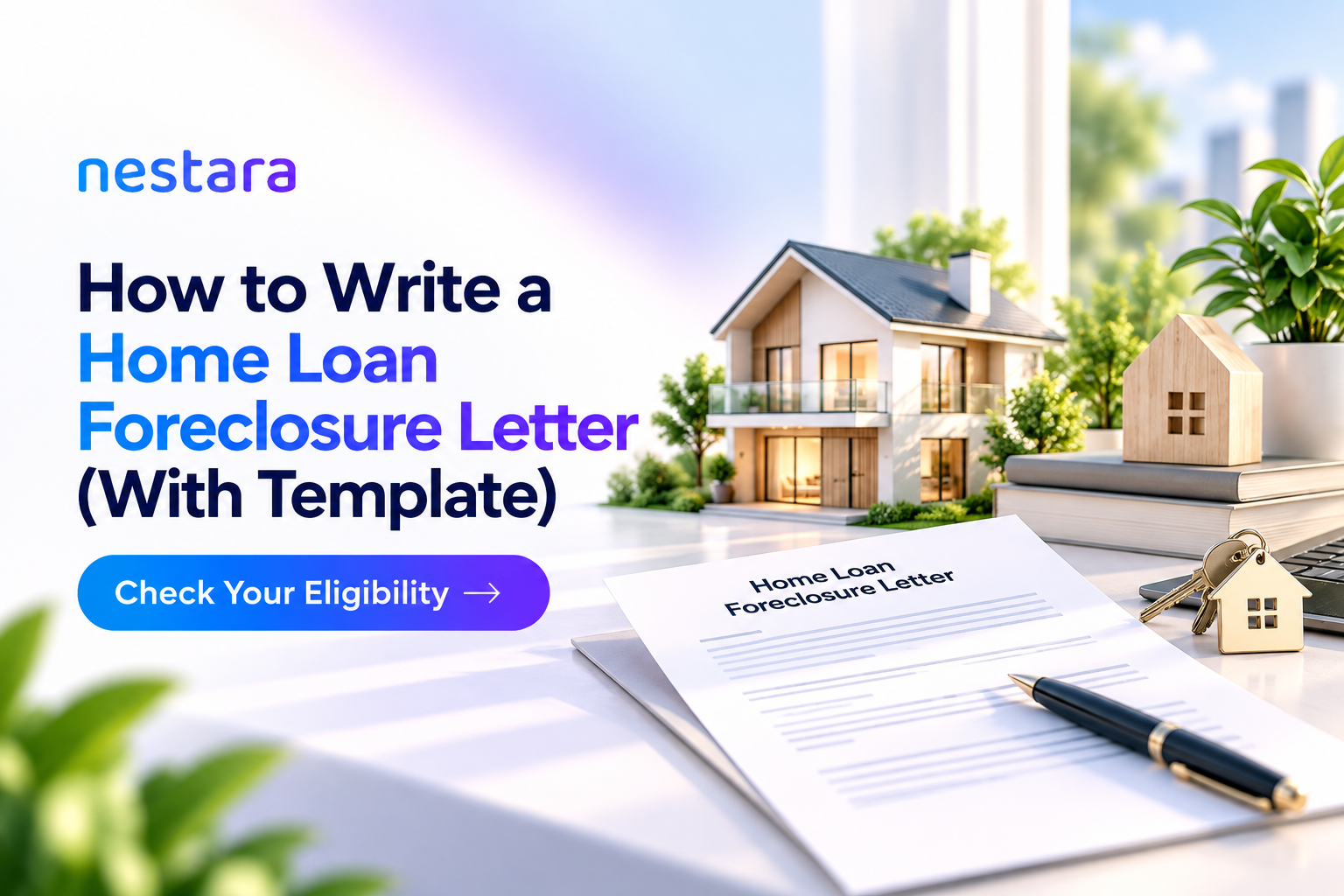
A foreclosure letter for a home loan is a formal request to your lender asking for the outstanding loan amount and the process required to close the loan before its original tenure ends. The letter should clearly state your loan details, request a foreclosure statement, and ask the lender to complete the closure and release the relevant property documents after payment.
If you are considering foreclosure because another lender is offering a lower interest rate, it is worth comparing the cost of closing your existing loan with the potential savings from a home loan balance transfer before making the final decision.
What is a home loan foreclosure letter?
A home loan foreclosure letter is a written request submitted to your lender to initiate or facilitate early closure of your outstanding home loan. It tells the lender that you want to repay the remaining loan balance and asks for the exact amount payable and closure procedure.
The letter is useful because your outstanding balance changes as interest accrues and EMIs are paid. Instead of estimating the amount yourself, you can ask the lender to provide an official foreclosure statement or foreclosure quotation.
This document generally specifies:
- Outstanding principal
- Interest payable up to the applicable date
- Applicable charges, if any
- Total amount required for closure
- Validity period of the quotation
- Payment instructions
- Documents or formalities required after closure
When should you write a foreclosure letter?
You should write a foreclosure letter when you are ready to explore or proceed with closing your home loan before its scheduled maturity. You may want to foreclose because you have accumulated sufficient savings, received funds from another source, or are planning to transfer the loan to another lender.
A foreclosure request can also be useful before a balance transfer because the new lender may require information about the amount needed to settle your existing loan.
However, requesting a foreclosure statement does not necessarily mean you must immediately close the loan. You can first use the lender’s quotation to understand the actual amount required and compare your options.
What should a home loan foreclosure letter contain?
A foreclosure letter should contain enough information for the lender to identify your loan and process your request without unnecessary back-and-forth.
Include:
- Date
- Borrower’s full name
- Address and contact details
- Lender and branch details
- Home loan account number
- Property details, if required
- Clear request for foreclosure
- Request for the foreclosure statement
- Request for closure confirmation
- Request for release of original property documents and applicable security/lien formalities
- Signature
Keep the language straightforward. You do not need to provide a lengthy explanation for why you want to close the loan.
Home loan foreclosure letter format
A simple foreclosure letter can follow the format below:
To,
The Branch Manager
[Bank/HFC Name]
[Branch Name]
[Branch Address]
Date: [DD/MM/YYYY]
Subject: Request for Foreclosure of Home Loan – Loan Account No. [XXXXXXXX]
Dear Sir/Madam,
I, [Full Name], am the borrower/co-borrower of the home loan bearing account number [Loan Account Number] with your institution.
I would like to foreclose and close the above-mentioned home loan before the scheduled maturity date.
I request you to kindly provide me with the foreclosure statement/quotation, including the outstanding principal, interest payable up to the applicable date, applicable charges, total amount required for foreclosure and the validity period of the quotation.
Upon payment of the required amount, I also request you to provide written confirmation of loan closure and complete the necessary formalities for the release of the original property documents and any applicable security-related documents.
Please also let me know if any additional documents or formalities are required from my side to complete the foreclosure process.
Thank you.
Yours faithfully,
[Full Name]
Loan Account No.: [XXXXXXXX]
Mobile No.: [XXXXXXXXXX]
Email: [Email Address]
Signature: [Signature]
What happens after you submit the foreclosure letter?
After receiving a foreclosure request, the lender typically calculates the amount required to settle the loan and provides the borrower with the relevant foreclosure statement or instructions.
The process generally looks like this:
1. Submit the request
Send the letter through the lender’s accepted channel, such as a branch, email or online service, depending on the lender’s process.
2. Receive the foreclosure statement
The lender provides the amount required to settle the outstanding loan as of a particular date.
3. Verify the amount
Check the statement carefully against your latest loan account information. Ask the lender to explain any charge you do not recognise.
4. Make the payment
Pay the required amount using the payment method specified by the lender and within the quotation’s validity period.
5. Obtain closure confirmation
Ask for written confirmation that the loan has been fully repaid and closed.
6. Collect the property documents
After the loan is closed, follow the lender’s process for collecting the original property documents and completing any applicable release of security formalities.
Keep copies of the foreclosure statement, payment proof and closure confirmation for your records.
Can a bank charge foreclosure fees on a home loan?
Whether a lender can charge a pre-payment or foreclosure charge depends on the type of loan, borrower, lender and applicable RBI rules.
For example, RBI has long prohibited banks from charging foreclosure charges or pre-payment penalties on floating-rate home loans for individual borrowers. RBI’s 2015 master circular also records the restriction on foreclosure charges for floating-rate term loans sanctioned to individual borrowers.
RBI’s newer pre-payment framework also provides protections for specified floating-rate loans, with the applicable rules depending on factors including the loan’s sanction or renewal date and purpose. Therefore, borrowers should check the rules applicable to their particular loan rather than assuming that every home loan can or cannot have a foreclosure charge.
If your lender has included a foreclosure charge in the statement, ask for the basis and calculation of the charge in writing before paying it.
Should you foreclose your loan or transfer it?
You should compare foreclosure with a balance transfer before using your savings to close the loan completely. Foreclosure may eliminate future interest, but it also uses your available cash. A balance transfer could potentially reduce your interest cost while allowing you to retain your savings.
For example:
| Option | Main benefit | Main consideration |
|---|---|---|
| Full foreclosure | Become debt-free | Uses a large amount of cash |
| Partial prepayment | Reduces principal and future interest | Uses part of your savings |
| Balance transfer | May reduce interest rate | Involves eligibility and switching costs |
| Continue current loan | No switching process | May cost more if your rate is uncompetitive |
The right choice depends on your outstanding balance, remaining tenure, interest rate, available savings and financial priorities.
How can Nestara help if you are considering a balance transfer?
Nestara’s Balance Transfer option can help you compare whether moving your existing home loan could be financially better than continuing with your current lender.
Before requesting foreclosure solely to switch lenders, compare:
- Current outstanding loan
- Existing interest rate
- Proposed new rate
- Remaining tenure
- Expected interest saving
- Processing and other applicable charges
- Any applicable foreclosure/pre-payment costs
This is important because a lower advertised rate does not automatically mean a cheaper loan. The net saving after all applicable costs is what matters.
What documents should you keep after foreclosure?
After closing your home loan, you should retain the lender’s closure confirmation and documents proving that the loan has been fully settled.
Depending on the lender and loan structure, these may include:
- Foreclosure statement
- Payment receipt
- No Dues Certificate or loan closure letter
- Original property documents
- Release of mortgage/security documentation, where applicable
- Updated loan account statement
Ask the lender what documents will be returned and whether you need to complete any further registration or record-update formalities.
Conclusion
A home loan foreclosure letter is a simple but important document that formally tells your lender you want to close your loan early and requests the exact amount and procedure for doing so. The most important step is to obtain an official foreclosure statement rather than relying on an estimated outstanding balance.
If your reason for foreclosure is to move to a lender offering a better rate, do not rush to close the existing loan. First compare the potential interest savings and all switching costs.
Use Nestara’s Balance Transfer option and savings calculator to see whether transferring your home loan could be more beneficial than simply continuing with your current lender or using your savings to foreclose it.
FAQs
What is a foreclosure letter for a home loan?
A foreclosure letter is a formal written request to a lender asking for the outstanding amount and procedure required to close a home loan before its original maturity date.
Is a foreclosure letter mandatory for closing a home loan?
Not necessarily. The exact process varies by lender. Some lenders may accept an online request or branch request instead of a formal letter. Check your lender’s current foreclosure procedure.
What is a foreclosure statement?
A foreclosure statement is a document from the lender showing the amount required to fully settle the home loan as of a specified date, along with applicable charges and payment instructions.
How long is a foreclosure statement valid?
The validity period depends on the lender and the statement’s terms. Since interest may continue to accrue, use the statement within the specified validity period or request an updated statement if it expires.
Can I request a foreclosure statement without actually closing the loan?
Yes, in many cases you can request the statement to understand the amount required for closure. However, the exact process and any applicable request requirements depend on your lender.
Can I use a foreclosure letter for a home loan balance transfer?
Yes. A foreclosure or outstanding-balance request can be part of the balance-transfer process because the new lender needs to know the amount required to settle your existing loan.
Are foreclosure charges allowed on floating-rate home loans?
RBI rules restrict regulated lenders from charging pre-payment or foreclosure charges in specified floating-rate loan situations. The exact applicability depends on the loan, borrower, lender and relevant regulatory framework.
What should I do if my lender asks for a foreclosure charge?
Ask the lender to provide the charge and its contractual and regulatory basis in writing. Check your loan type, sanction or renewal date and the RBI rules applicable to your loan before paying or disputing the amount.
What documents should I collect after foreclosing my home loan?
You should obtain written loan-closure confirmation and, as applicable, the No Dues Certificate, original property documents and documents confirming release of the lender’s security interest.
Is foreclosure better than a home loan balance transfer?
Not always. Foreclosure makes you debt-free but requires you to use your available funds. A balance transfer may reduce future interest without requiring you to pay off the entire loan from your own savings. Compare the net financial impact of both options before deciding.