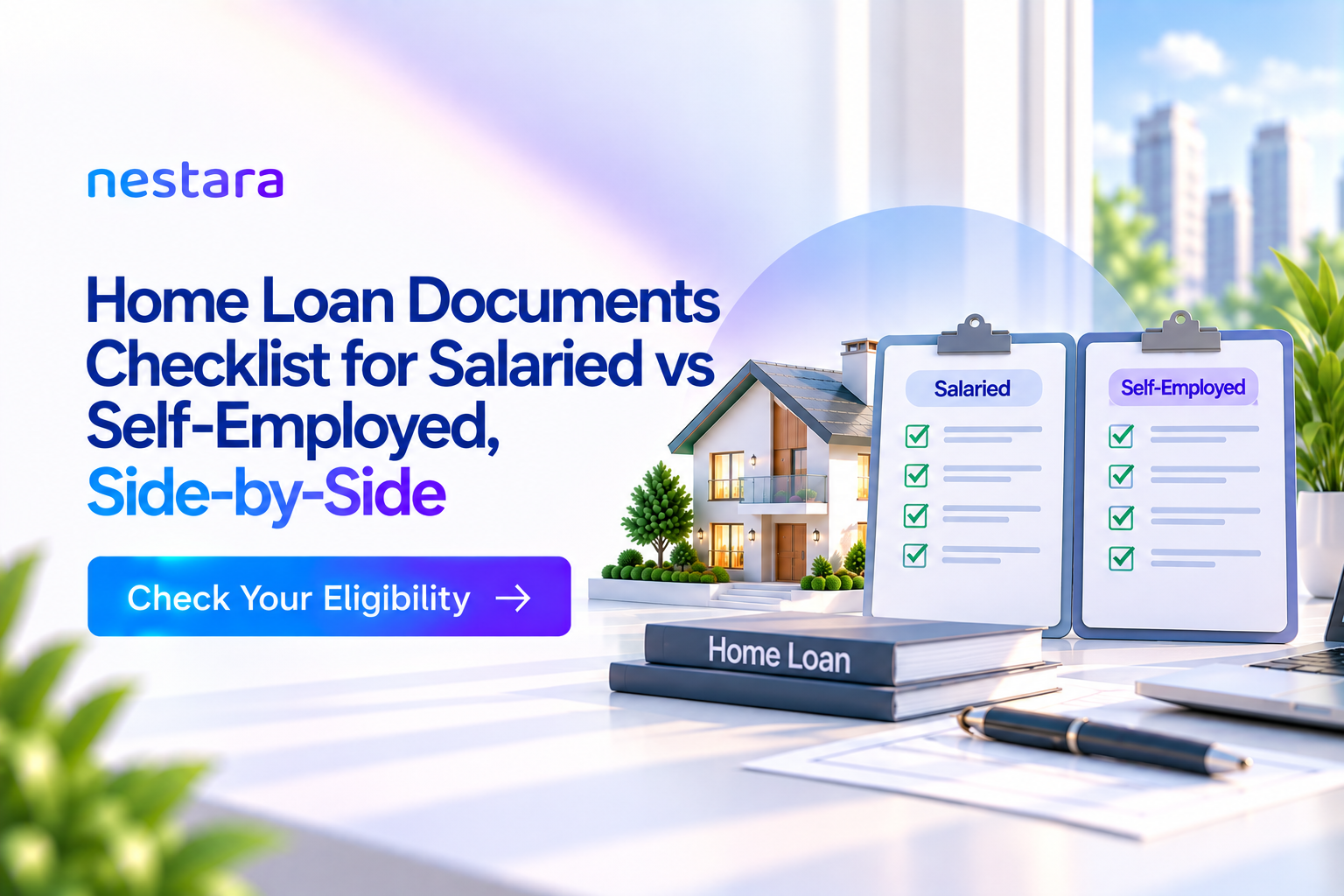
Home Loan Documents Checklist for Salaried vs Self-Employed, Side-by-Side
The home loan documents required for salaried and self-employed applicants overlap on basic KYC and property papers, but income-proof requirements are different. Salaried applicants usually prove income through salary slips, Form 16 and bank statements, while self-employed applicants generally need ITRs, financial statements and business-related documents. Exact requirements vary by lender, applicant profile and property.
If you are preparing to apply for a New Home Loan, having the right documents ready can make verification smoother and help avoid unnecessary back-and-forth.
What Documents Are Common to Salaried and Self-Employed Home Loan Applicants?
Both salaried and self-employed applicants generally need identity, address, income and property-related documentation. Lenders may also ask for additional documents depending on the application.
| Document category | Salaried | Self-employed |
|---|---|---|
| PAN / Form 60 | ✓ | ✓ |
| Identity proof | ✓ | ✓ |
| Address proof | ✓ | ✓ |
| Age proof, where required | ✓ | ✓ |
| Bank statements | ✓ | ✓ |
| Income documents | Salary-based | Business/professional income-based |
| Property documents | ✓ | ✓ |
| Existing loan details, if applicable | ✓ | ✓ |
| Additional business documents | Usually not required | Often required |
The important difference is how your income is established, not whether one category needs KYC and the other does not.
Salaried Home Loan Documents Checklist
Salaried applicants generally need documents that demonstrate their employment, regular salary and recent financial activity.
1. Identity and address proof
Keep commonly accepted KYC documents such as:
- PAN card or Form 60, where applicable
- Aadhaar or another accepted officially valid document
- Passport
- Driving licence
- Voter ID
Lenders can specify which documents they accept, so check the latest checklist before submission. For example, HDFC Bank lists PAN/Form 60 and officially valid identity/address documents among its home-loan requirements.
2. Salary and employment proof
Salaried applicants should generally keep:
- Recent salary slips
- Form 16 and/or income-tax documents, as applicable
- Recent salary-credit bank statements
- Employment or company ID, where requested
Some lenders may ask for additional employment information, particularly if income includes variable pay, bonuses or allowances.
3. Property documents
You will also need property-related papers once a specific property is being financed. Depending on the transaction, these can include the sale agreement, title documents, approvals and other papers required for the lender’s legal and technical verification.
The exact property checklist depends on whether you are buying a ready property, under-construction property, resale property or constructing a house.
Self-Employed Home Loan Documents Checklist
Self-employed applicants generally need more detailed financial documentation because their income may come from a business or professional practice rather than a fixed monthly salary.
1. Identity and address proof
Self-employed applicants generally provide the same basic KYC documents as salaried applicants, such as:
- PAN card or Form 60, where applicable
- Aadhaar or other accepted address/identity proof
- Passport
- Driving licence
- Voter ID
2. Income and tax documents
Self-employed applicants may need:
- Income-tax returns
- Computation of income
- Profit and loss statements
- Balance sheets
- Bank statements
- Financial statements or audit reports, where applicable
The period requested varies by lender and applicant profile. For example, lenders may assess multiple years of financial history to understand business continuity and income stability.
3. Business or professional documents
Depending on the nature of your work, you may also need documents establishing the existence and continuity of the business or profession.
These can include:
- Business registration documents
- GST-related documents, where applicable
- Partnership deed
- Memorandum and Articles of Association for companies, where applicable
- Professional registration or licence, where relevant
- Proof of business address
Not every self-employed borrower needs every document above. The appropriate list depends on whether you are a sole proprietor, partner, director, professional or another type of self-employed applicant.
Salaried vs Self-Employed Documents: Side-by-Side Checklist
The main difference is that salaried applicants document employment income, while self-employed applicants document business or professional income and continuity.
| Requirement | Salaried applicant | Self-employed applicant |
|---|---|---|
| PAN/KYC | PAN + accepted KYC | PAN + accepted KYC |
| Address proof | Required | Required |
| Salary slips | Generally relevant | Not applicable |
| Form 16 | Commonly relevant | Generally not applicable |
| ITR | May be requested | Commonly relevant |
| Bank statements | Commonly required | Commonly required |
| P&L statement | Usually not required | Often relevant |
| Balance sheet | Usually not required | Often relevant |
| Business registration | Usually not required | May be required |
| Professional proof | Usually not required | May be required |
| Property documents | Required | Required |
This is a practical comparison, not a universal lender checklist. Requirements can change by lender, loan amount, applicant type and property.
Why Do Self-Employed Applicants Need More Financial Documents?
Self-employed applicants often need more financial documents because lenders need to establish sustainable income when there is no fixed monthly salary slip.
For example, a consultant may receive different payments each month, while a business owner may have revenue that fluctuates seasonally. ITRs, financial statements and bank records can help lenders assess the broader income picture.
A lender may therefore look beyond one month’s bank credit and examine the applicant’s financial history and business continuity. Some lender requirements explicitly distinguish between salaried applicants and self-employed professionals or non-professionals.
What Property Documents Are Needed for a Home Loan?
Property documents are generally required for both salaried and self-employed borrowers because the lender must verify the property being financed.
The exact documents depend on the transaction, but the lender may require papers relating to:
- Ownership and title
- Sale agreement
- Previous ownership, where relevant
- Approved building or development plans
- Property tax or statutory records, where applicable
- Builder or project approvals for applicable purchases
- Registration and other transaction documents
Do not assume that having all your personal documents means the application is complete. Property verification is a separate part of the home-loan process.
What If You Have Multiple Income Sources?
Applicants with multiple income sources should disclose them consistently and keep supporting records for each income stream.
For example, a salaried person earning ₹80,000 per month who also has documented professional income should not simply provide the salary slips and ignore the additional income. If you want the lender to consider another income source, you may need appropriate tax, bank and supporting documentation.
The same principle applies to self-employed borrowers with income from multiple businesses or professional activities.
How Can You Prepare Your Home Loan Documents Faster?
You can make the application process smoother by preparing documents before selecting a lender.
Use this checklist:
- Create separate digital folders for KYC, income and property documents.
- Check that names match across PAN, bank records and other documents.
- Keep recent bank statements available.
- Keep tax documents organised by financial year.
- For self-employed applicants, organise financial statements and business records together.
- Keep property papers ready once the property is finalised.
- Check the lender’s latest document list before submission.
Also make sure scans are readable and documents are complete. Missing pages, mismatched details or unclear copies can lead to additional requests during verification.
Does Having All Documents Guarantee Home Loan Approval?
No. Complete documentation does not guarantee home-loan approval because lenders also assess income, repayment capacity, credit history, age, existing obligations, property details and their internal eligibility criteria.
Documentation establishes the facts behind your application; it does not by itself determine the lender’s decision. Home-loan eligibility is primarily linked to income and repayment capacity, alongside other applicant and property factors.
Conclusion
The biggest difference between salaried and self-employed home loan documentation is income verification. Salaried applicants usually rely on salary slips, Form 16 and salary-credit records, while self-employed applicants typically need ITRs, financial statements and documents that establish business or professional income and continuity.
Start by organising your KYC, income and property papers, then check the specific lender’s latest requirements. When you are ready to explore your New Home Loan options, you can use Nestara to compare suitable lenders and move forward with a clearer understanding of your eligibility and documentation requirements.
FAQs
What documents are required for a salaried person’s home loan?
A salaried applicant generally needs PAN/KYC documents, address proof, recent salary slips, Form 16 or applicable tax documents, bank statements and property documents. Additional documents may be requested based on the lender and application.
What documents are required for a self-employed person’s home loan?
A self-employed applicant generally needs PAN/KYC and address proof, ITRs, income computations, bank statements and financial statements such as profit and loss accounts or balance sheets. Business or professional documents may also be required.
Do self-employed applicants need more documents than salaried applicants?
Often, yes. Self-employed applicants usually need more financial and business documentation because lenders need to assess business or professional income, continuity and financial stability rather than relying on regular salary slips.
Is Form 16 required for self-employed home loan applicants?
Form 16 is generally associated with salary income and therefore is not the primary income document for most self-employed applicants. Self-employed borrowers typically establish income through ITRs and financial statements instead.
Are bank statements required for both salaried and self-employed home loans?
Yes, lenders commonly request bank statements from both types of applicants to verify income credits, financial activity and existing obligations. The exact period required varies by lender.
Do I need property documents before applying for a home loan?
You can begin the eligibility and application process before finalising every property document, but the lender will need relevant property papers for legal and technical verification before the loan can progress to the applicable stages. The exact documents depend on the property and transaction.
Can a self-employed professional get a home loan?
Yes. Self-employed professionals such as doctors, lawyers, chartered accountants, architects and consultants can apply for home loans, subject to the lender’s eligibility criteria and documentation requirements.
Does having complete documents guarantee home loan approval?
No. Complete documents help the lender verify your application, but approval also depends on factors such as income, repayment capacity, credit profile, age, existing liabilities, property and lender-specific criteria.
How should I organise documents before applying for a New Home Loan?
Keep separate folders for KYC, income, bank statements and property documents. Salaried applicants should prioritise salary and tax records, while self-employed applicants should organise ITRs, financial statements and business documents by financial year. Checking the lender’s latest checklist before submission can help avoid delays.