What Is Pre-Approved Home Loan and Should You Get One?
A pre-approved home loan is a conditional loan sanction given by a bank based on your income, credit score, and financial profile — before you have selected a specific property. In this guide, you’ll learn how pre-approval works, what’s actually guaranteed (and what’s not), how it speeds up your home buying, and when it might not be worth pursuing — so you can negotiate better with sellers and close deals faster.
Quick Summary
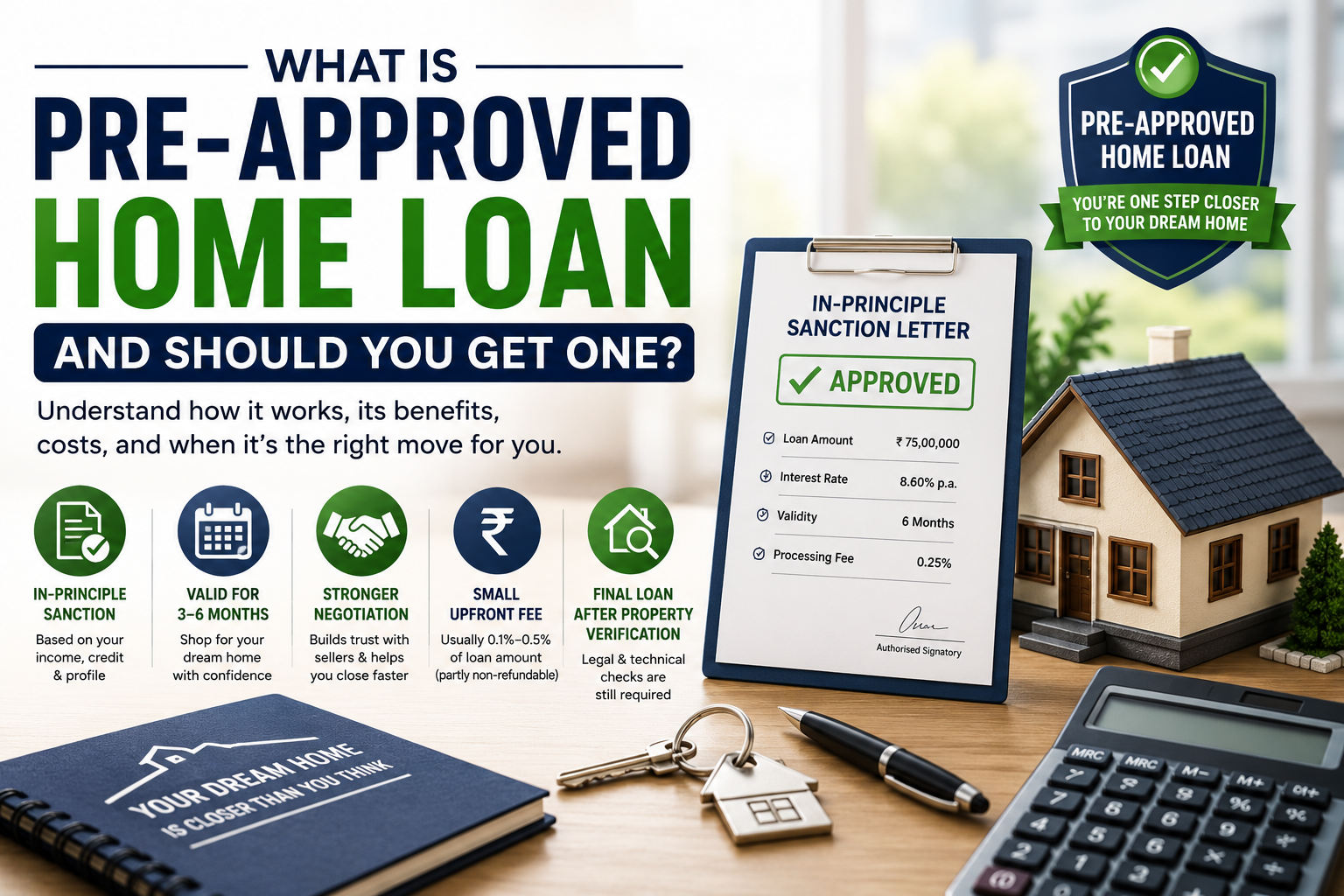
- Pre-approved loans give you an in-principle sanction letter valid for 3–6 months.
- The sanction is based only on your profile; the property is evaluated separately at the time of final disbursement.
- It strengthens your negotiating position with sellers and builders, often unlocking better deals.
- Most pre-approvals come with a small fee (0.1–0.5% of the loan amount), some of which is non-refundable.
- Final disbursement still depends on satisfactory property valuation and legal verification.
What Is a Pre-Approved Home Loan?
What does it mean?
A pre-approved home loan is an “in-principle” sanction from a bank stating that based on your income, employment, credit score, and existing liabilities, you qualify for a home loan up to a specific amount, at a specific interest rate, valid for a defined period (usually 3–6 months). Crucially, this sanction does not yet account for any specific property — it tells you what you can borrow, but actual disbursement requires you to select a property and clear its legal and technical evaluation.
To understand how lenders assess your income, existing EMIs, credit score and other factors before deciding your borrowing limit, read our guide on How Do Banks Decide Your Home Loan Eligibility? (Explained Simply).
How does it work?
You submit standard income, KYC, and credit documents to your chosen lender. The bank runs a CIBIL check, verifies your income and employment, and evaluates your repayment capacity. If you meet the criteria, the bank issues a pre-approval letter mentioning the sanctioned amount, interest rate, processing fee, and validity period. You then begin property hunting with this letter in hand. Once you finalise a property, the bank verifies it and converts the pre-approval into an actual loan disbursement.
Key Factors You Should Know
What are the important factors to consider?
Four factors matter most: the validity period of the pre-approval (usually 3–6 months), whether the rate is locked or floating, the upfront fee charged (often non-refundable), and whether the bank has property restrictions (only approved projects, only certain cities). Also check the difference between “pre-qualified” (informal indication) and “pre-approved” (formal sanction with documentation) — only the latter carries real weight with sellers.
How do these factors impact your decision?
These factors determine both the practical value and risk of pre-approval. A 6-month validity gives you breathing room to find the right property. A locked rate protects you if rates rise during your search. But the upfront fee (often ₹5,000–₹25,000) is sunk cost if you don’t end up using the bank. If your bank only finances “approved” projects, your property options narrow significantly — verify this before paying any fee.
- Validity Period — 3–6 months typical; longer = more flexibility
- Rate Lock — Whether the offered rate is fixed for the validity period
- Processing Fee — Often partly or fully non-refundable
- Approved Project List — Some banks restrict pre-approval to specific builders
- Conversion Process — How easy it is to convert to actual disbursement
Before accepting a quoted rate, explore our guide on Fixed vs Floating Interest Rates: What’s the Real Difference? to understand how each option affects your repayments and exposure to future rate changes.
Options / Scenarios Explained
What are the available options?
You have three approaches to home loan financing. First, get a pre-approved loan before property hunting — useful for serious buyers in active markets. Second, apply for the loan after finalising a property — slower but no upfront commitment. Third, get pre-qualified (informal estimate from your bank) without paying any fee, then formally apply only after property finalisation — a middle path that gives clarity without sunk cost.
How do different scenarios affect outcomes?
Each path suits different scenarios. Pre-approval is best in hot real estate markets where sellers prefer ready buyers and you may need to act in days. Post-property application is better if you’re still 6–12 months from a decision and want to avoid sunk fees. Pre-qualification works well if you want directional clarity on your budget without commitment. The right choice depends on how close you are to actually buying.
| Scenario | Best Approach | Key Benefit |
| Hot market, ready to buy in 3 months | Pre-approved | Negotiation power, faster closing |
| Casual exploration, 6+ months out | Pre-qualified | Free directional clarity |
| Specific property in mind | Apply post-finalisation | No sunk fees, maximum flexibility |
| Resale property in metro | Pre-approved | Sellers prefer financing-ready buyers |
Which Option Is Right for You?
When should you get a pre-approved home loan?
Get a pre-approved loan if you’re actively house-hunting in a competitive market, need to demonstrate financial readiness to sellers (especially in resale or builder negotiations), and expect to close a deal within 3–6 months. It’s also useful for first-time buyers who want clarity on their actual budget before falling in love with a property they can’t afford. The negotiating leverage often more than pays for the upfront fee.
When should you skip pre-approval?
Skip pre-approval if you’re 6+ months away from buying, still researching neighbourhoods, or unsure which lender offers the best rates. The pre-approval fee is largely non-refundable, and rates may change in your favour later — locking in a higher rate now is a real cost. Also skip it if your CIBIL score or income situation might change soon (job switch, new EMIs) — your final eligibility could differ from the pre-approval.
Practical Tips to Make the Best Decision
- Compare pre-approval fees and conversion terms across 2–3 lenders before paying anything.
- Confirm in writing whether the interest rate is locked for the validity period or will adjust to market rates at disbursement.
- Use the pre-approval as leverage with builders and sellers — many offer better pricing for financing-ready buyers.
- Check if the bank has a list of pre-approved builder projects — these often qualify for faster, cheaper processing.
Common Mistakes to Avoid
- Treating pre-approval as a guaranteed loan — it’s still subject to property evaluation and your financial situation at disbursement.
- Paying the fee with one bank and then trying to switch lenders — you’ll lose the fee and waste time.
- Buying a more expensive property because the pre-approval allows it — the pre-approval is your maximum, not your target.
Conclusion
A pre-approved home loan is a useful tool when used at the right stage of your buying journey. It shows sellers you’re a serious, financially-ready buyer and shortens the time between offer and possession. But it’s not free — the upfront fee is a real cost, and the sanctioned amount is conditional on the property and your finances at disbursement. Use it when you’re actively buying and confident in your lender choice; skip it if you’re still exploring or shopping rates.
FAQ Section
Is a pre-approved home loan guaranteed?
No, a pre-approved home loan is not a guaranteed disbursement. It’s an in-principle sanction based on your current profile and is subject to two further conditions: satisfactory legal and technical evaluation of the property you eventually choose, and your financial situation remaining unchanged at the time of disbursement. If your income drops, you take on new EMIs, or the property fails verification, the loan can still be denied or reduced.
What is the validity period of a pre-approved home loan?
Most pre-approved home loans in India are valid for 3 to 6 months from the date of issue, though some lenders offer up to 12 months. If you don’t finalise a property within this period, the pre-approval expires and you’ll need to reapply (often with updated documents and a fresh evaluation). Some lenders allow a one-time validity extension at no extra cost — check your sanction letter.
Does a pre-approved home loan affect my CIBIL score?
Yes, applying for a pre-approved home loan triggers a hard enquiry on your CIBIL report, which can temporarily drop your score by 5–15 points. The drop is small and recovers within a few months if you don’t make multiple applications. Avoid applying to several banks for pre-approval simultaneously, as multiple hard enquiries in a short period signal credit-hungry behaviour and hurt your score more significantly.
Can I negotiate a better price with pre-approved loan in hand?
Yes, this is one of the biggest practical benefits of pre-approval. Sellers (especially in resale and ready-to-move properties) often prefer financing-ready buyers because it means faster closing and less risk of the deal falling through. You can typically negotiate 2–5% off the listed price, or get extras like covered parking, white goods, or interior work thrown in. Builders may waive certain charges as well.
Is the processing fee for pre-approval refundable?
In most cases, the processing fee paid at pre-approval is partially or fully non-refundable, even if you don’t end up taking the loan. Some lenders adjust the fee against the final disbursement if you proceed; others retain it as administrative charges. Always read the sanction letter terms carefully and ask the bank in writing what happens to the fee if you cancel — verbal assurances are not enough.