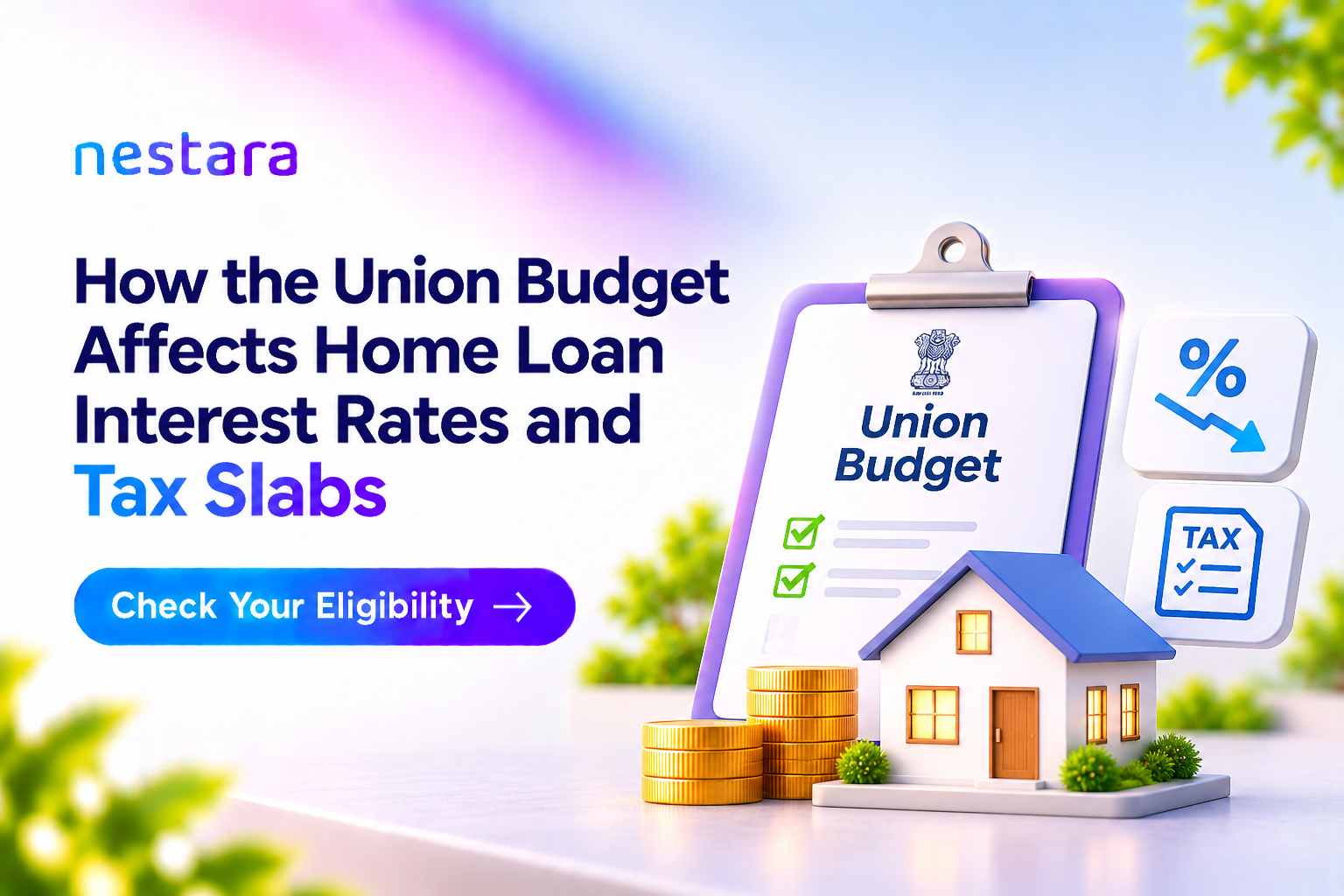
How the Union Budget Affects Home Loan Interest Rates and Tax Slabs
The Union Budget can affect your home loan costs through changes in income tax rules, deductions, housing incentives and government borrowing priorities. However, the Union Budget does not directly decide home loan interest rates. Those rates are influenced by factors such as the RBI’s monetary policy, lenders’ funding costs, market conditions and your credit profile.
For anyone planning to buy a home, it is important to understand both sides: how tax changes affect the cost of owning a house and how interest-rate movements affect your EMI. If you are planning to take a new home loan, you can explore our New Home Loan options to compare lenders and understand the repayment terms available to you.

Does the Union Budget Directly Change Home Loan Interest Rates?
No. The Union Budget does not set home loan interest rates or instruct banks to reduce them. The RBI determines the policy repo rate through its Monetary Policy Committee, while lenders decide their individual home loan rates based on funding costs, benchmark rates, borrower risk and market conditions.

The Budget can influence borrowing costs indirectly through government borrowing, fiscal policy, bond yields and overall market liquidity. However, these effects do not automatically translate into an immediate change in your home loan rate.
For context, the RBI increased the policy repo rate to 5.50% on October 7, 2026, from 5.25%, and adopted a calibrated tightening stance. This was an RBI monetary policy decision, not a Budget announcement.
If you have a floating-rate home loan, the impact depends on its benchmark and reset terms. Read our guide on what a floating-rate reset means and how often it changes.
What Are the Income Tax Slabs for Tax Year 2026–27?
The Union Budget 2026–27 retained the existing income tax slab rates. The new tax regime remains the default option under the Income-tax Act, 2025, which came into effect on April 1, 2026.
Here is a comparison of the tax slabs for individuals below 60 years of age:
| Annual taxable income | New regime (default) | Old regime |
|---|---|---|
| Up to ₹2.5 lakh | Nil | Nil |
| ₹2.5–4 lakh | Nil | 5% |
| ₹4–5 lakh | 5% | 5% |
| ₹5–8 lakh | 5% | 20% |
| ₹8–10 lakh | 10% | 20% |
| ₹10–12 lakh | 10% | 30% |
| ₹12–16 lakh | 15% | 30% |
| ₹16–20 lakh | 20% | 30% |
| ₹20–24 lakh | 25% | 30% |
| Above ₹24 lakh | 30% | 30% |
These are marginal slab rates before applicable rebate, surcharge and 4% Health and Education Cess. The old-regime slabs shown are for individuals below 60; different basic exemption limits apply to senior citizens.
Under the new regime, eligible resident individuals with taxable income up to ₹12 lakh can receive a rebate of up to ₹60,000, subject to the applicable conditions and marginal relief rules.
Remember that the tax slab applicable to you is only one part of the calculation. Your home loan deductions and exemptions can also influence which regime is more beneficial.
How Does the Budget Affect Home Loan Tax Benefits?
The Budget 2026–27 did not introduce a general increase in the main home loan deduction limits. However, the Income-tax Act, 2025 introduced a new section numbering system from April 1, 2026, and the Finance Act, 2026 amended the treatment of pre-construction interest.
The main provisions to understand are:
| Home loan benefit | Applicable provision from Tax Year 2026–27 | What it covers |
|---|---|---|
| Interest deduction | Section 22 | Eligible interest on borrowed capital |
| Principal repayment | Section 123 and Schedule XV | Eligible principal repayment within the combined ₹1.5 lakh limit |
| Affordable housing interest deduction | Section 131 | Additional deduction for qualifying older loans |
The availability of these deductions depends on the tax regime you choose and the conditions attached to each provision.
1. Home loan interest deduction
Under the old tax regime, eligible borrowers can claim a deduction of up to ₹2 lakh per year on interest paid for a qualifying self-occupied property, subject to conditions.
From Tax Year 2026–27, the corresponding provision is Section 22 of the Income-tax Act, 2025. The Finance Act, 2026 also clarified that the ₹2 lakh aggregate limit for eligible self-occupied properties includes both current-year interest and the relevant prior-period interest claimed in instalments.
Under the new tax regime, interest on a loan for a self-occupied property is not deductible. Interest on a let-out property can still be deducted while calculating house-property income, but a resulting loss cannot be set off against other income under the new regime.
2. Home loan principal repayment
Eligible principal repayment can be included under Section 123, corresponding to the familiar Section 80C provision under the previous Act. The combined deduction limit remains ₹1.5 lakh, shared with other eligible payments and investments.
This deduction is available under the old tax regime, not the default new regime. Stamp duty and registration expenses may also qualify, subject to the applicable conditions.
3. Additional deduction for affordable housing loans
An additional interest deduction of up to ₹1.5 lakh under Section 131 is available only for qualifying loans sanctioned between April 1, 2019 and March 31, 2022, subject to property-value and other eligibility conditions.
This is not a new benefit for home loans sanctioned in 2026.
For a more detailed explanation of these provisions, read our guide to home loan tax benefits under the old and new tax regimes.
Old Tax Regime vs New Tax Regime: Which Is Better for Home Loan Borrowers?
The better tax regime depends on your income, eligible deductions, property status and overall financial situation. Having a home loan does not automatically make the old regime more beneficial.
| Factor | Old tax regime | New tax regime |
|---|---|---|
| Self-occupied home loan interest | Up to ₹2 lakh, subject to conditions | Not allowed |
| Eligible principal repayment | Within the combined ₹1.5 lakh limit | Not allowed |
| Tax slab structure | Higher initial tax rates | Lower, more gradual slabs |
| Other deductions | More deductions available | Fewer deductions available |
| Default option | No | Yes |
For example, a borrower paying substantial home loan interest and making eligible investments may benefit from the old regime. Someone with fewer deductions may find the new regime more beneficial.
Compare your actual tax liability under both regimes before deciding. Do not choose a more expensive home loan simply to claim a tax deduction. Our guide on how the RBI repo rate affects home loan borrowers can also help you understand the interest-rate side of your borrowing costs.
What Should You Consider Before Taking a New Home Loan?
Before taking a new home loan, evaluate the interest rate, tax treatment and repayment affordability together. A favourable tax rule cannot compensate for an EMI that puts too much pressure on your monthly budget.
Consider these points:
- Compare actual lender rates: Do not assume every lender will offer the same rate after a Budget announcement.
- Check fixed and floating options: Understand how your interest rate could change during the tenure.
- Calculate your EMI: Compare different loan amounts and tenures to find a manageable repayment amount.
- Evaluate your tax regime: Estimate your eligible deductions and compare your tax liability under both regimes.
- Keep additional costs in mind: Include processing fees, legal charges, stamp duty and registration expenses in your home-buying budget.
Conclusion
The Union Budget affects homebuyers mainly through income tax provisions, housing-related policies and broader economic conditions. It does not directly determine home loan interest rates. For Tax Year 2026–27, the existing income tax slab rates have been retained, while the Income-tax Act, 2025 introduces updated section references and the Finance Act, 2026 clarifies the treatment of pre-construction interest.
If you are planning to purchase a property, look beyond Budget announcements and compare the actual loan terms available to you. Check out our New Home Loan options to compare lenders, explore interest rates and understand your eligibility before choosing a loan that fits your budget.
FAQs
1. Does the Union Budget reduce home loan interest rates?
No. The Union Budget does not directly reduce home loan interest rates. The RBI’s monetary policy, lenders’ funding costs, market conditions and borrower profiles influence the rates offered.
2. Has the home loan interest deduction limit increased in Budget 2026?
No general increase was introduced. The eligible deduction for interest on a self-occupied property under the old tax regime remains up to ₹2 lakh, subject to conditions. The new tax regime does not allow this deduction for self-occupied property.
3. Can I claim home loan tax benefits under the new tax regime?
You cannot claim the self-occupied home loan interest deduction or eligible principal repayment deduction under the new regime. Interest on a let-out property is treated differently and may be deducted while calculating house-property income, subject to applicable rules.
4. Is home loan principal repayment eligible for tax deduction in 2026–27?
Yes, eligible principal repayment can qualify under Section 123 and Schedule XV of the Income-tax Act, 2025, within the combined ₹1.5 lakh limit. This benefit is available under the old tax regime, subject to conditions.
5. Does the RBI repo rate affect my home loan EMI?
Yes, it can affect your EMI or tenure if your floating-rate loan is linked to a benchmark that responds to repo-rate changes. The actual impact depends on your lender, benchmark, spread and reset terms.
6. Should I wait for the next Union Budget before taking a home loan?
Not necessarily. Future tax changes or interest-rate movements are uncertain. Compare the rates and loan terms available now, check your repayment capacity and make sure the property purchase fits your financial plans.