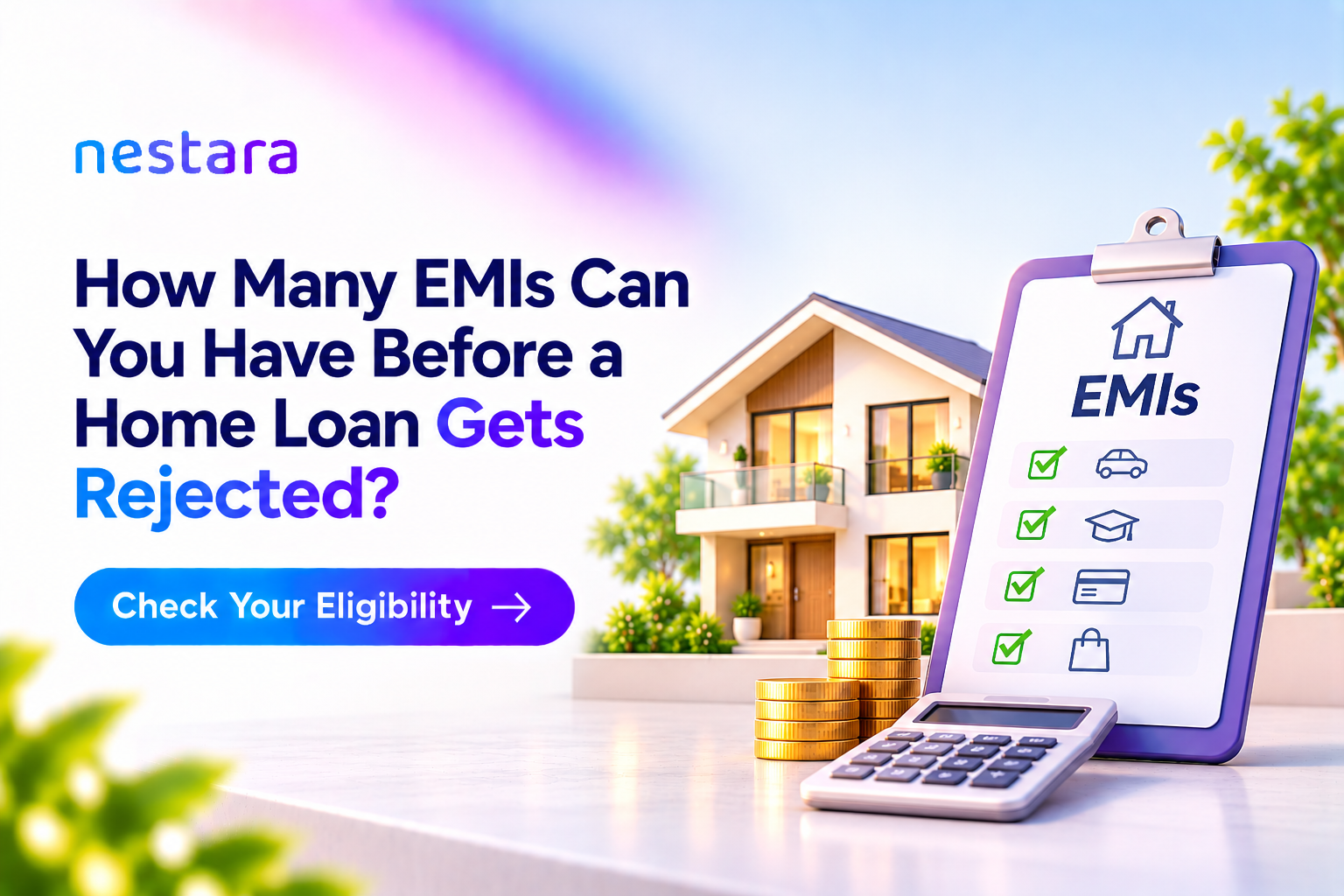
How Many EMIs Can You Have Before a Home Loan Gets Rejected?
There is no fixed number of existing EMIs that automatically gets a home loan application rejected in India. Lenders look at the total monthly repayment burden compared with your income, along with your credit history, employment stability and other eligibility factors. Having three or four existing EMIs does not automatically disqualify you, but the amount you pay towards them can affect how much you can borrow.
If you’re planning to apply for a home loan, understanding how your existing loans affect eligibility can help you prepare before submitting an application. Our New Home Loan eligibility checker can help you estimate your borrowing capacity based on your financial details.

How Many Existing EMIs Are Too Many for a Home Loan?
The number of existing EMIs matters less than their combined monthly value. A borrower with four small EMIs may have a lower repayment burden than someone with one large personal loan EMI.

For example:
- Applicant A earns ₹1 lakh per month and pays three EMIs totalling ₹15,000.
- Applicant B earns ₹1 lakh per month and pays one EMI of ₹35,000.
Although Applicant A has more active loans, Applicant B has a higher monthly debt commitment. A lender may therefore consider Applicant A to have more room for another repayment, subject to the rest of their financial profile.
Lenders generally assess whether you can manage the proposed home-loan EMI alongside your existing obligations. There is no RBI-prescribed maximum number of active loans or EMIs for every home-loan applicant.
How Do Existing EMIs Affect Home Loan Eligibility?
Existing EMIs reduce the portion of your income available for a new home-loan repayment. Lenders assess this through repayment-capacity measures such as the Fixed Obligation to Income Ratio (FOIR), although their calculation methods differ.
FOIR broadly compares your monthly fixed obligations with your monthly income. Depending on the lender, these obligations may include:
- Personal loan EMIs
- Car and two-wheeler loan EMIs
- Existing home-loan repayments
- Education loan EMIs
- Other recurring credit obligations considered by the lender
Your income is assessed according to the lender’s rules. Salary, documented business income and rental income may be treated differently.
Why does this matter? If a large part of your income is already committed to repayments, the lender may reduce the eligible home-loan amount, offer a different tenure or decline the application if repayment capacity is insufficient.
Which Existing EMIs Do Banks Consider When You Apply for a Home Loan?
Lenders generally consider existing loan repayments and other financial liabilities that affect your ability to repay a new home loan. The exact obligations included depend on the lender’s assessment policy.
These may include:
| Existing financial commitment | Potential impact |
|---|---|
| Personal loan EMI | Reduces available repayment capacity |
| Car or bike loan EMI | Counts towards existing loan obligations |
| Education loan EMI | May reduce eligible home-loan amount |
| Existing home-loan EMI | Considered alongside the proposed EMI |
| Consumer durable loan EMI | May be considered if it creates an ongoing repayment obligation |
| Credit card outstanding | Can affect credit assessment and repayment capacity |
| Buy Now, Pay Later (BNPL) repayments | May be considered depending on the facility and lender’s policy |
An important distinction: a credit card’s total outstanding balance is not necessarily treated like a conventional fixed EMI. Lenders may assess the outstanding amount, minimum payment or repayment history differently.
How Much Home Loan Can You Get If You Already Have EMIs?
Your potential home-loan amount depends on how much additional EMI your income can support after accounting for existing repayments. The following example illustrates how the calculation works.
Suppose you earn ₹80,000 per month and have these existing commitments:
| Particulars | Monthly amount |
|---|---|
| Monthly income | ₹80,000 |
| Personal loan EMI | ₹8,000 |
| Car loan EMI | ₹10,000 |
| Total existing EMIs | ₹18,000 |
If a lender considers a total monthly repayment capacity of ₹40,000 for this illustrative applicant, only ₹22,000 would remain for the proposed home-loan EMI.
This is a simplified example, not a universal FOIR limit or a promise of loan eligibility. Actual calculations depend on the lender’s income assessment, expenses, liabilities, credit profile, interest rate and tenure.
For a closer look at this calculation, read our guide on how your existing EMI affects a new home-loan application.
How Can You Improve Home Loan Eligibility If You Have Multiple EMIs?
You can improve your potential eligibility by reducing existing monthly obligations, avoiding fresh debt and choosing a home-loan amount that fits your repayment capacity.
Consider these steps before applying:
- Close smaller loans where practical: Paying off a loan can free up the EMI amount, but compare foreclosure costs and preserve emergency savings.
- Avoid taking new loans: A new personal loan, vehicle loan or consumer loan can increase your monthly commitments.
- Reduce your proposed loan amount: A higher down payment can lower the home-loan EMI you need to support.
- Consider an eligible co-applicant: Additional recognised income may strengthen the application, but the co-applicant’s liabilities will also be assessed.
- Check your FOIR: Understand how much of your income is already committed before approaching a lender.
If existing repayments are already affecting your borrowing capacity, our guide on how to improve a high FOIR before reapplying explains the practical steps you can take.
Conclusion
Having multiple EMIs does not automatically disqualify you from getting a home loan. What matters is how much you repay every month compared with your income and whether you can comfortably manage an additional EMI.
Before applying, review your existing loans, calculate your monthly repayment burden and avoid taking on unnecessary debt. Use our New Home Loan eligibility checker to estimate how your current EMIs affect your borrowing capacity and explore suitable lender options before you apply.
FAQs
1. Can I get a home loan with three or four existing EMIs?
Yes. There is no fixed number of existing EMIs that automatically leads to rejection. Your income, total monthly obligations, credit profile and the proposed home-loan EMI determine whether you meet the lender’s criteria.
2. Does having multiple personal loans affect home-loan eligibility?
Yes. Multiple personal-loan EMIs can reduce your repayment capacity. Lenders consider the combined monthly obligation rather than simply counting how many personal loans you have.
3. Will closing one existing loan improve my home-loan eligibility?
It can. If the lender removes that EMI from its repayment calculation, your available monthly repayment capacity may increase. However, consider foreclosure costs and your remaining savings before closing the loan.
4. Do credit card EMIs count when applying for a home loan?
Existing credit card EMIs and outstanding balances may affect your financial assessment. The lender’s treatment of credit card dues can differ from its treatment of conventional loan EMIs.
5. Can I get a home loan if my existing EMIs are more than half my income?
Possibly, but it may be difficult depending on the lender’s repayment-capacity assessment. There is no universal percentage that guarantees approval or rejection. Your income, expenses, liabilities and proposed loan amount all matter.
6. Does a higher salary compensate for multiple existing EMIs?
A higher, stable and verifiable income can improve repayment capacity, even when you have multiple existing loans. However, lenders also consider your total obligations, credit history and other eligibility factors.
7. Should I stop paying existing loans before applying for a home loan?
No. Never miss existing EMI payments to improve your home-loan eligibility. Missed payments can damage your credit history and make approval more difficult. Continue paying on time while reviewing whether you can reduce your outstanding debt.