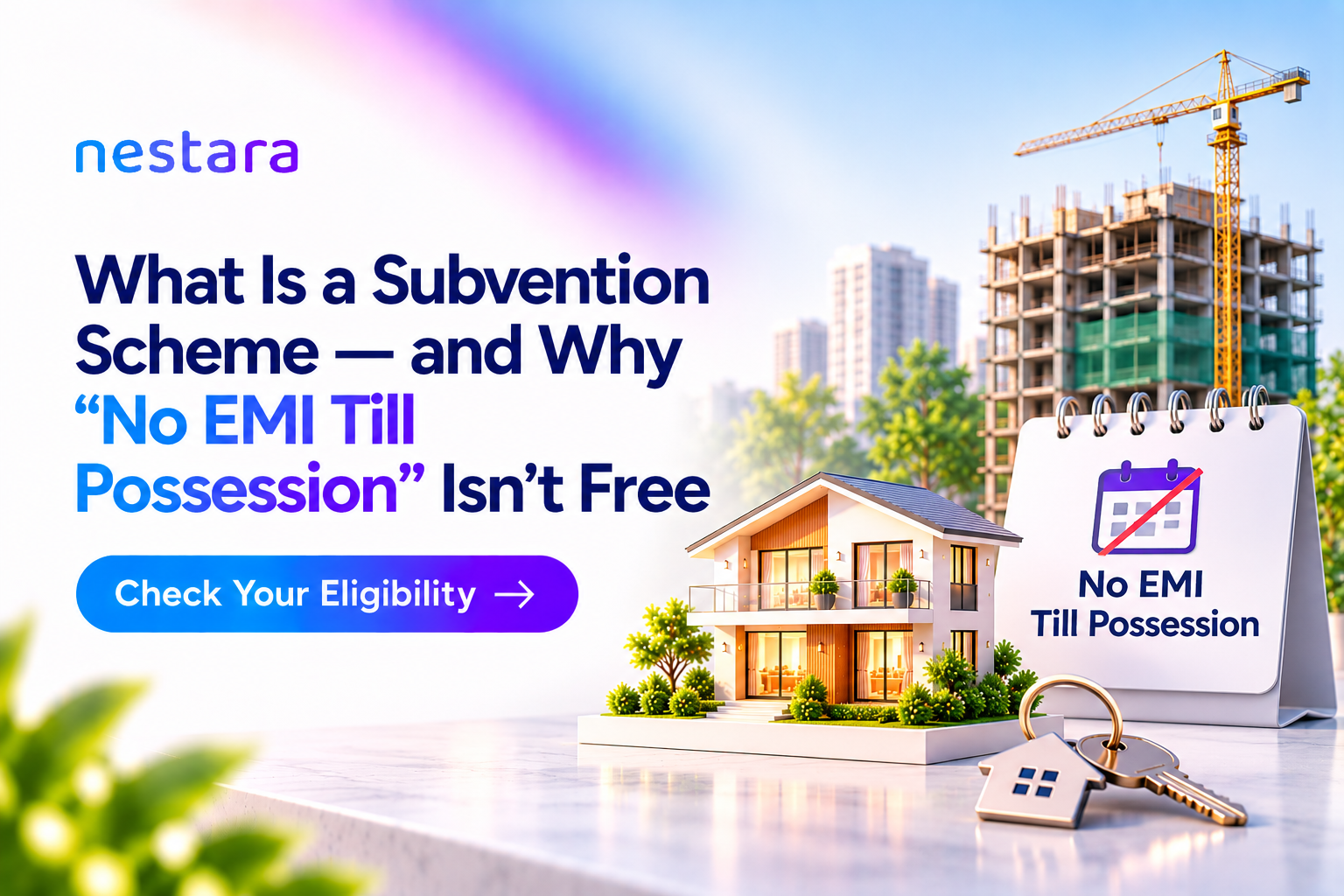
What Is a Subvention Scheme — and Why “No EMI Till Possession” Isn’t Free
A subvention scheme in a home loan is an arrangement in which a builder agrees to pay the buyer’s loan interest or EMIs for a specified period, usually until the property reaches an agreed construction stage or possession. However, “No EMI Till Possession” does not mean the loan is free: interest continues to accrue, and the buyer may still face financial risks if the builder delays payments or construction.
If you’re considering an under-construction property, it is important to understand who is actually paying the interest, what happens if possession is delayed, and whether the arrangement is financially safe. Before committing, review your New Home Loan options and assess the full repayment obligation—not just the initial EMI offer.
How does a subvention scheme work?
A subvention scheme involves three parties: the homebuyer, the lender and the property developer. The lender sanctions a home loan, the buyer becomes the borrower, and the builder agrees to pay the interest or EMI for a defined period under the scheme.
Here is how the arrangement typically works:
- You book an under-construction property. The builder offers a payment plan that includes a subvention benefit, often advertised as “No EMI Till Possession”.
- You apply for a home loan. The lender assesses your income, credit profile, repayment capacity and property documents.
- The lender disburses the loan. Depending on the arrangement and lender policy, the loan may be released in stages as construction progresses.
- The builder pays the agreed interest or EMI. These payments are meant to cover your repayment obligation during the specified period.
- You begin regular repayments. Once the agreed subvention period ends, you may have to start paying the EMI yourself, even if possession has not been delivered, depending on the contract.
The exact arrangement depends on the loan agreement, builder-buyer agreement and any tripartite agreement signed by the parties. Do not assume that every scheme follows the same payment or disbursement structure.
Why “No EMI Till Possession” does not mean interest-free
A home loan does not stop accumulating interest simply because you are not making monthly payments yourself. Interest is generally calculated on the amount disbursed by the lender and the applicable rate.
For example, suppose your lender has disbursed ₹50 lakh at an illustrative annual interest rate of 9%. If the entire amount remains outstanding for a month, the approximate interest for that month is:
| Calculation | Amount |
|---|---|
| Loan outstanding | ₹50,00,000 |
| Annual interest rate | 9% |
| Approximate monthly interest | ₹37,500 |
This is an illustration, not a lender quotation. Actual interest depends on the disbursement dates, outstanding balance, rate and calculation method.
Under a subvention arrangement, the builder may pay this interest on your behalf for the agreed period. But the interest is still a cost of borrowing. The scheme changes who is expected to make the payment during that period; it does not make the loan interest-free.
Also, check whether the builder is paying only the interest or the full EMI. These are different arrangements:
- Pre-EMI: You pay interest only on the amount disbursed so far. The principal generally remains outstanding.
- Full EMI: Your payment includes both principal and interest, so the outstanding principal reduces over time.
- Builder-paid interest or EMI: The builder agrees to make the specified payments during the agreed period. Your liability under the loan contract does not automatically disappear.
To understand how interest-only payments differ from regular principal-and-interest repayments, read our guide to Pre-EMI vs Full EMI during an under-construction property.
What are the risks of a subvention scheme?
A subvention scheme can reduce your immediate cash outflow, but it can expose you to financial and credit risks if the builder does not fulfil the payment commitment.
The Reserve Bank of India has specifically highlighted risks associated with housing loan schemes in which builders service interest or EMIs for borrowers. These include delayed payments by developers, project non-completion and the possibility of borrowers’ credit scores being affected when loan repayments are reported late.
Here are the main risks to consider:
1. The builder may miss interest payments
If the builder delays or stops paying the lender, your loan account may become overdue. Even if the builder promised to pay, you should not assume the lender will automatically hold you harmless.
A missed repayment can affect your credit history. Ask the lender, in writing, what happens if the builder fails to pay on time.
2. Possession may be delayed
The scheme may promise payments only until a specified date or event. If construction takes longer than expected, the builder’s payment obligation may end before you receive possession.
You could then have to pay the EMI while still paying rent or managing other household expenses.
3. The loan may be disbursed faster than construction progresses
A key concern is whether the lender releases money in line with actual construction progress. If a large amount is disbursed upfront, interest can accumulate on a higher outstanding balance even when the project is far from completion.
4. The property price may not reflect the full cost
A subvention offer should be assessed alongside the property’s total price, payment schedule and other charges. Do not assume the scheme is a financial saving simply because you do not pay EMIs immediately. Compare the complete cost with similar properties that do not offer subvention.
Construction delays can affect both your possession timeline and your home-loan repayment commitments. Before committing to an under-construction property, understand the differences in under-construction vs ready-to-move properties.
What does RBI say about subvention schemes?
The RBI has cautioned banks about housing loan arrangements in which builders service borrowers’ interest or EMIs, particularly where loans are disbursed upfront without being linked to construction progress.
The RBI’s Master Circular on Housing Finance dated 1 April 2025 consolidates instructions up to 31 March 2025. It reiterates that housing loan disbursements should be closely linked to construction stages and that upfront disbursal should not be made for incomplete or under-construction projects, subject to the circular’s stated scope and exceptions.
This is important: a builder’s promise to pay interest does not remove the need to examine how the lender disburses the loan or how your repayment obligations are documented.
What should you check before accepting a subvention offer?
Before signing a subvention agreement, examine the loan documents and builder’s commitments separately. A verbal assurance or promotional advertisement is not enough to protect you if payments are missed or possession is delayed.
Use this checklist:
- Who is responsible for payment? Confirm whether the builder is paying interest, pre-EMI or the full EMI.
- How long does the benefit last? Check whether it ends on a fixed date, a construction milestone or possession. Look for what happens if possession is delayed.
- How will the loan be disbursed? Ask whether the lender will release funds in stages linked to construction progress.
- What happens if the builder defaults? Get written clarity from the lender about who must pay overdue amounts and whether you could face penalties or credit-reporting consequences.
- Is the project RERA-registered? Verify the project’s registration and promised completion date with the relevant state RERA authority.
- What is the total property cost? Compare the price, payment schedule and other charges with similar properties that do not offer subvention.
- What happens after possession? Confirm when your regular EMI begins, the outstanding principal, interest rate and remaining tenure.
You should also read the tripartite agreement carefully. It should clearly describe the builder’s payment commitment, the period covered, consequences of default and your obligations as the borrower.
What protection does RERA provide if possession is delayed?
The Real Estate (Regulation and Development) Act, 2016 provides remedies when a promoter fails to complete or deliver a property by the date specified in the agreement for sale. Under Section 18, an allottee who chooses to withdraw may seek a refund with prescribed interest and compensation; an allottee who stays in the project may be entitled to interest for every month of delay until possession. The applicable state rules and circumstances matter.
However, RERA remedies do not automatically settle your home loan obligations with the lender. Your loan agreement and builder’s subvention commitment are separate matters. Do not rely on a possible future RERA claim as a substitute for checking how you would manage repayments if the builder stops paying.
Is a subvention scheme better than a regular under-construction home loan?
A subvention scheme may help with cash flow during construction, but a regular construction-linked home loan can offer greater clarity about disbursement and repayment responsibilities.
| Factor | Subvention scheme | Regular construction-linked loan |
|---|---|---|
| Interest during construction | Builder agrees to pay for an agreed period | Borrower generally pays applicable pre-EMI or EMI |
| Loan disbursement | Depends on the scheme and lender; check for upfront disbursement | Generally linked to construction stages |
| Main payment risk | Builder may delay or stop payments | Borrower must plan for repayments |
| Possession delay | The subvention benefit may expire before possession | Repayment continues according to the loan terms |
| Best consideration | Whether the builder’s commitment is reliable and documented | Whether you can comfortably manage payments during construction |
Neither option is automatically better for every buyer. Your decision should depend on the project’s credibility, the loan structure, your savings and your ability to manage repayments if the arrangement does not go as planned.
Conclusion
A subvention scheme can reduce your immediate repayment burden, but “No EMI Till Possession” should never be treated as a free home loan. Interest still accrues, the builder’s payment commitment has limits, and you remain responsible for understanding your obligations to the lender.
Before booking, compare the property’s total cost, verify the project’s RERA details, read every agreement and understand what happens if the builder delays payments or possession. With Nestara, you can explore your New Home Loan options and make a more informed borrowing decision before committing to a property.
FAQs
1. Is a subvention scheme legal in India?
Subvention arrangements are not automatically illegal. However, RBI has cautioned banks about risks associated with certain builder-linked housing loan structures, particularly upfront disbursement and builder-paid EMIs. The specific arrangement, lender’s compliance and applicable regulations matter.
2. Who pays the home loan EMI under a subvention scheme?
The builder agrees to pay the interest or EMI for a specified period, as set out in the agreement. However, the borrower remains responsible for understanding and meeting obligations under the home loan contract.
3. What happens if the builder stops paying the EMI?
If the builder fails to make the agreed payments, your loan account may become overdue. This can lead to penalties and potentially affect your credit history. Contact your lender immediately and do not assume the builder’s commitment removes your responsibility.
4. Does “No EMI Till Possession” mean I pay no interest?
No. Interest continues to accrue on the loan amount disbursed. The builder may agree to pay it during the specified period, but the interest cost does not disappear.
5. Can I get a subvention scheme for a ready-to-move property?
Subvention schemes are generally marketed for under-construction properties because the builder’s payment commitment covers a construction period. They are not typically relevant to ready-to-move homes, where the loan is usually disbursed according to the purchase transaction and lender’s terms.
6. Should I choose a subvention scheme or a regular home loan?
Choose based on the total property cost, construction progress, lender’s disbursement terms, builder’s financial credibility and your ability to manage repayments. A regular construction-linked loan may be more predictable if you can afford the pre-EMI or EMI during construction.