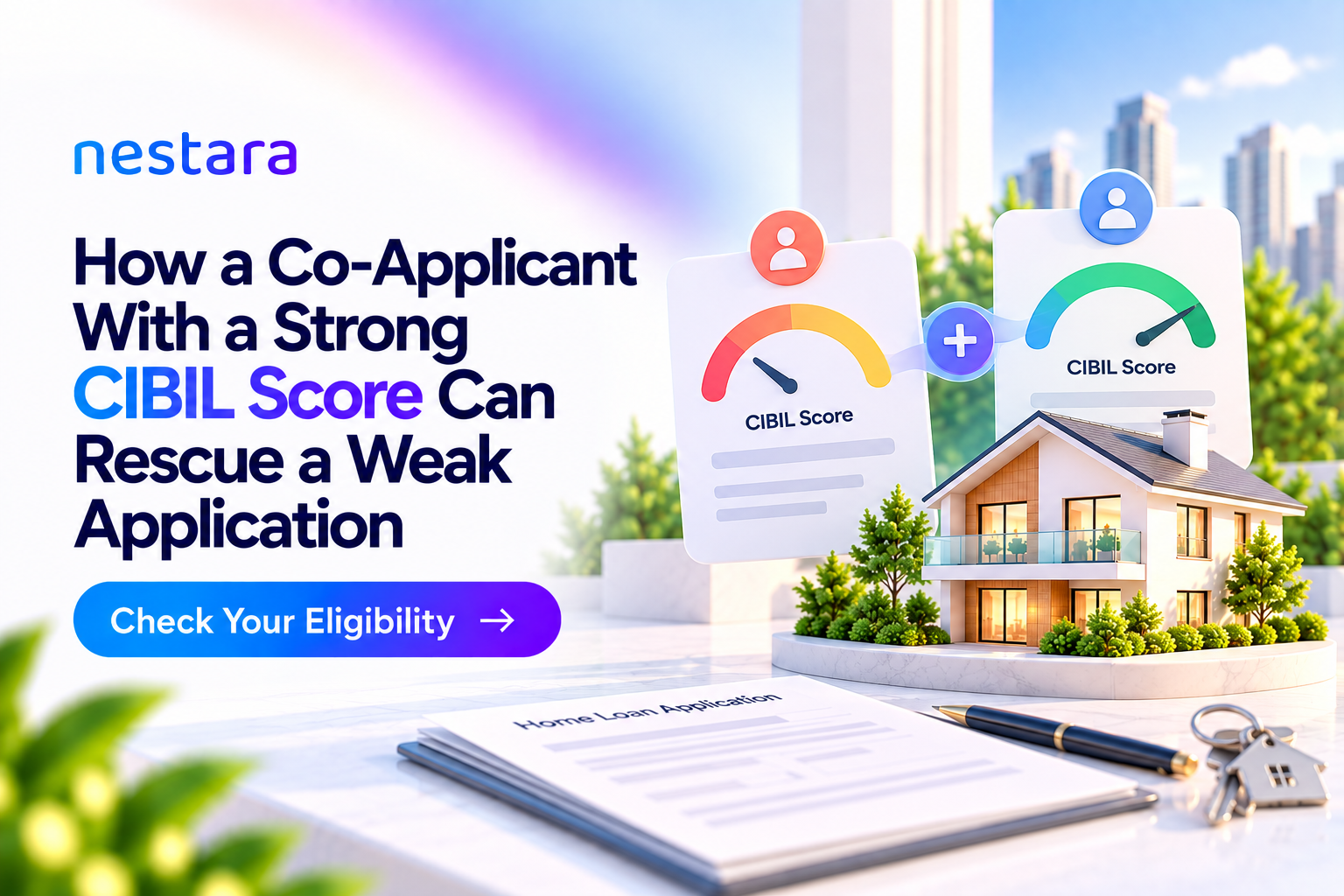
How a Co-Applicant With a Strong CIBIL Score Can Rescue a Weak Application
A co-applicant with a strong CIBIL Score can strengthen a weak home loan application, particularly when the co-applicant also has stable, eligible income.
However, a strong credit score does not automatically cancel out the primary applicant’s weaknesses because lenders assess the combined application, including income, existing obligations, credit history and other eligibility factors.
Can a Strong-CIBIL Co-Applicant Improve a Weak Home Loan Application?
Yes, a financially strong co-applicant can improve the overall profile of a joint home loan, but the impact depends on why the original application was weak. A co-applicant may help when the main issue is insufficient income or limited borrowing capacity, while serious repayment defaults or unresolved credit problems may still affect the application.
CIBIL Scores range from 300 to 900, with a higher score generally indicating a stronger credit profile. However, lenders do not approve home loans based on the score alone.
A lender may consider factors such as:
- Credit history and repayment behaviour
- Existing loans and monthly obligations
- Income and employment or business stability
- Loan amount requested
- Property-related factors
- The co-applicant’s income and liabilities
- The lender’s own eligibility and underwriting policies
When Can a Strong Co-Applicant Actually Help?
A strong co-applicant is most useful when they add genuine repayment capacity or a stronger credit profile to the application.
| Weakness in original application | Can a strong co-applicant help? |
|---|---|
| Insufficient combined income | Potentially yes |
| Shorter income history | Potentially, depending on lender policy |
| Limited borrowing capacity | Potentially yes |
| Main applicant has a lower CIBIL Score | May strengthen the overall profile, but does not erase it |
| Recent missed payments/defaults | Not necessarily |
| Excessive existing EMIs | Depends on both applicants’ obligations |
| Property/documentation problem | Usually no |
| Unacceptable property | No; the property issue still needs to be resolved |
The key distinction is that a co-applicant adds financial strength; they do not erase an existing problem.
How Does the Co-Applicant’s CIBIL Score Affect the Application?
The co-applicant’s credit profile can influence the lender’s assessment because the co-applicant becomes part of the borrowing arrangement. A strong score may support the application, but lenders can still review both applicants’ credit histories.
For example, suppose one applicant has a weaker credit profile but stable income, while the proposed co-applicant has a stronger repayment history and stable income. The second applicant may strengthen the overall case.
But if the primary applicant has serious recent defaults, simply adding someone with a high score does not guarantee approval. The lender may continue to assess the weaker applicant’s repayment history.
This is why you should understand why the application is weak before adding a co-applicant.
Can a Co-Applicant Increase Home Loan Eligibility?
A co-applicant can potentially increase home loan eligibility when the lender accepts the co-applicant’s income for repayment-capacity assessment. The exact increase depends on the lender’s policy and the co-applicant’s income, existing obligations and credit profile.
Consider a simplified illustration:
- Applicant A’s eligible income: ₹60,000 per month
- Co-applicant’s eligible income: ₹40,000 per month
- Combined eligible income: ₹1,00,000 per month
If the lender considers both incomes, the household may have greater repayment capacity than Applicant A would have alone.
However, this does not mean the eligible loan automatically increases in the same proportion as income. Existing EMIs, interest rate, tenure, age, lender policy and other factors also affect the final amount.
Who Can Be a Co-Applicant for a Home Loan?
Eligible co-applicants depend on the lender’s rules and the relationship between the borrowers. Spouses and close family members are commonly accepted in joint home loan arrangements, but lenders can impose their own conditions.
Before adding someone, check:
- Whether the lender permits that relationship
- Whether the co-applicant’s income will be considered
- Whether the co-applicant must also be a co-owner
- Whether both applicants must meet specific documentation requirements
- How the co-applicant’s existing EMIs affect the application
Do not add someone solely because their CIBIL Score is high. Their income, liabilities and legal role in the loan also matter.
What Happens If the Co-Applicant Has a High Score but Existing EMIs?
A high CIBIL Score does not automatically make someone an ideal co-applicant if they already have substantial financial obligations. A lender may consider the co-applicant’s existing liabilities when assessing repayment capacity.
For example, someone with an excellent credit score but several existing EMIs may contribute less additional borrowing capacity than expected.
Before adding a co-applicant, therefore, look at both credit strength and repayment capacity.
Can a Co-Applicant Fix a Low CIBIL Score?
A co-applicant cannot directly repair another applicant’s CIBIL Score. The original applicant’s credit history remains part of their own credit report.
If your score is weak because of missed payments, high credit utilisation or incorrect information, address the underlying issue separately. CIBIL identifies payment history, credit utilisation, age of credit and enquiries among important factors in its scoring framework.
Before applying jointly, review both applicants’ credit reports and check for errors or unresolved accounts.
When Should You Add a Co-Applicant?
You should consider a co-applicant when their financial profile genuinely improves the application’s repayment capacity or strengthens the overall borrowing profile.
A practical approach is:
- Identify the original weakness. Was it income, FOIR, credit history or the requested loan amount?
- Review both credit reports. Check scores, repayment history, outstanding balances and recent enquiries.
- Compare existing obligations. A co-applicant’s EMIs can affect the benefit they bring.
- Check lender eligibility. Confirm that the relationship and income qualify under the lender’s policy.
- Recalculate affordability. Do not assume that adding another income automatically makes the desired loan affordable.
- Apply only when the combined profile makes sense.
If the original application was rejected because of a property issue, changing the applicant structure will usually not solve the underlying problem.
Check Your Combined Eligibility Before Applying
Checking your estimated borrowing capacity before submitting another application can help you decide whether a co-applicant genuinely improves your position.
With our New Home Loan eligibility checker, you can enter income, existing EMIs, expected interest rate, tenure and co-applicant details to estimate your borrowing capacity. The result is an estimate rather than a guaranteed sanction because each lender applies its own eligibility and underwriting criteria.
If the main issue is the EMI you can comfortably afford, you can also explore our guide on how to reduce your home loan EMI without extending the tenure before deciding whether a co-applicant is necessary.
Conclusion
A co-applicant with a strong CIBIL Score can rescue a weak home loan application when they genuinely strengthen the combined financial profile. Their stable income and healthy credit history may improve repayment capacity, but they cannot automatically erase the primary applicant’s defaults, excessive debt or other unresolved weaknesses.
Before applying jointly, compare both applicants’ credit profiles, incomes and existing EMIs and identify the specific reason the original application was weak. Then use our New Home Loan eligibility checker to estimate whether the combined profile supports the loan you actually need.
FAQs
Can a co-applicant with an 800 CIBIL Score guarantee home loan approval?
No. A high CIBIL Score can strengthen the application, but approval also depends on income, existing obligations, property, documentation, loan amount and the lender’s underwriting criteria.
Does the primary applicant’s low CIBIL Score still matter?
Yes. Adding a strong co-applicant does not remove the primary applicant’s credit history from the lender’s assessment. The lender may evaluate both applicants.
Is a strong CIBIL Score enough to increase home loan eligibility?
No. A strong score helps establish creditworthiness, but income, existing EMIs, loan amount, tenure and other lender-specific factors also affect eligibility.
Can adding a co-applicant reduce the home loan interest rate?
It can potentially help the overall application profile, but a co-applicant does not automatically guarantee a lower interest rate. The final rate depends on the lender’s pricing and assessment of the borrowers.
What if the co-applicant has a high CIBIL Score but a lot of existing debt?
The benefit may be limited because the lender can consider the co-applicant’s existing obligations. A strong score and high repayment burden are two different aspects of the application.
Can my spouse’s CIBIL Score help my home loan application?
A spouse can potentially strengthen a joint home loan application if the lender accepts the spouse as a co-applicant and considers their income and credit profile. The exact rules vary by lender.
Should I add a co-applicant after my home loan is rejected?
You can consider it if the co-applicant genuinely addresses the reason for rejection. First identify the original problem and check whether the co-applicant improves the relevant part of your application.