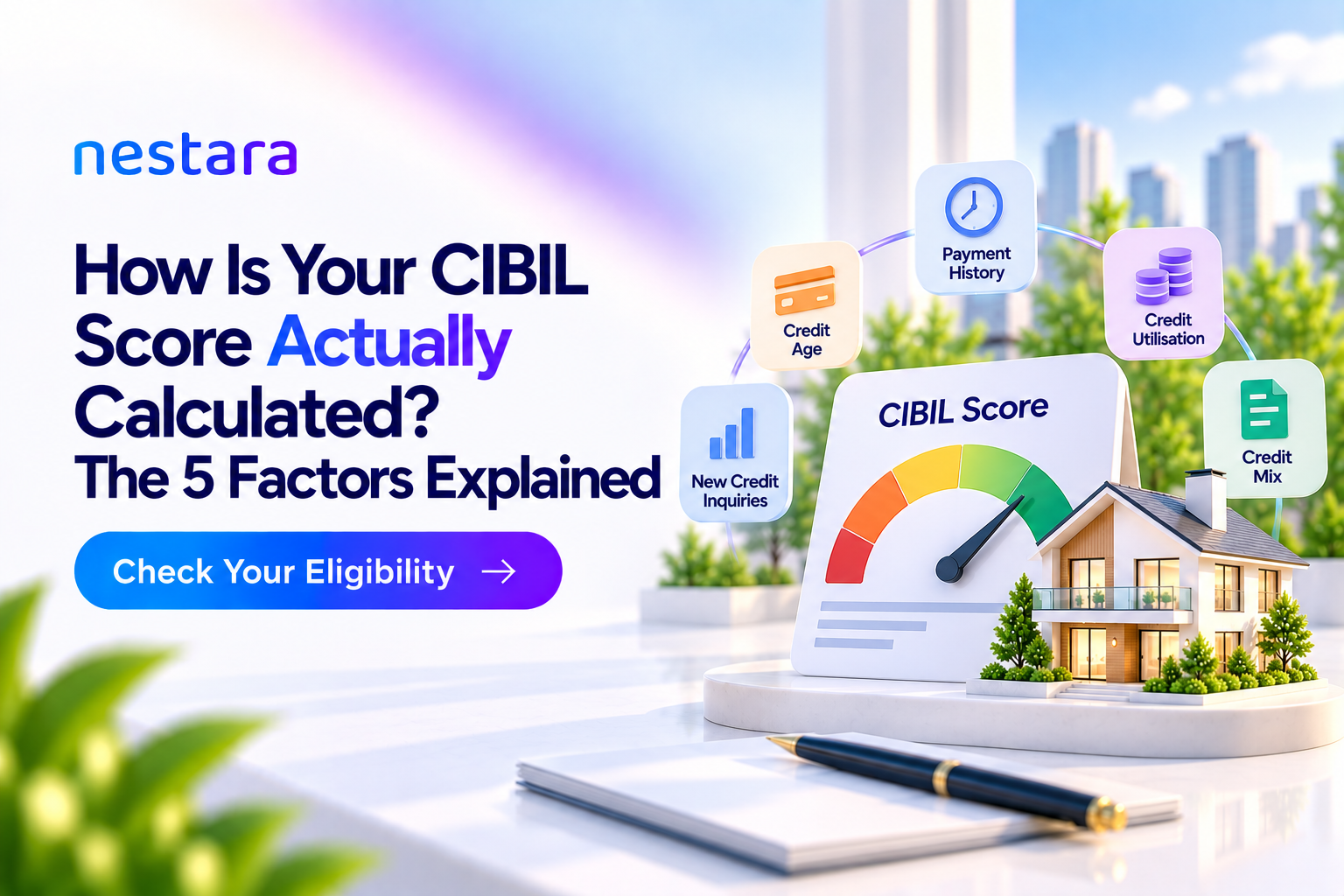
How Is Your CIBIL Score Actually Calculated? The 5 Factors Explained
Your CIBIL Score is calculated using information in your credit report, but there is no publicly disclosed formula that assigns a fixed percentage to each factor. TransUnion CIBIL uses a proprietary scoring model that considers your credit behaviour, including payment history, credit utilisation, age of credit, enquiries and credit mix.
Understanding these factors can help you identify what may be hurting your score before you apply for a home loan. You can start by checking your latest credit profile through our Free Credit Score Check.
What Is a CIBIL Score?
A CIBIL Score is a three-digit summary of your credit history, ranging from 300 to 900. It is calculated from information in the Accounts and Enquiries sections of your CIBIL Credit Information Report, which includes details such as your credit accounts, payment behaviour, outstanding amounts and lender enquiries.
A higher score generally indicates a stronger credit history and can improve your chances of getting credit, although lenders make their own lending decisions.
Importantly, CIBIL does not publish a simple formula such as “payment history = X%, utilisation = Y%.” RBI also states that credit information companies use proprietary scoring models and that it has not prescribed a specific methodology for calculating credit scores.
So, when people talk about the “factors that calculate your CIBIL Score,” they are referring to the credit behaviours and information that influence the score—not five publicly fixed mathematical weights.
What Are the 5 Main Factors That Influence Your CIBIL Score?
The five practical factors to understand are payment history, credit utilisation, age of credit, credit enquiries and credit mix. CIBIL’s current consumer material specifically highlights payment history, utilisation, age of credit and enquiries, while CIBIL also identifies credit mix as an important element influencing the score.
| Factor | What it tells lenders | What can help |
|---|---|---|
| Payment history | Whether you repay on time | Consistent, timely payments |
| Credit utilisation | How much revolving credit you are using | Keep balances manageable |
| Age of credit | How long you have managed credit | Maintain a stable credit history |
| Credit enquiries | How often you seek new credit | Avoid unnecessary applications |
| Credit mix | Your experience with different credit types | Maintain a healthy mix where appropriate |
1. Payment History
Payment history is one of the most important indicators of how you have managed credit. Late payments, missed EMIs and defaults can negatively affect your CIBIL Score.
Your report can reflect your repayment behaviour across loans and credit cards. The impact of a missed payment is not determined simply by whether it happened once; CIBIL also notes that factors such as the magnitude of overdue amounts and the broader repayment pattern can matter.
For example, consistently paying a ₹25,000 home-loan EMI on time builds a very different repayment record from repeatedly paying after the due date.
What to do: Set up reminders or automatic payments and avoid carrying overdue amounts.
2. Credit Utilisation
Credit utilisation measures how much of your available revolving credit you are using, particularly on credit cards. Higher utilisation can signal that you are relying heavily on available credit and may negatively affect your score.
For example, if your total credit-card limit is ₹2 lakh and your outstanding balance is ₹1.5 lakh, you are using 75% of the available limit.
There is no CIBIL-published universal percentage at which your score automatically falls, so avoid treating a particular utilisation threshold as a guaranteed rule.
What to do: Keep credit-card balances manageable and avoid routinely using most of your available limit.
3. Age of Credit
The length of your credit history can influence your CIBIL Score. CIBIL refers to this as the depth or age of your credit history—the duration for which you have held credit accounts.
A longer history gives the scoring model more information about how you have handled credit over time.
That does not mean you should keep an unnecessary loan simply to make your credit history older. It means that responsible, established credit behaviour can contribute positively to your overall profile.
What to do: Manage existing credit responsibly rather than opening and closing accounts without a clear reason.
4. Credit Enquiries
A hard credit enquiry occurs when a lender accesses your credit report while evaluating a credit application, and repeated enquiries over a short period can negatively affect your score. CIBIL notes that applying for credit too frequently in a short period may have a negative impact.
For example, applying separately to several lenders without first comparing your options can create multiple recorded enquiries.
This is different from checking your own credit score. Accessing your own CIBIL Score does not work like a lender enquiry.
What to do: Check your credit profile first, compare suitable options and avoid unnecessary loan or credit-card applications.
5. Credit Mix
Credit mix refers to the types of credit in your credit history, including secured and unsecured credit. CIBIL identifies a healthy mix of secured and unsecured credit as one factor that can contribute to a stronger credit profile.
Secured credit includes products such as home and auto loans, while unsecured credit includes products such as personal loans and credit cards.
However, you should not take a new loan simply to create a particular credit mix. The purpose is to understand how your existing credit portfolio is viewed, not to borrow unnecessarily.
Does CIBIL Give Each Factor a Fixed Weight?
No, CIBIL does not publicly disclose a fixed percentage weight for each factor. Its scoring algorithm is proprietary, and the score can be influenced by the absolute values and qualitative characteristics of information in your credit report.
This is why statements such as “payment history always contributes exactly 35%” should not be treated as an official CIBIL formula.
Your score is the result of the scoring model assessing your overall credit information.
How Can You Check What Is Hurting Your CIBIL Score?
Checking your complete credit report is more useful than looking at the score alone. Your report can help you identify repayment issues, high outstanding balances, unfamiliar accounts or enquiries that you do not recognise.
Before applying for a home loan, check:
- Whether all loan and card accounts belong to you
- Whether payment information is reported correctly
- Whether outstanding balances appear accurate
- Whether any account is incorrectly marked overdue
- Whether you recognise all recent credit enquiries
CIBIL currently provides consumers with one free CIBIL Score and Report per calendar year.
You can also use our Free Credit Score Check to understand your credit position before evaluating your home-loan options.
How Can You Improve Your CIBIL Score Before a Home Loan?
The most reliable way to improve your credit profile is consistent, responsible credit behaviour over time. There is no guaranteed overnight method for moving your score to a particular number.
Focus on these actions:
- Pay every EMI and credit-card bill on time.
- Keep revolving credit balances under control.
- Avoid unnecessary new credit applications.
- Review your credit report for inaccuracies.
- Maintain existing credit responsibly instead of borrowing simply to improve your score.
If you are preparing for a home loan, it is better to review your credit profile before submitting applications rather than discovering a reporting error after a lender has already assessed your application.
Does Your CIBIL Score Affect Your Home Loan Interest Rate?
Your CIBIL Score can influence the interest rate and terms a lender offers, but it is not the only factor. Lenders can also assess income, existing obligations, employment or profession, loan amount, tenure, property and their own credit and pricing policies.
That means two borrowers with similar CIBIL Scores can still receive different home-loan offers.
If your score is strong, don’t stop at the score itself. Compare the actual rates, fees, tenure and repayment terms available to you.
You can also read our guide on how your credit score affects the home loan interest rate you are offered to understand the connection between your credit profile and borrowing cost.
Conclusion
Your CIBIL Score is not calculated using a simple five-number formula that is publicly available. Instead, a proprietary scoring model evaluates information in your credit report, with payment history, credit utilisation, age of credit, credit enquiries and credit mix being important factors to understand.
If your score is lower than expected, don’t focus only on the number. Check your report, identify the underlying issue and work on consistent repayment and responsible credit behaviour.
Start with our Free Credit Score Check to understand where you stand before applying for a home loan. Once you know your credit position, you can use Nestara to evaluate your borrowing options with greater confidence.
FAQs
How is a CIBIL Score calculated?
A CIBIL Score is calculated using a proprietary scoring model based on information in your credit report. Key factors include payment history, credit utilisation, age of credit, credit enquiries and credit mix. CIBIL does not publish fixed percentage weights for these factors.
What is the most important factor in a CIBIL Score?
Payment history is a major factor because it shows how consistently you have repaid your credit obligations. However, your CIBIL Score reflects your overall credit information rather than one factor alone.
What is the CIBIL Score range?
A CIBIL Score ranges from 300 to 900. A higher score generally indicates a stronger credit history, although lenders use their own eligibility and risk-assessment criteria.
Does checking my own CIBIL Score reduce my score?
No. Checking your own credit score is different from a lender accessing your report during a credit application. CIBIL’s enquiry information relates to lender requests for your credit history.
Does closing a credit card improve your CIBIL Score?
Not necessarily. Closing an account can change the information in your credit profile, including your available credit and credit history. Whether it helps or hurts depends on your overall credit situation, so don’t close a credit card solely because you believe it will automatically increase your score.
How often can I get a free CIBIL Score?
CIBIL currently provides one free CIBIL Score and Report once per calendar year.