What Is PMAY (Pradhan Mantri Awas Yojana) and Are You Eligible?
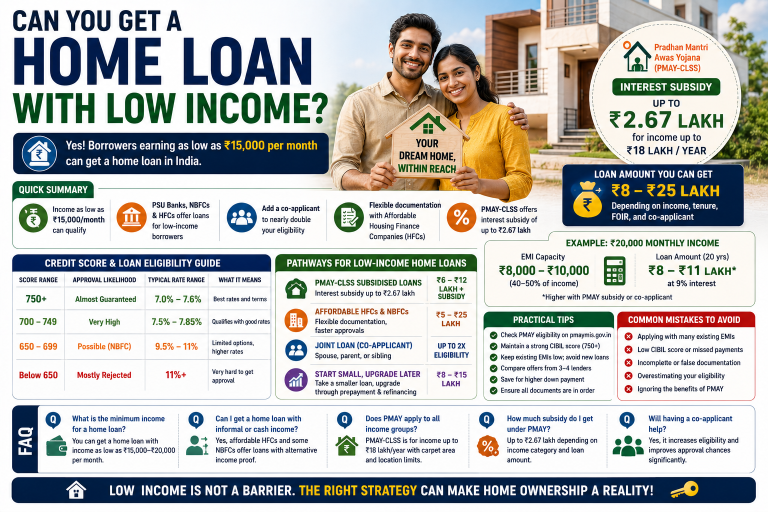
PMAY eligibility for a home loan subsidy depends on your household income, property value, loan amount, house ownership and other scheme conditions. Under the current PMAY-U 2.0 Interest Subsidy Scheme (ISS), eligible households with annual income up to ₹9 lakh can receive an interest subsidy on qualifying home loans, subject to the applicable limits.
If you are planning to buy or construct a home with a new home loan, understanding these conditions can help you determine whether PMAY benefits may apply to you before you apply.
What is PMAY and how does the home loan subsidy work?
PMAY, or Pradhan Mantri Awas Yojana, is a government housing mission aimed at expanding access to affordable housing. For eligible urban households, PMAY-U 2.0 includes an Interest Subsidy Scheme that can reduce the effective cost of a qualifying home loan.
Under the current PMAY-U 2.0 Interest Subsidy Scheme:
- Annual household income can be up to ₹9 lakh.
- The maximum eligible home loan is ₹25 lakh.
- The maximum property value is ₹35 lakh.
- The maximum carpet area is 120 sq. m.
- A 4% interest subsidy applies to the first ₹8 lakh of the qualifying loan for up to 12 years.
- The maximum actual interest subsidy is ₹1.80 lakh, subject to the scheme’s calculation.
- The subsidy is released in five equal yearly instalments, subject to applicable conditions.
The subsidy is not simply a cash payment handed to the borrower. It is linked to the qualifying housing loan and reduces the effective cost of borrowing.
Who is eligible for PMAY home loan subsidy?
You may be eligible for the PMAY-U 2.0 Interest Subsidy Scheme if your household meets the scheme’s income, ownership, property and loan requirements.
PMAY-U 2.0 classifies households by annual income as follows:
| Category | Annual household income |
|---|---|
| EWS | Up to ₹3 lakh |
| LIG | Above ₹3 lakh to ₹6 lakh |
| MIG | Above ₹6 lakh to ₹9 lakh |
For the Interest Subsidy Scheme, households earning up to ₹9 lakh annually can potentially qualify. However, income alone does not establish eligibility. The other conditions must also be satisfied.
What are the main PMAY eligibility criteria?
The main PMAY-U 2.0 eligibility criteria cover household income, existing house ownership, property characteristics and previous government housing benefits.
1. Your household income must be within the limit
Your annual household income must be up to ₹9 lakh for the Interest Subsidy Scheme. The scheme uses household income rather than simply looking at one applicant’s salary.
For example, if one spouse earns ₹5 lakh annually and the other earns ₹3 lakh, the household income would be ₹8 lakh for this purpose, subject to the scheme’s applicable income assessment.
2. You generally must not own a pucca house
A beneficiary family under PMAY-U 2.0 must not own a pucca house anywhere in India. The official guidelines define the beneficiary family around the husband, wife and unmarried children, with specific provisions for adult earning members.
This means simply meeting the income limit does not make an existing homeowner automatically eligible.
3. The property value must be within the limit
For the Interest Subsidy Scheme, the maximum eligible house value is ₹35 lakh. Therefore, a borrower with qualifying income may still fall outside the subsidy if the property exceeds this limit.
4. The home loan must meet the loan limit
The maximum home-loan amount eligible for the current Interest Subsidy Scheme is ₹25 lakh. A larger home loan does not become fully subsidy-eligible simply because the household income falls below ₹9 lakh.
5. The property must meet the carpet-area condition
The maximum carpet area for a house covered under the Interest Subsidy Scheme is 120 square metres.
How much PMAY home loan subsidy can you get?
The maximum actual interest subsidy under the current PMAY-U 2.0 Interest Subsidy Scheme is ₹1.80 lakh, subject to the scheme’s calculation and eligibility conditions. The guidelines specify a maximum net present value of ₹1.50 lakh at the stated discount rate.
The 4% subsidy is calculated on the first ₹8 lakh of the eligible loan for a tenure of up to 12 years. It does not mean that 4% is deducted from the interest on your entire home loan.
For example, if you borrow ₹20 lakh, the scheme does not calculate the subsidy on the entire ₹20 lakh. The subsidy calculation is restricted to the specified first ₹8 lakh and the applicable scheme period.
Is PMAY subsidy available on every home loan?
No, PMAY subsidy is not automatically available on every home loan. Your household, property and loan must satisfy the conditions of the applicable PMAY-U 2.0 component.
It is also important to distinguish the current scheme from the older Credit Linked Subsidy Scheme (CLSS). Older articles may mention subsidy rates, income categories and loan limits that applied to previous PMAY-U provisions and should not be assumed to apply to new applications. The official PMAY-U portal now provides separate PMAY-U 2.0 guidelines.
When researching PMAY eligibility online, always check the date and whether the information relates to PMAY-U 2.0 or an earlier scheme.
Does taking a home loan through Nestara make you eligible for PMAY?
No. Using Nestara does not itself create PMAY eligibility. The subsidy depends on whether you satisfy the government’s applicable PMAY-U 2.0 conditions and the lender’s requirements.
However, checking your new home-loan eligibility first can help you understand whether the loan you are considering is realistic. With Nestara’s New Home Loan journey, you can compare your borrowing options while keeping factors such as income, existing EMIs and loan affordability in view.
You should then separately verify whether your household and property meet the latest PMAY-U 2.0 requirements.
What should you check before applying for a PMAY-linked home loan?
Before applying for a PMAY-linked home loan, verify both your loan eligibility and your PMAY eligibility.
Use this checklist:
- Calculate your annual household income.
- Check whether you or your beneficiary family owns a pucca house.
- Check whether the property value is within ₹35 lakh.
- Check whether the proposed loan is within the ₹25 lakh eligible limit.
- Confirm that the property’s carpet area is within 120 sq. m.
- Check whether you have previously received housing benefits that affect eligibility.
- Confirm the latest PMAY-U 2.0 requirements before submitting your application.
It is also important to compare the home loan itself rather than selecting a lender solely because you expect a subsidy. Interest rate, processing fees, tenure and other loan terms can materially affect your total borrowing cost.
Can PMAY subsidy and home-loan eligibility be checked separately?
Yes. PMAY eligibility and home-loan eligibility are two different assessments. You may meet the government’s PMAY conditions but still need to satisfy the lender’s income, credit, property and repayment-capacity requirements.
For example, a household could fall within the ₹9 lakh PMAY income limit but still not qualify for a ₹25 lakh home loan because of existing EMIs or insufficient repayment capacity.
That is why it helps to check your borrowing capacity first and then assess whether the property and proposed loan fit the PMAY limits.
Conclusion
PMAY can make a meaningful difference to the cost of a qualifying home loan, but PMAY eligibility depends on much more than your income. Under the current PMAY-U 2.0 Interest Subsidy Scheme, eligible households with annual income up to ₹9 lakh may receive an interest subsidy, subject to conditions including a maximum eligible loan of ₹25 lakh, property value of ₹35 lakh and carpet area of 120 sq. m.
If you are planning to buy a home, start by understanding how much you can realistically borrow. Use our New Home Loan to estimate your loan eligibility, then verify your property and household against the latest PMAY-U 2.0 requirements before applying.
FAQs
What is PMAY eligibility for home loan subsidy?
Under the current PMAY-U 2.0 Interest Subsidy Scheme, households with annual income up to ₹9 lakh can potentially qualify, subject to conditions relating to house ownership, loan amount, property value, carpet area and other scheme requirements.
How much subsidy can I get under PMAY-U 2.0?
The maximum actual interest subsidy under the current Interest Subsidy Scheme is ₹1.80 lakh, subject to the applicable calculation and eligibility conditions. The subsidy is calculated on the first ₹8 lakh of the eligible loan at 4% for up to 12 years.
Is PMAY subsidy available on a ₹30 lakh home loan?
A ₹30 lakh home loan exceeds the ₹25 lakh maximum loan amount eligible for the current PMAY-U 2.0 Interest Subsidy Scheme. Therefore, a ₹30 lakh loan would not meet the loan-value limit for this subsidy.
Can I get PMAY subsidy if my house costs ₹40 lakh?
The current Interest Subsidy Scheme has a maximum eligible house value of ₹35 lakh. A ₹40 lakh property would therefore exceed this specific property-value limit.
Does PMAY subsidy apply to the entire home loan?
No. The current scheme applies the 4% subsidy to the first ₹8 lakh of the qualifying home loan for up to 12 years, subject to the scheme’s conditions. It is not a 4% subsidy on the entire loan amount.
Can I get PMAY benefits if I already own a house?
Generally, owning a pucca house can make a beneficiary family ineligible for PMAY-U 2.0. The official guidelines contain specific provisions for certain existing dwellings and beneficiary circumstances, so your exact situation should be checked against the latest rules.
Is PMAY-U 2.0 the same as the old CLSS scheme?
No. PMAY-U 2.0 is the current mission framework, while CLSS was an earlier PMAY-U component with different income categories, subsidy rates and loan limits. Older CLSS information should not be used to determine eligibility for a new PMAY-U 2.0 application.
Does Nestara guarantee PMAY eligibility?
No. Our New Home Loan tools can help you estimate your borrowing capacity, but PMAY benefits depend on the government’s applicable eligibility conditions and the lender’s assessment. Always verify the latest official PMAY-U 2.0 guidelines before applying.