RBI Keeps Repo Rate Unchanged: What It Means for Your EMI
The RBI kept the policy repo rate unchanged at 5.25% in its August 2026 monetary policy meeting, so borrowers with repo-linked floating home loans should not expect an immediate rate-driven EMI reduction from this decision. The bigger takeaway is that your home-loan rate is likely to remain broadly stable for now, although your actual EMI depends on your lender, benchmark, spread and reset terms.
For borrowers already paying a home loan, this is a good time to check whether your current rate is still competitive rather than simply waiting for the next RBI rate cut.
What Did the RBI Decide in August 2026?
The RBI decided to keep the repo rate at 5.25% and retain its neutral monetary-policy stance at its August 3–5, 2026 Monetary Policy Committee meeting. The decision was unanimous. The SDF rate remains 5.00%, while the MSF rate and Bank Rate remain 5.50%.
The RBI also highlighted uncertainty around global developments, weather-related risks and inflation. Its decision therefore signals a wait-and-watch approach rather than an immediate change in borrowing costs.
For homebuyers, the important point is simple: there was no new repo-rate cut for lenders to pass through after this meeting.
How Does the RBI Repo Rate Affect Your Home Loan?
The RBI repo rate affects your home loan most directly when your floating-rate loan is linked to an external benchmark based on the repo rate.
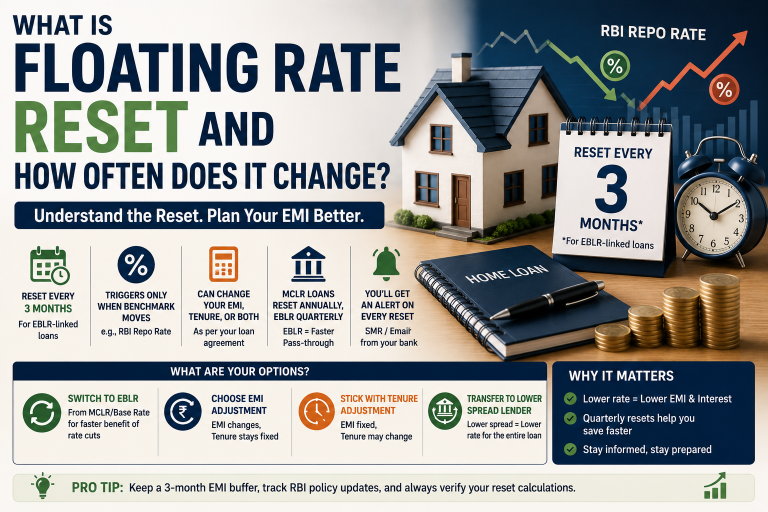
For eligible retail floating-rate loans, banks use external benchmarks rather than their internal MCLR. The RBI permits the policy repo rate as one such external benchmark, and the interest rate on these loans must be reset at least once every three months.
A simplified example:
Home-loan rate = External benchmark + lender’s spread
So if the benchmark stays unchanged, your lender does not automatically get a lower benchmark rate to pass on.
However, the spread and other loan-specific terms matter. Two borrowers can therefore have different home-loan rates even when their loans are linked to the same benchmark.
Does an Unchanged Repo Rate Mean Your EMI Will Stay the Same?
An unchanged repo rate generally means there is no repo-driven rate change from this particular RBI decision, but it does not guarantee that every borrower’s EMI will remain unchanged.
Your EMI or tenure can also be affected by:
- Your lender’s benchmark and spread
- The loan’s reset date
- Changes already scheduled under the loan agreement
- Previous rate changes that have not yet fully reflected in your repayment structure
- Whether the lender adjusts EMI, tenure, or both
For example, if your floating home-loan rate is currently 8.5%, the RBI leaving the repo rate unchanged does not by itself reduce that 8.5%.
What Does the 5.25% Repo Rate Mean for a ₹50 Lakh Loan?
The impact of even a small interest-rate change can be significant on a large home loan.
Consider a ₹50 lakh loan for 20 years:
| Interest rate | Approx. monthly EMI |
|---|---|
| 7.5% | ₹40,280 |
| 8.0% | ₹41,822 |
| 8.5% | ₹43,391 |
| 9.0% | ₹44,986 |
A difference of 1 percentage point can therefore change the monthly repayment by several thousand rupees.
These figures are illustrative. Your actual EMI depends on the outstanding principal, tenure, interest rate and lender’s repayment method.
The important lesson is that you should compare your actual loan rate rather than focusing only on the RBI repo rate.
What If the RBI Cuts the Repo Rate Later?
If the RBI cuts the repo rate in a future policy meeting, borrowers with eligible repo-linked external-benchmark loans may benefit when the lower benchmark reaches their loan at the applicable reset.
The effect could be:
- Lower EMI while keeping tenure unchanged
- Shorter tenure while keeping EMI broadly unchanged
- A combination of both
The exact treatment depends on your lender’s loan terms and the options available to you.
Similarly, if the repo rate rises, your borrowing cost can increase.
This is why borrowers with long-term floating loans should plan for both directions rather than assuming rates will always fall.
Should You Wait for a Repo Rate Cut Before Taking a Home Loan?
Not necessarily. Waiting only makes sense if delaying your purchase is financially and practically reasonable; there is no guarantee that the RBI will cut rates at the time you expect.
A better approach is to compare the loan offers available to you today.
Look at:
- Actual interest rate offered
- Benchmark and spread
- EMI at your chosen tenure
- Processing and other applicable charges
- Prepayment terms
- Fixed versus floating structure
- Total interest payable
What Should Existing Borrowers Do After the RBI Rate Decision?
Existing borrowers should check their current home-loan rate and compare it with the rates they may qualify for today.
This matters because the RBI’s decision applies to the benchmark; it does not guarantee that every lender offers the same customer rate.
Suppose you have:
- Outstanding loan: ₹40 lakh
- Remaining tenure: 15 years
- Current rate: 9.25%
If another lender offers you a substantially lower rate, the potential savings could be meaningful even without waiting for another RBI announcement.
But don’t look only at the lower rate. Include transfer-related costs and calculate your break-even point.
Nestara’s Balance Transfer lets you compare your outstanding principal, remaining tenure and current rate against a potential new rate to estimate the savings and break-even period.
Is a Balance Transfer Worth Considering Right Now?
A balance transfer can be worth considering when your current home-loan rate is significantly higher than the rate you could realistically obtain elsewhere and the resulting savings exceed the switching costs.
You don’t need to wait for an RBI rate cut to explore this.
Compare:
| Stay with current lender | Balance transfer |
|---|---|
| Keep existing loan | Move outstanding loan to another lender |
| No transfer process | Requires new lender’s approval |
| Current rate continues subject to future resets | Potentially lower rate |
| No new switching costs | Applicable transfer costs must be considered |
| Simpler administratively | May reduce interest cost |
Nestara’s balance-transfer journey is designed to help borrowers compare the potential savings before deciding whether switching makes financial sense.
How Can You Reduce EMI If Rates Don’t Fall?
If the repo rate stays unchanged, you still have options to reduce your home-loan burden.
You can consider:
- Negotiating a lower rate with your current lender
- Making a partial prepayment
- Transferring the loan to a lender offering better terms
- Keeping EMI unchanged after a rate reduction to shorten tenure
- Reviewing whether your current loan structure remains competitive
For example, a lower rate can be used either to reduce your monthly EMI or to repay the loan faster. Extending the tenure simply to reduce EMI can increase your total interest cost.
What Should Home Loan Borrowers Watch Next?
Borrowers should watch future RBI policy decisions, but they should also monitor their own loan rate and reset dates.
The August 2026 decision does not tell us when the next rate movement will happen. The RBI retained a neutral stance, meaning future policy decisions remain dependent on incoming economic data and conditions.
Instead of planning your finances around a predicted rate cut, maintain enough monthly flexibility to handle a possible rate increase and take advantage of a lower rate if one eventually arrives.
Conclusion
The RBI’s decision to keep the repo rate at 5.25% means there is no fresh repo-driven reduction in home-loan rates from the August 2026 policy meeting.
But an unchanged repo rate does not mean you have to accept your current home-loan rate. Your lender, spread, benchmark and loan terms can make a significant difference to what you actually pay.
If you’re already paying a home loan, now is a good time to check whether a balance transfer could lower your interest cost. Use Nestara’s Balance Transfer to see the potential benefit before making a switch.
If you’re planning to buy a home, compare your available loan options based on the actual rate and total borrowing cost, not just the latest RBI announcement.
FAQs
Will my home-loan EMI decrease because of the RBI decision?
No, not because of this August 2026 decision. The RBI kept the repo rate unchanged at 5.25%, so there is no new repo-rate cut to pass through to borrowers.
What is the current RBI repo rate in August 2026?
The RBI policy repo rate is 5.25%. The RBI’s current-rates page also lists the SDF at 5.00% and MSF and Bank Rate at 5.50%.
Does a repo-linked home loan always become cheaper when the RBI cuts rates?
Not necessarily immediately. The effect depends on the loan’s external benchmark, reset frequency, spread and other applicable terms. External-benchmark rates are reset at least once every three months under the RBI framework.
Should I wait for the next RBI repo-rate cut before buying a house?
Not necessarily. There is no guaranteed date or size for a future rate cut. Compare the home-loan offers you can actually qualify for today and assess whether the EMI fits your budget.
Can I reduce my EMI without waiting for an RBI rate cut?
Yes. Depending on your circumstances, you can explore a lower rate from your existing lender, make a partial prepayment or consider a home-loan balance transfer. The best option depends on your outstanding balance, remaining tenure and available offers.
Should I consider a balance transfer if the repo rate is unchanged?
You can, if your current loan is expensive compared with the rate you could realistically obtain elsewhere. Calculate the expected interest saving after accounting for all applicable transfer costs before deciding.