What Is Credit Enquiry and Does It Affect Your CIBIL Score?
A credit enquiry is when a lender, employer, or you yourself request a copy of your credit report from a bureau like CIBIL. In this guide, you’ll learn the difference between hard and soft enquiries, how each affects your CIBIL score, and how to avoid unnecessary score damage.
Quick Summary
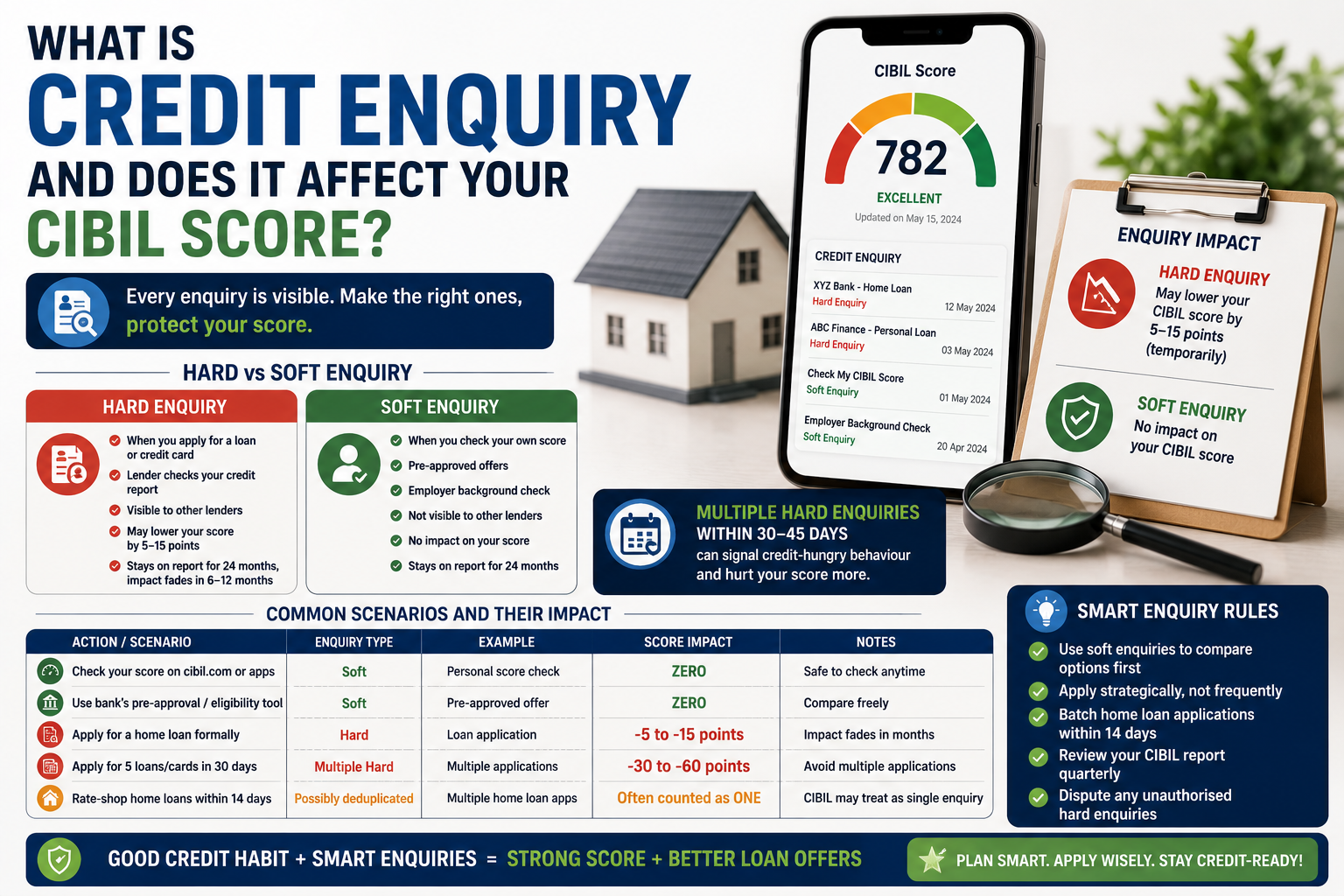
- A “hard enquiry” happens when you formally apply for a loan or credit card; it can lower your CIBIL score by 5–15 points temporarily.
- A “soft enquiry” happens when you check your own score or a lender pre-screens you; it has zero impact on your score.
- Multiple hard enquiries in a short period (30–45 days) signal credit-hungry behaviour and hurt more.
- Hard enquiries stay on your credit report for 24 months, but their score impact fades within 6–12 months.
- Always compare loan offers using soft enquiries (eligibility checks, pre-approvals based on basic info) before formally applying.
What Is a Credit Enquiry?
What does it mean?
A credit enquiry is a formal request to a credit bureau to pull a copy of your credit report. When you apply for a loan, the lender requests your CIBIL report — this is a “hard enquiry.” When you check your own score, it’s a “soft enquiry” — it doesn’t impact your score.
How does it work?
Each hard enquiry slightly reduces your score because it signals to other lenders that you’re seeking credit. Soft enquiries are recorded but don’t impact your score.
Enquiry Impact Guide
| Action | Enquiry Type | Score Impact |
|---|---|---|
| Check your CIBIL score on cibil.com or apps | Soft | Zero |
| Use bank’s pre-approval/eligibility calculator | Soft | Zero |
| Apply for a home loan formally | Hard | -5 to -15 points |
| Apply for 5 loans/cards in 30 days | Multiple Hard | -30 to -60 points |
| Rate-shop home loans within 14 days | Possibly deduplicated | Often counted as one |
Managing Credit Enquiries
Allow a hard enquiry only when: You’ve already shortlisted the lender(s) and are committed to formally applying.
Avoid further enquiries when: Your CIBIL score has dropped recently, or you have a major loan application coming up in 3–6 months.
Practical Tips
- Use cibil.com, BankBazaar, CRED, Loan Network or your bank’s app to monitor your score monthly — these are soft enquiries.
- When rate-shopping for a home loan, complete all formal applications within a 14-day window.
- Review your CIBIL report quarterly for unauthorised hard enquiries.
- Avoid applying for credit cards just before a major loan application.
Common Mistakes to Avoid
- Applying to 5–10 lenders simultaneously to compare rates.
- Confusing soft and hard enquiries — using your bank’s eligibility calculator (soft) is always safe.
- Ignoring unauthorised enquiries on your report — they could indicate identity theft.
FAQ
How much does a hard enquiry reduce my CIBIL score?
A single hard enquiry typically reduces your score by 5–15 points. Multiple enquiries within 30 days can compound damage to 30–60 points.
How long does a credit enquiry stay on my report?
Hard enquiries remain visible for 24 months. Their score impact fades after 6–12 months.
Does checking my own credit score lower it?
No, checking your own score is a “soft enquiry” and does not lower your CIBIL score.
Are home loan enquiries treated differently from credit card enquiries?
Yes — multiple home loan enquiries within 14–45 days may be treated as a single enquiry (“rate shopping”).
What should I do if I see an unknown hard enquiry on my CIBIL report?
Raise a dispute on the CIBIL portal immediately. CIBIL will investigate with the lender and remove it if unauthorised.