What Is Down Payment in Home Loans and How Much Do You Need?
A down payment is the upfront amount you pay from your own funds when buying a property — usually 10% to 25% of the property’s value, with the bank financing the rest as a home loan. In this guide, you’ll learn the minimum down payment required by Indian lenders, why a higher down payment can save you lakhs, and how to plan your savings strategy — so you can buy your home without overstretching your finances.
Quick Summary
- Indian banks typically finance 75%–90% of the property value; the rest is your down payment.
- For loans up to ₹30 lakh, banks may finance up to 90%; for loans above ₹75 lakh, max financing drops to 75%.
- The actual cash outflow includes down payment + stamp duty + registration + processing fees + interiors — typically 25–35% of property cost.
- A higher down payment reduces your EMI, total interest paid, and lowers approval risk.
- Down payment cannot be borrowed from another loan — banks verify the source of funds.
What Is Down Payment?
What does it mean?
The down payment is the portion of a property’s purchase price that you pay upfront, in cash, from your own savings or assets — not from the home loan. It’s also called the “borrower’s contribution” or “margin money.” This payment goes directly to the seller or builder and reduces the amount the bank needs to finance. The bank then disburses the home loan for the remaining property value, secured by mortgage on the property.
How does it work?
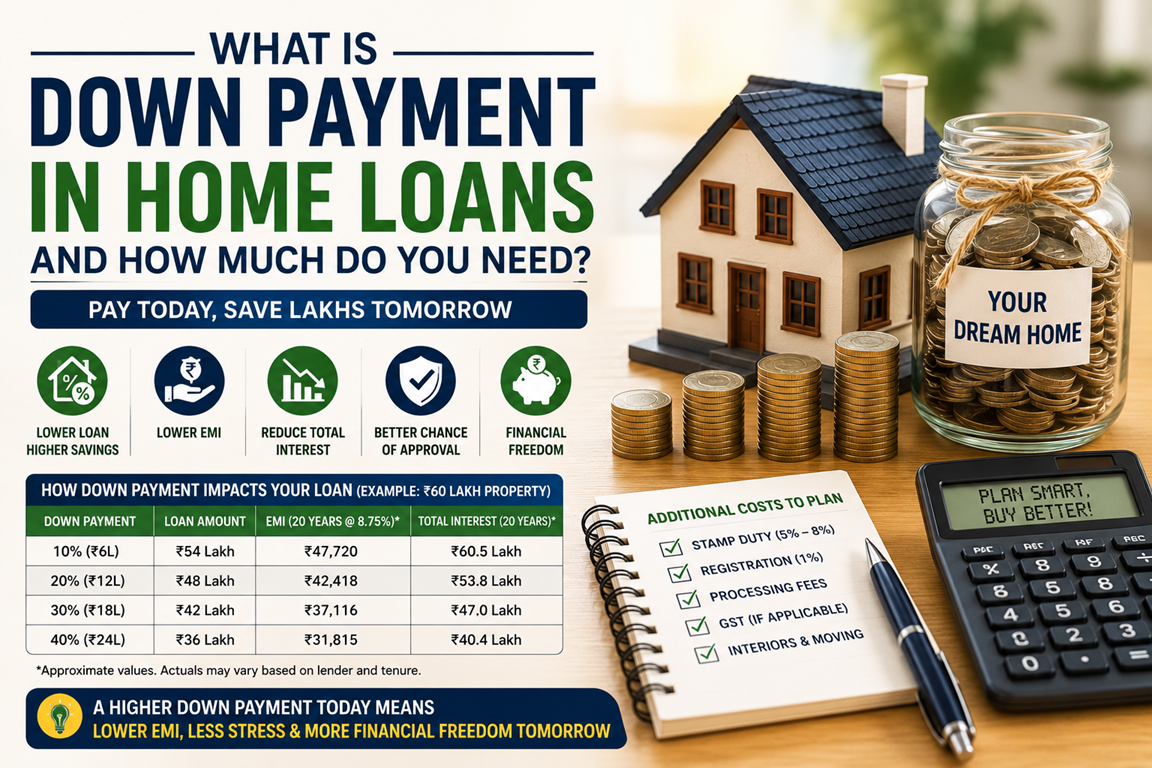
Suppose you’re buying a ₹60 lakh property. The bank may sanction up to 80% LTV — that’s ₹48 lakh as a home loan. The remaining ₹12 lakh is your down payment, which you arrange and pay before disbursement. In addition, you’ll need to separately fund stamp duty, registration, processing fees, GST (for under-construction properties), and any interior work. Total upfront outlay typically ranges from 25% to 35% of the property’s price, well above the down payment alone.
Key Factors You Should Know
What are the important factors to consider?
Five key factors influence your down payment requirement: the property value (RBI rules cap LTV by loan size), your income and credit profile (better profiles get higher LTV), the property type (under-construction vs ready, residential vs commercial), the lender’s policy, and your liquidity (how much you can comfortably part with). Stamp duty, registration, GST, and interiors must also be planned separately — they’re not part of the LTV.
How do these factors impact your decision?
These factors determine how much cash you need to arrange and how much loan you can take. If you put down 10% on a ₹60 lakh property (₹6 lakh) and borrow ₹54 lakh at 8.75% for 20 years, EMI is ₹47,720. If you put down 25% (₹15 lakh) and borrow ₹45 lakh, EMI drops to ₹39,767 — saving ₹19 lakh in total interest over the tenure. The trade-off: bigger down payment depletes liquidity that could earn returns elsewhere.
- Property Value — Higher value usually means lower LTV cap
- Loan Amount — RBI caps LTV at 90/80/75% based on loan size
- Borrower Profile — Strong CIBIL and income may unlock higher LTV
- Property Stage — Ready properties get higher LTV than under-construction
- Add-on Costs — Stamp duty, registration, GST, interiors are extra
Options / Scenarios Explained
What are the available options?
You can structure your down payment in several ways: pay the minimum 10–20% required and maximise the loan, pay 30–40% to keep EMI comfortable and save on interest, use a combination of savings, mutual fund redemption, EPF withdrawal (allowed for home purchase), or family contribution. Some buyers also liquidate gold, take a personal loan for shortfall (not recommended — increases overall debt), or sell other assets.
How do different scenarios affect outcomes?
Each strategy changes both your liquidity and total cost dramatically. A higher down payment lowers EMI, total interest, and processing fees — but ties up cash that could earn 10–14% in equity. A minimum down payment preserves liquidity but increases total cost. Using EPF (under EPFO Para 68B) lets you withdraw up to 90% of accumulated balance for home purchase — an underused option that can fund a large chunk of down payment.
| Down Payment % | EMI on ₹60L Property | Total Interest (20 yr) |
| 10% (₹54L loan) | ₹47,720 | ₹60.5 lakh |
| 20% (₹48L loan) | ₹42,418 | ₹53.8 lakh |
| 30% (₹42L loan) | ₹37,116 | ₹47.0 lakh |
| 40% (₹36L loan) | ₹31,815 | ₹40.4 lakh |
Which Option Is Right for You?
When should you make a higher down payment?
Make a higher down payment (30%+) if you have surplus savings beyond your emergency fund, prefer lower EMI for cash flow comfort, want to minimise total interest over the loan tenure, and don’t have higher-return investment opportunities. Higher down payment also reduces approval risk — banks prefer lower LTV applications. It’s particularly smart if your investment returns aren’t beating the home loan rate (8.5–10%) consistently after tax.
When should you make the minimum down payment?
Make the minimum down payment (10–20%) if your savings are limited, you have higher-return investment opportunities (equity SIPs, business growth), or you need liquidity for other goals (emergency fund, children’s education, marriage). Tax benefits on home loan interest (up to ₹2 lakh under Section 24(b)) also reduce the effective cost of borrowing — this changes the math in favour of borrowing more for many salaried borrowers.
Practical Tips to Make the Best Decision
- Save your down payment in a liquid mutual fund or short-term FD 12–24 months in advance — don’t liquidate equity in a hurry.
- Don’t forget stamp duty (5–8% in most states) and registration (1%) — budget them separately.
- Use the EPF withdrawal option (Para 68B) for home purchase — it’s tax-free and doesn’t need repayment.
- Avoid borrowing the down payment as a personal loan — banks check, and it can disqualify your application.
Common Mistakes to Avoid
- Emptying your emergency fund for the down payment — keep at least 6 months of expenses liquid.
- Underestimating add-on costs — stamp duty, registration, GST, and interiors can add 10–20% to the upfront outlay.
- Stretching to a larger property by minimising down payment — bigger loan means bigger EMI, more interest, and higher default risk.
Conclusion
The right down payment is the one that balances upfront affordability with long-term cost and financial security. The minimum 10–20% gets you in the door but multiplies total interest. A higher 25–35% slashes total cost and EMI stress but ties up liquidity. The smartest strategy is usually somewhere in between — enough down payment to get a comfortable EMI, but not so much that you have no cushion for emergencies, opportunities, or life’s surprises.
FAQ Section
What is the minimum down payment for a home loan in India?
The minimum down payment is 10% for home loans up to ₹30 lakh, 20% for loans between ₹30 lakh and ₹75 lakh, and 25% for loans above ₹75 lakh — as per RBI’s LTV guidelines. So if you’re buying a ₹50 lakh property and want to borrow ₹40 lakh, you need at least ₹10 lakh as down payment, plus separate funds for stamp duty, registration, and other charges.
Does the down payment include stamp duty and registration?
No, stamp duty and registration charges are separate from the down payment and must be funded entirely from your own pocket — banks do not finance them. Stamp duty varies from 4% to 8% depending on the state, and registration is typically 1%. So on a ₹60 lakh property, you might pay ₹3.6–4.8 lakh in stamp duty plus ₹60,000 in registration — over and above your down payment.
Can I borrow my down payment from another loan?
Officially, no — banks check the source of your down payment and may reject the application if it’s funded by another loan. Personal loans, credit card cash advances, or top-up loans used for down payment are red flags because they show you don’t have genuine financial capacity. You can use savings, gifts from family (with declaration), EPF withdrawal, or asset sale — but not other borrowed money.
Is it better to make a higher down payment?
A higher down payment reduces your EMI, total interest paid, and approval risk. On a ₹60 lakh property, increasing down payment from 10% to 30% can save ~₹13 lakh in total interest over 20 years. However, if you can earn returns higher than your home loan rate (after tax) by investing the extra money elsewhere, a smaller down payment may make more financial sense. It depends on your risk profile and opportunity cost.
Can I withdraw from EPF for home loan down payment?
Yes, EPFO allows withdrawal of up to 90% of your accumulated EPF balance (employee + employer + interest) for purchasing or constructing a house, under Para 68B of the EPF Scheme. You must have 5 years of EPF membership to qualify. The withdrawn amount is tax-free and doesn’t need to be repaid. It’s one of the most underused but legitimate sources of down payment funding for salaried Indians.