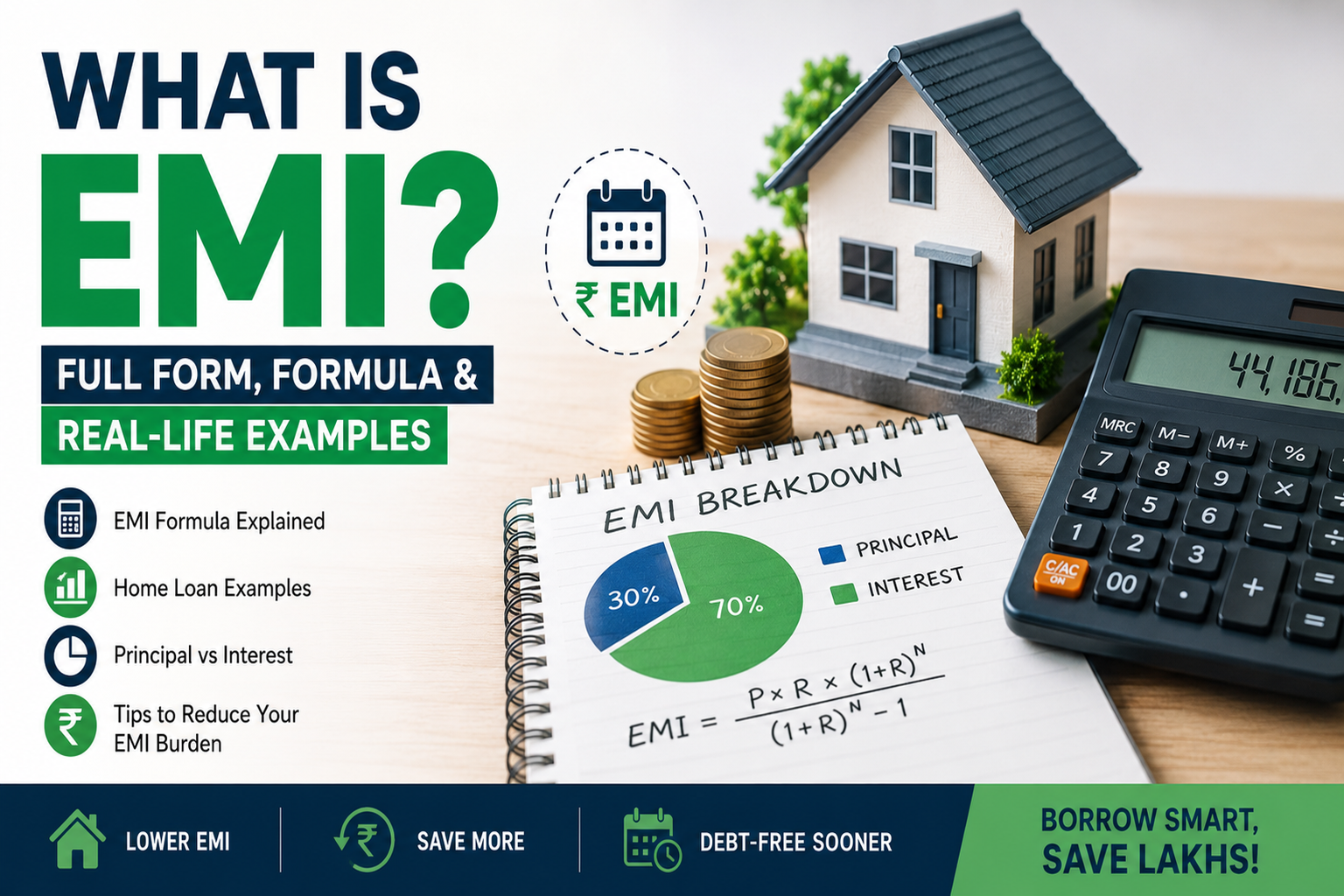
What Is EMI? Full Form, Formula & Real-Life Examples
EMI stands for Equated Monthly Installment — the fixed amount you pay your lender each month to repay a loan, comprising both principal and interest. In this guide, you’ll learn the EMI formula, see real Indian home loan examples, understand how each rupee is split between principal and interest, and learn how to reduce your total EMI burden — so you can make smarter borrowing decisions.
Quick Summary
- EMI = [P × R × (1+R)^N] / [(1+R)^N – 1], where P is principal, R is monthly interest rate, N is number of months.
- In early years of the loan, most of the EMI goes towards interest; in later years, more goes towards principal.
- A ₹50 lakh loan at 8.75% for 20 years has an EMI of approximately ₹44,186/month.
- EMI stays constant for fixed-rate loans; for floating loans, either the EMI or tenure changes when rates move.
- Prepayments and shorter tenures can significantly reduce total interest paid over the loan’s life.
What Is EMI?
What does it mean?
EMI (Equated Monthly Installment) is the standardized monthly payment a borrower makes to a lender to repay a loan within a fixed tenure. Each EMI has two components: principal (the amount borrowed) and interest (the cost of borrowing). The “equated” part means the total EMI amount stays the same every month, even though the internal split between principal and interest changes over time. EMIs apply to home loans, car loans, personal loans, and education loans.
How does it work?
Lenders use an amortization schedule to break down each EMI. In the first year of a 20-year home loan, roughly 70–80% of every EMI goes toward interest, and only 20–30% toward principal. As the outstanding principal reduces, the interest component shrinks and principal repayment grows. By the final years, almost the entire EMI is going toward principal. This back-loaded principal recovery is exactly why prepaying early saves so much in total interest.
Key Factors You Should Know
What are the important factors to consider?
Three variables decide your EMI: the principal (loan amount), the interest rate, and the tenure. A higher principal means a higher EMI. A higher rate also pushes EMI up — but increases total interest disproportionately. A longer tenure reduces the EMI but multiplies total interest paid. The relationship isn’t linear, which is why even a 0.25% rate difference or a 5-year tenure change can mean lakhs over the life of the loan.
How do these factors impact your decision?
Understanding how these factors interact helps you balance affordability with total cost. Stretching tenure makes EMI affordable but is expensive long-term. A shorter tenure has higher EMI but slashes total interest. A higher rate hurts both — bigger EMI and bigger total. For example, on a ₹50 lakh loan: at 8.5% for 20 years, EMI is ₹43,391; total interest is ₹54.13 lakh. Drop tenure to 15 years and EMI rises to ₹49,237, but total interest drops to ₹38.62 lakh — a ₹15.5 lakh saving.
- Principal — The total loan amount borrowed
- Interest Rate — Annual rate, expressed as monthly for the formula
- Tenure — Loan duration in months
- Loan Type — Fixed or floating affects long-term EMI behaviour
- Prepayments — Reduce principal and shorten tenure or EMI
Options / Scenarios Explained
What are the available options?
You can manage your EMI burden through several strategies: choose a tenure that balances EMI and total interest, opt for step-up EMIs (lower initial EMI that grows with income), step-down EMIs (higher initial, lower later), or balloon EMIs in business loans. You can also pay only interest during a moratorium period, switch lenders for lower rates, or make periodic part-prepayments to reduce principal and shorten tenure.
How do different scenarios affect outcomes?
Each option changes the cash flow and total interest outcome dramatically. A 30-year tenure on ₹50 lakh at 8.75% has an EMI of ₹39,335 but total interest of ₹91.6 lakh — almost double the loan! A 15-year tenure has EMI of ₹49,983 and total interest of just ₹39.97 lakh. Prepaying ₹2 lakh annually on a 20-year loan can shorten it to ~14 years and save ₹15–20 lakh in interest.
| Tenure | EMI on ₹50L @ 8.75% | Total Interest Paid |
| 10 years | ₹62,757 | ₹25.3 lakh |
| 15 years | ₹49,983 | ₹39.97 lakh |
| 20 years | ₹44,186 | ₹56.05 lakh |
| 25 years | ₹41,113 | ₹73.34 lakh |
| 30 years | ₹39,335 | ₹91.6 lakh |
Which Option Is Right for You?
When should you choose a longer tenure?
Choose a longer tenure (25–30 years) if you’re young, have a long career runway, and your priority is keeping monthly EMI low to manage other commitments — rent, education, family expenses. A lower EMI also leaves room for SIPs, emergency funds, and lifestyle. You can always prepay later when income grows. A long tenure is a flexibility play, not a permanent commitment to that EMI for 30 years.
When should you choose a shorter tenure?
Choose a shorter tenure (10–15 years) if you have stable, growing income, want to minimise total interest paid, and want to be debt-free before major life milestones like children’s education or retirement. A shorter tenure forces financial discipline and saves a substantial amount — often 30–50% less interest than a 30-year option. Make sure your EMI stays under 40% of net income to avoid liquidity stress.
Practical Tips to Make the Best Decision
- Use an online EMI calculator before signing any loan to test different rate, tenure, and prepayment scenarios.
- Aim to keep total EMI obligations (home + car + personal) under 40% of your net monthly income.
- Make at least one part-prepayment a year, even ₹50,000–1 lakh — it dramatically reduces total interest.
- If your income grows, increase EMI rather than stretching the tenure further.
Common Mistakes to Avoid
- Picking the longest tenure just to “afford” a bigger loan — you may end up paying nearly double the loan amount in interest.
- Not understanding the front-loaded interest structure — this is why refinancing in the last 5 years rarely makes sense.
- Skipping the EMI calculator and relying only on the bank’s verbal estimate — small rate or tenure differences shift EMI more than you’d expect.
Conclusion
EMI is the single biggest financial commitment most Indians make in their lifetime. Understanding the formula, the principal-interest split, and how tenure dramatically changes total cost gives you real control. Pick a tenure that keeps your EMI under 40% of income, prepay periodically, and revisit your loan every few years to see if a balance transfer or extra prepayment makes sense. Small, consistent decisions can save you 15–20 lakh over the loan’s life.
FAQ Section
How is EMI calculated?
EMI is calculated using the formula: EMI = [P × R × (1+R)^N] / [(1+R)^N – 1], where P is the principal loan amount, R is the monthly interest rate (annual rate ÷ 12 ÷ 100), and N is the tenure in months. For a ₹50 lakh loan at 8.75% annual interest over 20 years (240 months), the EMI works out to approximately ₹44,186 per month.
What happens to EMI if interest rates change?
For fixed-rate loans, the EMI does not change. For floating-rate loans, when the benchmark (e.g., RBI repo rate) changes, banks have two options: keep your EMI the same and adjust the tenure, or keep the tenure the same and adjust the EMI. Most banks default to adjusting the tenure for small rate changes and revising the EMI for larger ones. You can request your preference.
Can I reduce my EMI mid-loan?
Yes, in three ways. First, request a tenure extension with your existing lender (lower EMI but more total interest). Second, do a balance transfer to a lender offering a lower rate (lower EMI without extending tenure). Third, make a part-prepayment to reduce the outstanding principal and ask the bank to recalculate the EMI lower while keeping the tenure the same.
Is EMI tax-deductible in India?
The EMI itself isn’t directly deductible, but its components are. Under Section 80C, you can claim up to ₹1.5 lakh per year on the principal portion of your home loan EMI. Under Section 24(b), you can claim up to ₹2 lakh per year on the interest portion for self-occupied property. Section 80EEA offers an additional ₹1.5 lakh interest deduction for first-time homebuyers under specific conditions.
What’s the difference between EMI and pre-EMI?
EMI is the full monthly instalment that includes both principal and interest, paid after the entire loan amount is disbursed. Pre-EMI is interest-only payment made during the construction period of an under-construction property, when the bank disburses the loan in instalments. Pre-EMI is lower than full EMI but doesn’t reduce the principal — once construction completes and full disbursement happens, you start paying full EMI.