Plot Loan Plus Construction Loan: How Combined Financing Works
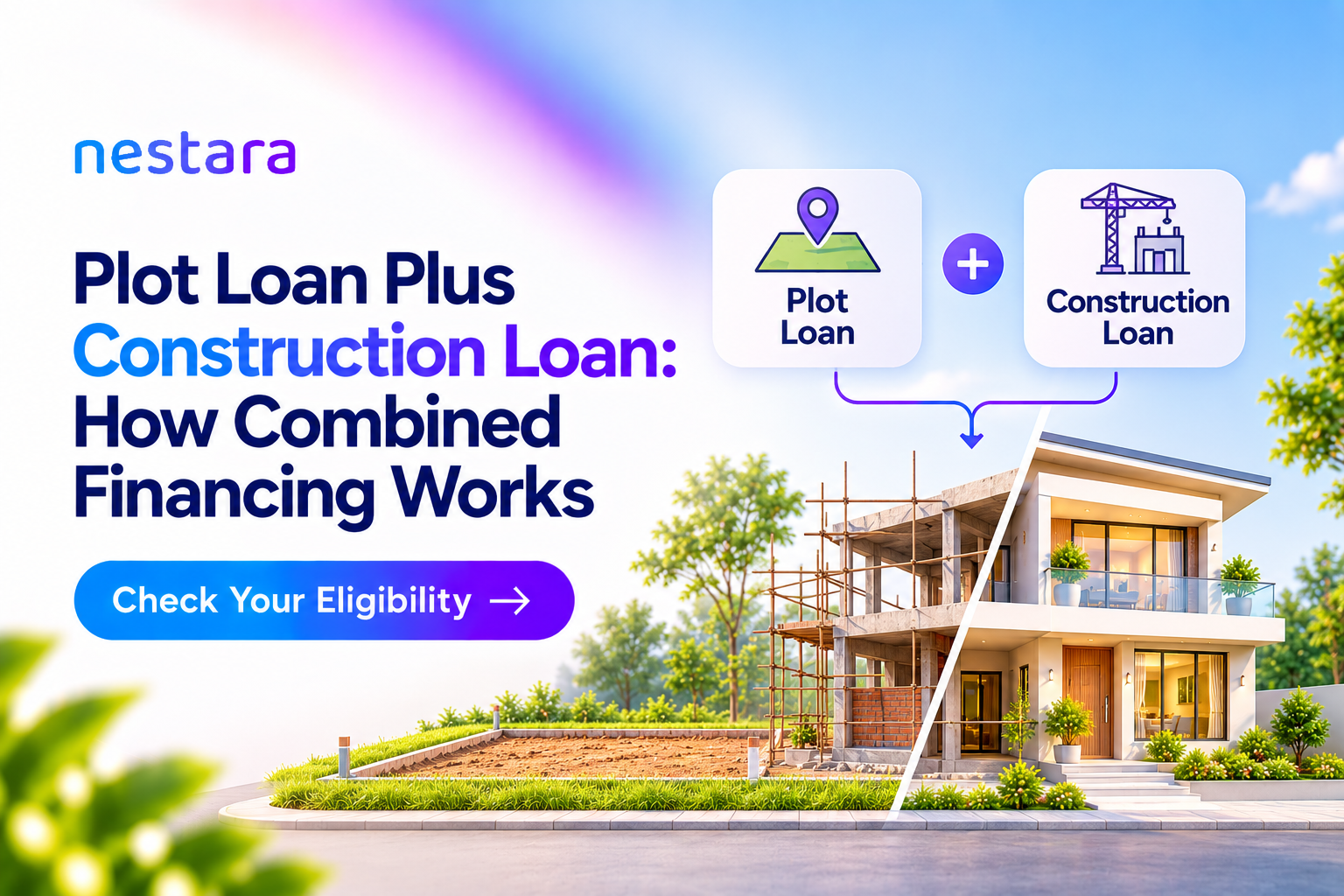
A plot loan plus construction loan allows you to finance both the purchase of a residential plot and the construction of a house on it. Instead of arranging separate funding entirely from your savings, you can explore a combined loan or a plot loan with a linked construction facility, depending on the lender’s products and eligibility conditions.
This option can be useful if you have found the right plot but do not have enough funds to build your home immediately. However, lenders generally impose conditions on the plot’s legal status, construction timeline, approved building plans and loan disbursement. Before choosing this financing option, let’s understand how it works, what it costs and what you should check when exploring our New Home Loan options.
What Is a Plot Loan Plus Construction Loan?
A plot loan plus construction loan is a financing arrangement that covers the cost of purchasing land and building a residential property on that land.
There are generally two ways to arrange this financing:
- Combined plot and construction loan: A lender evaluates the land purchase and proposed construction together and provides financing under a product designed for both purposes.
- Separate plot and construction loans: You finance the land first and subsequently apply for a construction loan, subject to the lender’s approval and the property’s eligibility.
Not every lender offers a single combined product. Some provide dedicated plot-plus-construction facilities, while others require separate applications or impose construction conditions on their plot loans.
For example, if you purchase a plot worth ₹20 lakh and plan to construct a house costing ₹30 lakh, your total project cost is ₹50 lakh before additional expenses. A suitable financing arrangement may cover eligible portions of both costs, depending on the lender’s assessment.
How Does Combined Plot and Construction Financing Work?
Combined financing generally follows the stages of land purchase, construction approval and construction-linked disbursement.
- Plot selection and legal verification: The lender evaluates the plot’s ownership, title, location, land-use classification and other legal requirements.
- Loan eligibility assessment: Your income, existing EMIs, credit history, repayment capacity and total project cost are assessed.
- Construction plan approval: You may need to submit an approved building plan, construction estimate and other property documents.
- Loan sanction and plot payment: Once approved, the lender sanctions the eligible facility and disburses the amount according to the agreed terms.
- Construction-linked disbursement: The construction portion may be released in stages based on construction progress and lender inspections.
The exact process depends on the lender. Some lenders sanction the combined amount upfront but release it in stages, while others structure the plot and construction components separately.
If your construction loan is disbursed in stages, it is important to understand how repayments work during construction. Read our guide to Pre-EMI vs Full EMI during an under-construction property to compare the two repayment options.
How Much Can You Borrow for a Plot and Construction?
The amount you can borrow depends on the property’s valuation, project cost, your repayment capacity and the lender’s loan-to-value (LTV) policy.
Consider this illustrative project:
| Project component | Estimated cost |
|---|---|
| Residential plot | ₹20 lakh |
| House construction | ₹30 lakh |
| Total project cost | ₹50 lakh |
Suppose a lender offers an illustrative financing arrangement covering 80% of the eligible project cost.
- Total eligible project cost: ₹50 lakh
- Illustrative loan amount: ₹40 lakh
- Your contribution: ₹10 lakh
This is only a mathematical illustration, not a universal lending limit or an assured sanction. The lender may assess the land and construction separately, apply different LTV limits, exclude certain expenses or require a higher contribution.
Also budget separately for stamp duty, registration, architectural fees, approvals, utility connections and other costs that may not be financed.
What Are the Eligibility Requirements for a Plot Plus Construction Loan?
To qualify for combined plot and construction financing, you generally need to meet the lender’s income, credit, property and construction-related requirements.
Although eligibility varies across lenders, the following are commonly assessed:
1. Applicant eligibility
- Stable income from salaried employment or self-employment.
- Sufficient repayment capacity after accounting for existing EMIs.
- Acceptable credit history and repayment record.
- Age within the lender’s permitted borrowing and loan-maturity limits.
Your eligibility for a combined plot and construction loan depends on factors such as your income, existing EMIs, credit score, and repayment capacity. Learn more about how banks decide your home loan eligibility before applying.
2. Plot eligibility
- The plot should be approved for residential use.
- Ownership and title documents must be legally acceptable.
- The property should meet the lender’s location and valuation requirements.
- Applicable land-use permissions and development approvals must be available.
3. Construction eligibility
- An approved building plan from the competent authority.
- A detailed construction estimate prepared by a qualified professional, where required.
- A clear intention to construct a residential house.
- Completion within the timeline prescribed by the lender or relevant authority.
For example, ICICI Bank specifies a four-year construction completion requirement for its land loan, while LIC Housing Finance’s composite loan product specifies construction within three years. These are product-specific conditions, not universal rules.
What Documents Are Required?
You generally need identity, income, plot ownership and construction documents to apply for a plot-plus-construction loan.
| Document category | Documents you may need |
|---|---|
| Identity and KYC | PAN, Aadhaar and address proof |
| Income proof | Salary slips, Form 16, ITR and bank statements, as applicable |
| Plot documents | Sale deed, title documents and encumbrance certificate |
| Purchase documents | Agreement to sell and payment receipts |
| Construction documents | Approved building plan and construction cost estimate |
| Additional documents | Land-use approvals, permissions and valuation reports, as requested |
The lender may also require a legal opinion, technical valuation and property inspection before sanctioning the loan. PNB’s official housing loan checklist, for example, separately identifies documents for plot purchase and house construction.
What Are the Tax Benefits of a Plot Plus Construction Loan?
Tax benefits may be available on the construction-related home loan interest and principal repayment, but purchasing a vacant plot alone does not qualify for the usual home loan deductions.
Under the applicable tax rules, eligible borrowers may claim:
- Interest deduction: Interest on a qualifying loan for construction of a residential house may qualify under Section 24(b), subject to the applicable tax regime and conditions.
- Principal repayment: Eligible principal repayment may qualify under Section 80C under the old tax regime, within the overall annual deduction limit.
- Construction completion: For a self-occupied property, the applicable interest deduction limit depends partly on whether construction is completed within the prescribed period.
For a self-occupied property, the familiar ₹2 lakh interest deduction limit under Section 24(b) applies under the old tax regime when the statutory conditions are met. Under the new tax regime, the usual self-occupied home loan interest and principal deductions are not available.
Keep your loan statements, interest certificates, construction records and completion documents to support any eligible claims. Consult a tax professional to establish the treatment applicable to your specific loan and tax year.
Before choosing a loan, compare the available interest rate options and understand how they affect your long-term repayment. Our guide to fixed vs floating home loan interest rates explains the key differences.
Is a Combined Loan Better Than Taking Separate Plot and Construction Loans?
A combined loan can simplify financing because the land purchase and proposed construction are evaluated as one residential project. However, separate loans may offer more flexibility if you want to purchase the plot now and decide on construction later.
| Factor | Combined financing | Separate financing |
|---|---|---|
| Application | May involve one combined application | May require separate applications |
| Loan assessment | Plot and construction evaluated together | Each facility assessed separately |
| Disbursement | May be divided into plot and construction stages | Depends on individual loan terms |
| Construction timeline | Usually subject to a specified deadline | Depends on the construction loan conditions |
| Flexibility | Less flexibility if construction is delayed | Potentially more flexibility, subject to approval |
For example, SBI’s published product information describes its Combo Loan as financing land purchase and house construction under a single sanction. PNB also offers a composite home loan for purchasing a residential plot and constructing a house on it.
The better option depends on when you intend to construct, how much money you need and the conditions offered by the lender.
Before choosing this route, consider how your plans compare with buying a property that is already constructed. Our guide to under-construction vs ready-to-move properties explains the differences in financing, disbursement and repayment.
Conclusion
A plot loan plus construction loan can be a practical financing option if you want to purchase residential land and build your own home. It allows you to plan both expenses together, but you must consider the lender’s construction timeline, disbursement conditions, property approvals and repayment requirements.
Before applying, compare combined financing with separate loan options and calculate the total amount you can comfortably repay. A lower initial EMI or a larger sanctioned amount does not necessarily mean a more affordable loan.
With our New Home Loan options, you can explore your borrowing eligibility, compare lenders and understand your home loan requirements before purchasing a plot or starting construction.
FAQs
1. Can I get a home loan for both buying a plot and constructing a house?
Yes. Several lenders offer composite or combined loans that finance the purchase of an eligible residential plot and construction of a house on it. Approval depends on the lender’s product conditions, your eligibility and the property’s legal status.
2. Is a plot loan different from a plot-plus-construction loan?
Yes. A plot loan primarily finances the purchase of residential land, whereas a plot-plus-construction loan covers both land acquisition and house construction. A composite loan may also impose a deadline for completing construction.
3. How much loan can I get for purchasing a plot and constructing a house?
The amount depends on your income, repayment capacity, project cost, property valuation and the lender’s LTV and margin requirements. Some lenders also restrict how much of the total sanctioned amount can be used for purchasing the plot.
4. Can I buy a plot now and construct a house several years later?
Possibly, but the answer depends on the loan product. Some lenders impose construction deadlines even when the loan initially finances only the plot. For example, ICICI Bank specifies a four-year construction completion period for its land loan. Always check the applicable deadline before borrowing.
5. Can I get a plot-plus-construction loan if I already own the land?
Yes. If you already own an eligible residential plot, you can approach a lender for a home construction loan. You will generally need ownership documents, an approved building plan, a construction estimate and income proof.
6. Is a construction loan disbursed in one instalment?
Not necessarily. Construction loans are commonly disbursed in stages based on actual construction progress. The lender may inspect the property and verify the completed stage before releasing the next instalment.
7. Can I claim tax benefits on a plot loan?
A loan used solely to purchase vacant land does not qualify for the usual home loan interest and principal deductions. Eligible deductions may become available for the residential construction component, subject to applicable tax rules, completion requirements and the chosen tax regime.
8. Can I apply for a plot-plus-construction loan jointly with my spouse?
Yes. Many lenders allow eligible individuals to apply jointly. Combining incomes may improve borrowing eligibility, but both applicants must meet the lender’s requirements and the property ownership and loan documentation must be structured appropriately.