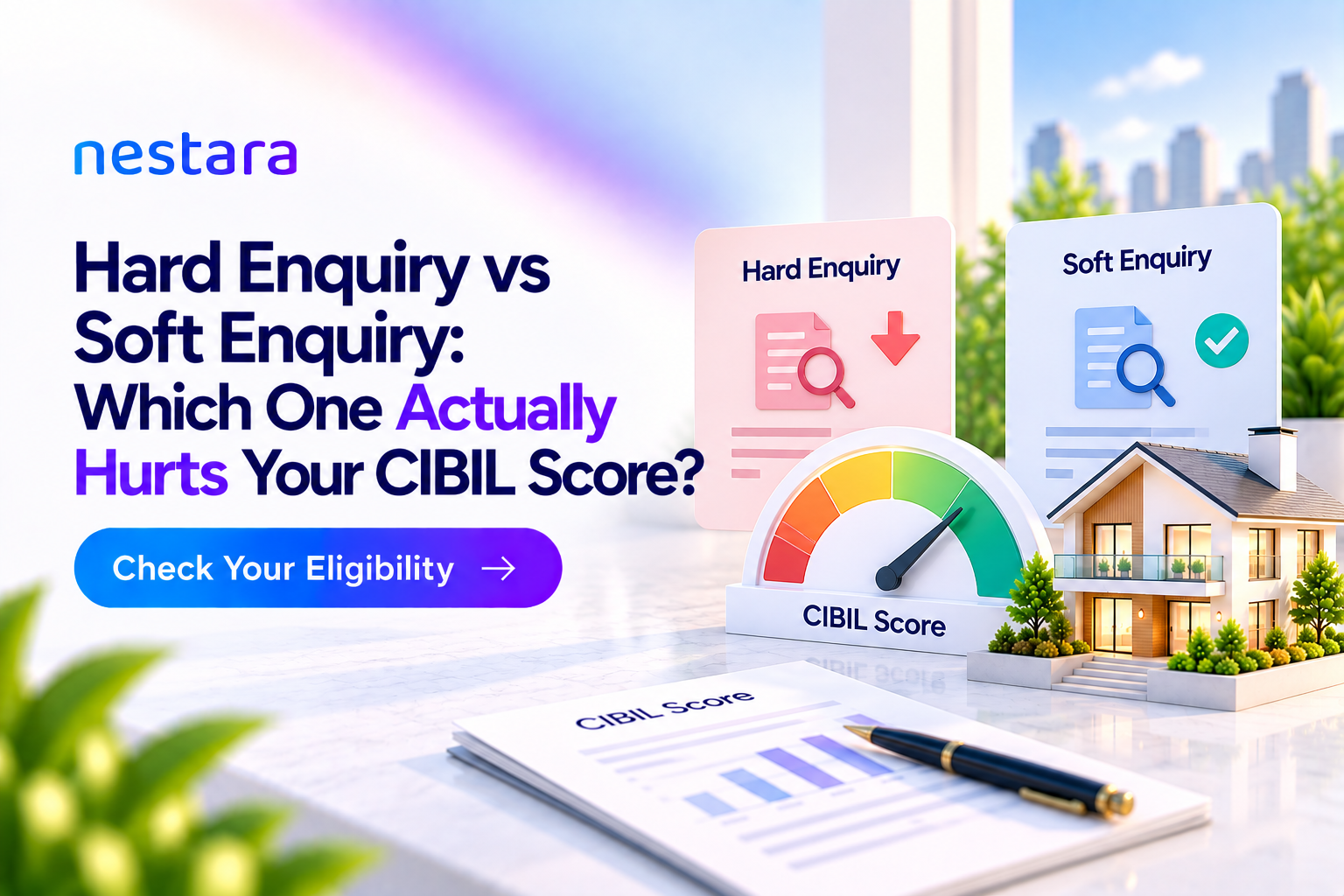
Hard Enquiry vs Soft Enquiry: Which One Actually Hurts Your CIBIL Score?
A hard enquiry can affect your CIBIL Score, while checking your own CIBIL Score is a soft enquiry and does not lower your score. The real concern is not one isolated hard enquiry, but multiple credit applications and lender enquiries within a short period.
If you’re preparing for a home loan, understanding the difference matters because comparing your options should not unnecessarily damage the credit profile you’re trying to protect.
What Is the Difference Between a Hard Enquiry and a Soft Enquiry?
A hard enquiry happens when a lender accesses your CIBIL Report while assessing a credit application, whereas a soft enquiry generally refers to checking your own credit information without applying for new credit.
| Feature | Hard Enquiry | Soft Enquiry |
|---|---|---|
| Usually triggered by | Loan or credit-card application | Checking your own credit |
| Appears in CIBIL Report | Yes | Your own check does not appear as a lender enquiry |
| Can affect CIBIL Score? | Yes, particularly when enquiries are multiple | No |
| Should you worry about it? | Avoid unnecessary repeated applications | No |
CIBIL confirms that when a bank or financial institution accesses your report for a loan or credit-card application, an enquiry is recorded.
Does a Hard Enquiry Lower Your CIBIL Score?
A hard enquiry can affect your CIBIL Score, but a single enquiry does not automatically mean a significant score drop.
The bigger concern is multiple and frequent hard enquiries. CIBIL explains that repeated enquiries over a short period can affect your score because they may indicate that you are actively seeking additional credit.
For example, imagine you apply for:
- A personal loan from one lender
- A credit card from another
- Another personal loan a few days later
- A consumer loan shortly afterwards
Each lender may access your CIBIL Report. Multiple enquiries appearing close together can make your credit profile look more credit-seeking than if you had made a single, necessary application.
This does not mean you should avoid applying for credit altogether. It means you should avoid submitting unnecessary applications simply to see whether you qualify.
Does Checking Your Own CIBIL Score Hurt Your Score?
Checking your own CIBIL Score does not hurt your CIBIL Score.
This is an important distinction because regularly checking your credit profile is actually useful before applying for a major loan. CIBIL specifically states that checking your own score and report does not affect the score.
That means you can review your report to look for:
- Incorrect personal information
- Unrecognised loan or credit-card accounts
- Missed payments that were incorrectly reported
- Unfamiliar lender enquiries
- Outstanding balances
- Other inaccurate credit information
Checking your own report is therefore very different from repeatedly applying for new credit.
Why Do Multiple Hard Enquiries Matter When Applying for a Home Loan?
Multiple hard enquiries can matter during a home loan application because lenders use the enquiries section of your CIBIL Report to understand your recent credit-seeking behaviour.
CIBIL’s report records lender enquiries, including information such as the lender, date and type of credit requested. The enquiries section can therefore give a lender additional context about how frequently you have recently sought credit.
Consider two borrowers:
Borrower A checks their CIBIL Report, compares home loan options and then submits one application to a suitable lender.
Borrower B submits applications to several lenders without first comparing eligibility and loan terms.
Borrower B could end up with multiple hard enquiries even before receiving a final home loan offer.
This is one reason it is better to research and compare first, then apply selectively.
Can You Compare Home Loans Without Hurting Your CIBIL Score?
You can compare home loans without unnecessarily creating multiple hard enquiries, provided you distinguish between researching your options and formally applying for credit.
Before submitting applications, compare:
- Interest rate
- Loan amount and eligibility
- Processing charges
- Loan tenure
- Prepayment terms
- Other applicable fees and conditions
You can also review your credit profile first. With our Free Credit Score Check, you can understand where you stand before deciding which lenders are worth approaching.
The objective is simple: do the comparison before creating a trail of unnecessary credit applications.
How Many Hard Enquiries Are Too Many?
There is no universal number of hard enquiries that CIBIL publicly defines as a guaranteed “safe limit” for every borrower.
CIBIL says that multiple enquiries in a short period may affect your score, but the impact depends on the information in your overall credit profile.
So don’t rely on rules such as “three enquiries are safe” or “five enquiries will reduce your score by exactly X points.” Those are not universal CIBIL rules.
Instead, focus on the behaviour behind the enquiries. Applying for credit repeatedly without a clear need can be more concerning than a legitimate application made when you actually need a loan.
What Should You Do If You Already Have Multiple Hard Enquiries?
If you already have several hard enquiries, don’t panic or immediately apply for more credit to compensate.
Instead:
- Review your CIBIL Report.
- Identify which enquiries you recognise.
- Check whether any enquiry was made without your knowledge.
- Avoid unnecessary new credit applications.
- Continue paying existing EMIs and credit-card dues on time.
- Keep your credit utilisation under control.
- Give your credit profile time to stabilise.
If you see an enquiry that you genuinely do not recognise, CIBIL recommends contacting the lender and provides a dispute process for reporting inaccuracies.
Does a Hard Enquiry Matter More Than Late Payments?
A hard enquiry can affect your CIBIL Score, but it should not be confused with the broader impact of poor repayment behaviour.
CIBIL identifies payment history, credit utilisation, age of credit and enquiries among the main factors used in calculating the score. Its consumer material also highlights factors such as credit mix and repayment behaviour.
That means you should not become so worried about one enquiry that you ignore more important credit habits.
A practical priority is:
Pay on time → manage balances → avoid unnecessary applications → monitor your report.
Should You Check Your CIBIL Score Before a Home Loan Application?
Yes, checking your CIBIL Score before a home loan application is a sensible first step because your own check does not lower the score.
It can help you discover problems before a lender reviews your application. You can then decide whether you are ready to apply or whether you should first improve an issue in your credit profile.
You can also use our EMI Calculator to understand how different loan amounts, interest rates and tenures could affect your monthly repayment before approaching lenders.
Conclusion
The simple rule is: hard enquiries can affect your CIBIL Score, while checking your own score does not. One legitimate hard enquiry is not a reason to panic, but repeatedly applying for loans or credit cards within a short period can work against your credit profile.
If you’re planning a home loan, don’t apply everywhere just to compare offers. Check your credit profile first, understand your eligibility, compare suitable lenders and then make informed applications.
Start with our Free Credit Score Check to understand your current credit position before you move ahead with your home loan search.
FAQs
Does checking CIBIL Score reduce the score?
No. Checking your own CIBIL Score and Report does not lower your score. CIBIL explicitly states that self-checks do not affect the score.
Does a hard enquiry always reduce CIBIL Score?
Not necessarily in a meaningful way. A hard enquiry can affect your score, but the greater concern is multiple and frequent enquiries, particularly when they occur within a short period.
How long do hard enquiries stay on a CIBIL Report?
CIBIL’s consumer material states that the Enquiries section records lender checks made in the last 36 months.
Can multiple home loan applications hurt my CIBIL Score?
Multiple formal applications can result in multiple hard enquiries, and repeated enquiries within a short period may affect your CIBIL Score. It is therefore better to compare suitable options before submitting multiple applications.
Is there a fixed number of enquiries that will reduce my CIBIL Score?
No universal number is published by CIBIL as a guaranteed cutoff. The effect depends on your overall credit profile and the pattern of enquiries.
Can I check my CIBIL Report before applying for a home loan?
Yes. Checking your own CIBIL Report is useful before applying and does not reduce your score. CIBIL also provides one free CIBIL Score and Report each calendar year.
What should I do if I find an enquiry I don’t recognise?
First check whether you recently applied for a loan or credit card. If the enquiry is genuinely unfamiliar, contact the lender and raise a dispute with CIBIL if necessary.