Salaried vs Self-Employed: How Lenders Score Risk Differently
Salaried and self-employed borrowers can both qualify for a home loan, but lenders assess their income differently. For salaried applicants, predictable monthly income and employment stability are easier to verify; for self-employed applicants, lenders typically examine business income, banking patterns, tax returns and financial consistency more closely.
If you are unsure how your employment type affects salaried vs self-employed home loan eligibility, understanding what lenders actually look for can help you prepare a stronger application.
Is salaried income easier for lenders to assess?
Yes, salaried income is generally more straightforward for lenders to verify because it is usually supported by salary slips, bank credits and employment records.
A salaried applicant may typically provide:
- Recent salary slips
- Bank statements showing salary credits
- Form 16 or income-tax records
- Employment or employer details
- KYC documents
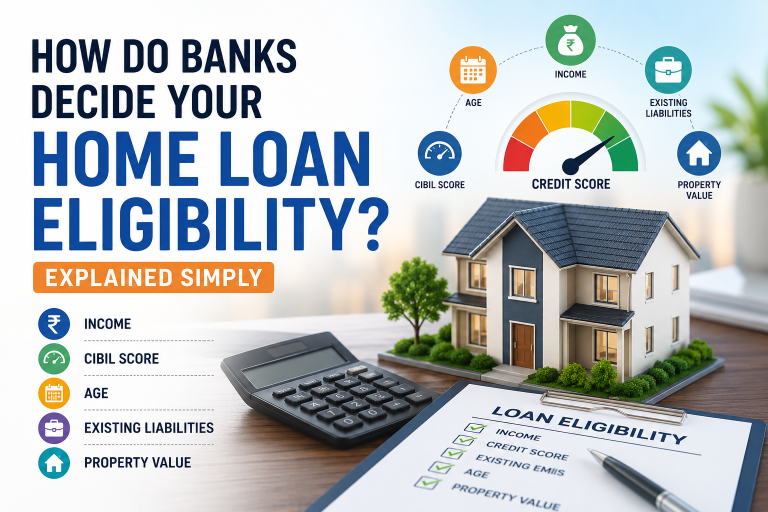
However, being salaried does not automatically mean higher eligibility. Lenders still consider your existing EMIs, credit history, age, income level, employment stability and the property being financed. CIBIL notes that lenders consider both employment status and the stability of the borrower’s income when evaluating home-loan applications.
How do lenders assess self-employed home loan applicants?
Self-employed applicants are usually assessed on the stability, sustainability and verifiability of their income rather than simply on gross business turnover.
For a business owner, professional or freelancer, lenders may examine:
- Income-tax returns
- Profit and loss statements
- Balance sheets or audited financials, where applicable
- Business bank statements
- Business vintage and continuity
- Existing liabilities
- Income consistency across financial years
- Nature and stability of the business
The documentation can therefore be more extensive. CIBIL’s indicative home-loan checklist includes financial statements and longer bank-statement history for self-employed applicants, while noting that exact requirements vary by lender.
This does not mean self-employed borrowers are automatically considered riskier. It means their repayment capacity may require more documentation to establish.
Salaried vs self-employed: what changes in home loan eligibility?
The biggest difference is how the lender verifies and interprets income, not whether one category is automatically preferred.
| Factor | Salaried borrower | Self-employed borrower |
|---|---|---|
| Income proof | Salary slips, bank credits, Form 16 | ITRs, financial statements, bank records |
| Income pattern | Usually monthly | Can fluctuate |
| Employment/business stability | Employer and job history | Business/professional continuity |
| Bank statement review | Salary credits and obligations | Business/personal cash flows and obligations |
| Documentation | Often simpler | Often more detailed |
| Eligibility assessment | Based on stable eligible income | Based on sustainable eligible income |
| Credit history | Important | Equally important |
| Property assessment | Important | Important |
The exact underwriting process varies by lender, so there is no single formula that applies to every salaried or self-employed borrower.
Does a higher income mean a higher home loan eligibility?
A higher income can improve borrowing capacity, but income alone does not determine your eligible loan amount.
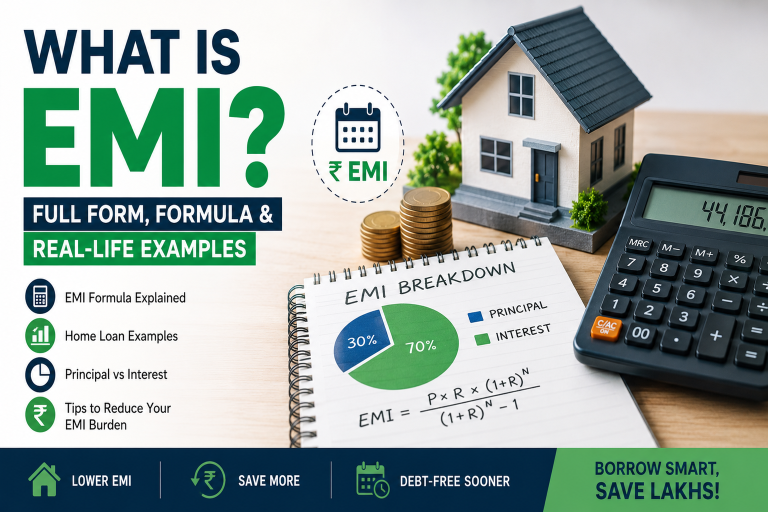
Lenders also consider existing EMIs and other financial obligations. For example, two borrowers earning ₹1 lakh per month could have very different eligibility if one already pays ₹35,000 in EMIs while the other has no existing debt.
Credit history also matters. CIBIL states that lenders use the credit report and score as part of the loan-approval assessment, alongside factors such as employment status and repayment history.
This is why checking eligibility based only on your monthly income can give you an incomplete picture.
Why can self-employed income look lower than actual business earnings?
Self-employed applicants can face an eligibility gap when business turnover is high but the income considered for lending is substantially lower.
For example, imagine a business with:
- Annual turnover: ₹40 lakh
- Business expenses: ₹25 lakh
- Reported profit: ₹15 lakh
The lender cannot simply treat the entire ₹40 lakh turnover as personal repayment capacity. It needs to establish how much sustainable income is actually available to the borrower after considering business expenses and other obligations.
The same principle applies to professionals with variable receipts. Strong bank inflows are helpful, but lenders generally need documented, sustainable income rather than relying only on gross credits.
What can improve home loan eligibility for a self-employed borrower?
Self-employed borrowers can improve their application by making their income and financial records easy to verify.
Before applying:
- Keep ITRs filed and consistent. Avoid unexplained gaps between reported income and banking activity.
- Maintain clean bank statements. Regular business and personal cash flows are easier to assess when records are organised.
- Reduce unnecessary existing debt. Lower obligations can improve repayment capacity.
- Keep credit payments on time. A strong repayment history supports your credit profile.
- Prepare financial documents early. Requirements vary, so confirm the lender’s current checklist.
- Avoid taking on fresh debt just before applying. New obligations can reduce available repayment capacity.
Does credit score matter more for self-employed borrowers?
Credit score matters for both salaried and self-employed borrowers, although income verification can be more involved for self-employed applicants.
A strong credit history demonstrates consistent repayment behaviour, while overdue accounts, defaults or excessive recent credit applications can raise concerns. CIBIL specifically identifies credit score, payment history, account information and EMI-to-income considerations among factors lenders examine during loan assessment.
So, a self-employed applicant should not focus only on improving income documentation. Credit health matters just as much.
Which borrower gets better home loan eligibility?
Neither salaried nor self-employed borrowers automatically receive better eligibility. The stronger application is generally the one that demonstrates sufficient, stable and verifiable repayment capacity with a healthy credit profile and acceptable property.
A salaried borrower with a high income but heavy existing EMIs may qualify for less than a self-employed professional with consistent documented income and minimal debt.
Likewise, a self-employed applicant with strong turnover but inconsistent reported income may receive a lower eligible amount than a salaried applicant with similar earnings.
The right comparison is therefore not “salaried or self-employed?” but “how clearly can I demonstrate that I can repay this loan?”
How can you check your home loan eligibility before applying?
You can estimate your eligibility by looking at income, existing EMIs, proposed loan tenure, interest rate and any co-applicant contribution.
With Nestara’s home loan eligibility checker, you can enter your financial details and get an estimate before approaching lenders. The result is an indication, not a guaranteed sanction, because each lender applies its own credit and underwriting criteria.
Checking first can also help you set a realistic property budget instead of choosing a property and discovering later that the required loan amount is difficult to obtain.
Conclusion
Salaried vs self-employed home loan eligibility comes down less to your employment label and more to the quality and consistency of your financial profile. Salaried applicants generally have simpler income verification, while self-employed applicants may need to provide more evidence that their income is stable and sustainable.
If you are evaluating your borrowing capacity, start with our home loan eligibility checker to understand your estimated eligibility and plan your application around a realistic loan amount. Then compare lender requirements rather than assuming your employment type alone will determine the outcome.
FAQs
Can a self-employed person get a home loan in India?
Yes. Self-employed individuals can apply for home loans, provided they meet the lender’s eligibility and documentation requirements. Lenders generally assess income stability, financial records, credit history, existing obligations and the property.
Is home loan eligibility higher for salaried people?
Not necessarily. Salaried applicants may have more predictable income documentation, but eligibility depends on income, existing EMIs, credit profile, age, tenure and other lender-specific factors.
How many years of ITR are needed for a self-employed home loan?
The exact requirement varies by lender and applicant profile. Self-employed borrowers should be prepared to provide recent ITRs and financial documents, but they should confirm the current checklist with the lender before applying.
Does CIBIL score affect self-employed home loan eligibility?
Yes. Credit score and repayment history are relevant to both salaried and self-employed borrowers. A stronger credit profile can improve the overall strength of a loan application.
Can freelancers apply for a home loan?
Yes. Freelancers can apply, although proving stable and sustainable income can require more documentation than a conventional salary-based application. Bank statements, ITRs and other income records may help establish repayment capacity.
Can a self-employed borrower add a salaried co-applicant?
A salaried co-applicant may be considered by lenders and can potentially strengthen the combined repayment-capacity assessment. However, the impact on eligibility depends on the lender’s rules, both applicants’ profiles and their existing obligations.