
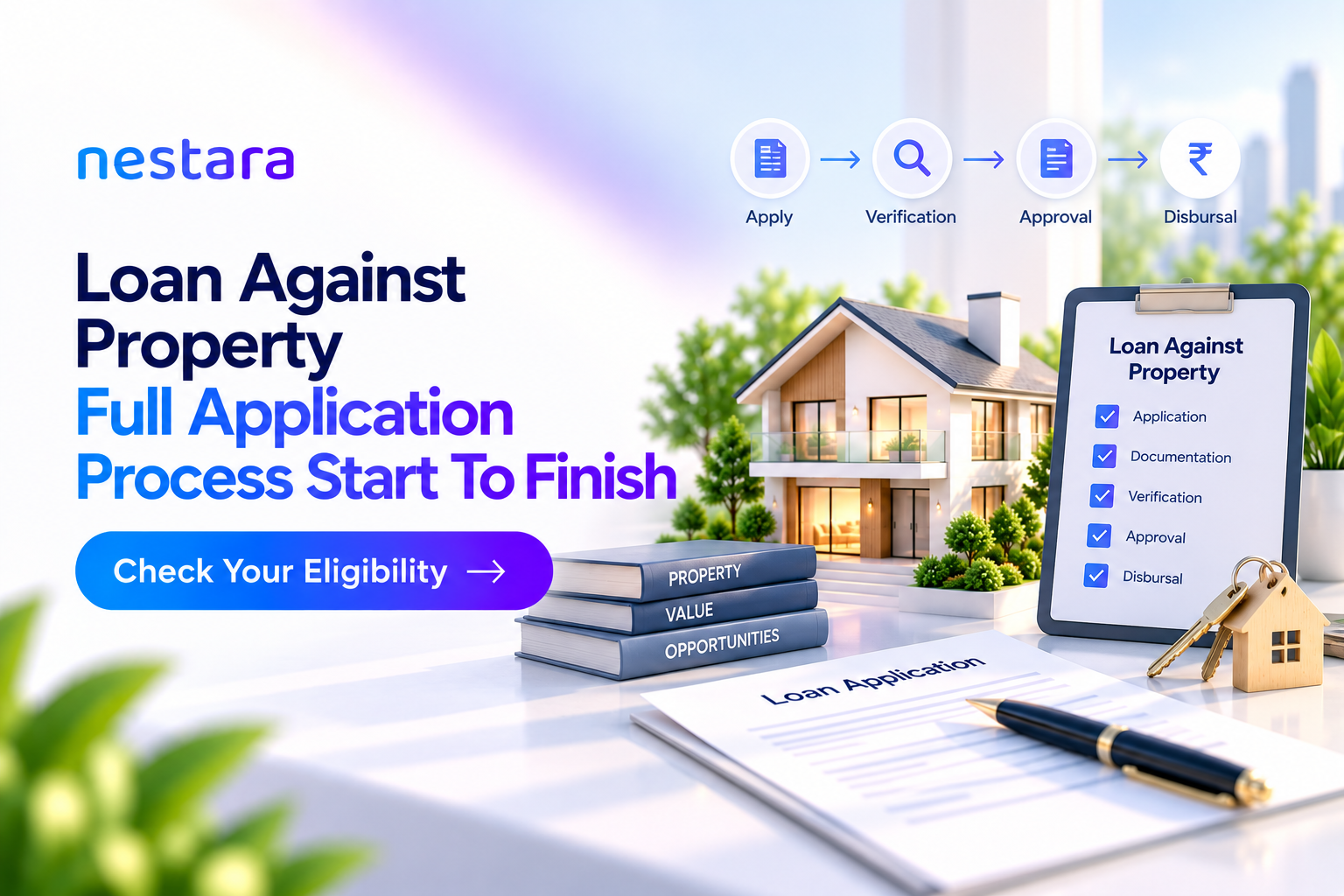
Loan Against Property: Full Application Process, Start to Finish
The Loan Against Property (LAP) application process typically involves checking eligibility, preparing documents, submitting the application, property valuation and legal verification, sanction, signing the loan and mortgage documents, and finally disbursement. Because LAP is secured against an existing property, the lender evaluates both your repayment capacity and the property offered as collateral before approving the loan.
If you are considering unlocking the equity in your property, understanding each stage beforehand can help you avoid delays, unnecessary applications and unexpected costs.
What is the Loan Against Property application process?
The LAP application process is a sequence of financial, credit, legal and property checks that a lender completes before releasing funds against your property.
The process generally looks like this:
- Check your borrowing requirement and eligibility
- Prepare your financial and property documents
- Compare lenders and LAP terms
- Submit the application
- Complete KYC, income and credit verification
- Get the property valued
- Complete legal and title verification
- Receive the sanction and review the loan terms
- Sign the loan and mortgage documentation
- Complete required security formalities and receive disbursement
The exact sequence, documentation and turnaround time can differ between banks, NBFCs, property types and borrower profiles.
Step 1: Check how much you actually need to borrow
Before applying for LAP, determine the amount you need rather than automatically borrowing the maximum available against your property.
For example, suppose you own a residential property worth around ₹1 crore and need ₹30 lakh for business expansion. Your decision should be based on whether the ₹30 lakh EMI comfortably fits your cash flow—not simply on whether a lender could potentially offer a larger amount.
Your potential loan amount depends on factors such as:
- Property value and type
- Location and legal status of the property
- Your income and existing EMIs
- Credit history
- Age and repayment capacity
- Lender-specific LAP policy
Lenders may offer different loan amounts against the same property, so comparing options before making a formal application can be useful.
Step 2: Keep your LAP documents ready
Preparing your documents before submitting the application can significantly reduce back-and-forth during verification.
A typical LAP application may require:
| Category | Common documents |
|---|---|
| Identity | PAN, Aadhaar/passport or other accepted KYC |
| Income | Salary slips, bank statements, Form 16 or ITRs |
| Employment/business | Employment proof or business documents |
| Existing liabilities | Loan statements and EMI details |
| Property | Sale/title deed, previous title documents and applicable approvals |
| Other | Photographs, application form and lender-specific documents |
Self-employed applicants may need additional business and financial records. Property documentation can also become extensive where the ownership history, construction approvals or title requires additional verification.
The exact checklist is lender-specific, so treat a general checklist as preparation rather than a universal requirement.
Step 3: Compare lenders before submitting the application
Comparing LAP offers before applying can help you evaluate the complete borrowing cost rather than choosing a lender based only on the advertised interest rate.
Look at:
- Interest rate and whether it is fixed or floating
- Processing and other applicable charges
- Loan amount offered
- Tenure
- Prepayment or foreclosure terms
- Property eligibility
- Income and credit criteria
- Expected processing timeline
RBI’s Key Facts Statement framework is designed to give eligible borrowers important loan information, including the overall cost, in a simpler format. Review the lender’s applicable KFS and sanction terms carefully before accepting the facility.
You can also use our Loan Against Property option to understand how LAP works before comparing options.
Step 4: Submit the LAP application
Once you have identified a suitable option, you submit the application along with the required information and documents.
At this stage, the lender typically collects details about:
- Your personal and contact information
- Income and employment/business
- Existing loans and liabilities
- Requested loan amount and purpose
- Property ownership and details
Submitting an application does not mean the loan has been approved. The lender still needs to independently verify your information, credit profile and property.
With Nestara, you can start by exploring LAP options and identifying relevant lenders before moving through the formal lender process.
Step 5: Complete credit, income and KYC verification
The lender next verifies whether you have the repayment capacity for the proposed LAP.
This assessment can include your:
- Credit history and repayment behaviour
- Income and banking activity
- Existing EMIs and liabilities
- Employment or business stability
- Age and proposed tenure
- Requested loan amount
A strong property does not automatically compensate for inadequate repayment capacity. LAP remains a loan that you must service through regular repayments.
Step 6: Get the property valued
Property valuation is a critical stage because the lender needs to establish the property’s acceptable value before determining the amount it is willing to lend.
A lender-appointed or empanelled valuer may assess factors such as:
- Property type
- Location
- Size and construction
- Condition
- Marketability
- Comparable property values
- Applicable lender valuation standards
The lender’s accepted valuation may therefore differ from the price you believe your property could command in the open market. The final loan amount is also subject to the lender’s applicable loan-to-value and credit policies.
Step 7: Complete legal and title verification
Legal verification confirms whether the property can be accepted as security for the loan.
The lender may examine the ownership chain, title documents, encumbrances, approvals, tax records and other applicable property paperwork.
This is one reason property-document issues can delay an otherwise strong LAP application. If there is a title dispute, missing document, unauthorised construction or unresolved ownership issue, the lender may request clarification or decline the property as collateral.
Step 8: Review the sanction letter carefully
If the application passes the required checks, the lender issues a sanction outlining the approved loan and applicable conditions.
Before accepting it, check:
- Sanctioned amount
- Interest rate
- Tenure
- EMI
- Processing fee and other charges
- Disbursement conditions
- Prepayment/foreclosure provisions
- Security and mortgage requirements
Do not compare loans on EMI alone. A lower EMI can simply result from a longer tenure and a higher total interest cost.
Step 9: Sign the agreement and complete mortgage formalities
After accepting the terms, you sign the applicable loan and security documents and complete the mortgage or charge-creation formalities required by the lender.
The property remains yours to use according to applicable law and the loan agreement, but it serves as security for the outstanding borrowing. The lender’s security interest remains until the loan is repaid and the applicable charges are released.
Step 10: Receive the LAP disbursement
Disbursement happens after the lender’s required documentation and security conditions are completed.
The exact timeline varies significantly depending on the lender, property, documentation and complexity of the application. A sanction is not the same as disbursement; receiving a sanction does not mean funds are automatically released immediately.
Once the loan is disbursed, continue tracking your EMI schedule, outstanding principal and applicable loan conditions.
What can delay a Loan Against Property application?
A LAP application can be delayed by incomplete documents, inconsistent information, unclear property titles, valuation differences, additional legal requirements, income-verification issues or unresolved existing liabilities.
To reduce delays:
- Prepare property documents before applying.
- Keep income and bank records updated.
- Ensure names and key details are consistent across documents.
- Disclose existing loans honestly.
- Ask the lender for a complete list of outstanding conditions.
- Compare lenders before making multiple formal applications.
If you are considering LAP because you want to unlock property equity, compare the borrowing cost with your expected use of funds. A secured loan can offer access to substantial capital, but the property itself is at risk if the loan is not repaid as agreed.
Conclusion
The Loan Against Property application process is not simply an application followed by disbursement. It involves borrower verification, credit assessment, property valuation, legal due diligence, sanction and mortgage formalities before the funds are released.
The best time to compare your options is before you submit multiple applications. With Nestara, you can explore LAP options, assess relevant lenders and take the next step with a clearer understanding of the borrowing decision.
FAQs
How long does the Loan Against Property application process take?
A LAP application can take anywhere from several days to a few weeks, depending on the lender, documentation, property valuation, legal verification and borrower profile. There is no universal approval timeline.
Can I apply for LAP if I am self-employed?
Yes, self-employed individuals can apply for LAP, subject to the lender’s eligibility criteria. Lenders may assess ITRs, business records, bank statements, existing liabilities and other evidence of repayment capacity.
Is property valuation mandatory for LAP?
Property valuation is generally a key part of LAP underwriting because the lender needs to determine an acceptable collateral value before deciding the loan amount. The exact valuation process varies by lender.
Can I get LAP if the property has an existing loan?
It may be possible, but the existing charge and outstanding loan must be considered. Depending on the situation, a lender may structure the transaction differently, including refinancing or taking over the existing liability.
Does LAP approval depend only on property value?
No. Property value is only one part of the assessment. Income, existing obligations, credit history, property title, location, property type and the lender’s internal policies can all affect the final approval and loan amount.
What happens to my property after I repay the LAP?
After full repayment and settlement, the lender should complete the applicable release of security and return the original property documents according to the applicable regulatory requirements. RBI directions require covered regulated entities to release original movable or immovable property documents and remove registered charges within 30 days after full repayment or settlement.


One Comment