How Does Your Existing EMI Affect a New Home Loan Application?
Your existing EMI can reduce your new home loan eligibility because lenders consider your current debt obligations when assessing how much additional repayment you can afford. The higher your existing EMIs, the lower your available repayment capacity may be for a new home loan. RBI says lenders assess factors including monthly disposable income, expenses, liabilities and income stability when determining housing-loan eligibility.
That does not mean having an existing loan automatically disqualifies you. What matters is whether your income can comfortably support both your current EMIs and the proposed home-loan EMI. Check out Nestara’s New Home Loan eligibility checker to understand this better.
Why Does an Existing EMI Reduce Home Loan Eligibility?
An existing EMI reduces home loan eligibility because part of your monthly income is already committed to repaying another loan.
For example, suppose you earn ₹1,00,000 per month.
- Existing EMI: ₹20,000
- Income remaining before other expenses: ₹80,000
If you had no existing EMI, the lender would have more repayment capacity to consider for your new home loan.
This is why two people earning the same salary can qualify for different home-loan amounts.
How Do Banks Calculate Existing EMI While Checking Eligibility?
Banks generally look at your overall repayment capacity rather than considering your salary alone. Existing loan EMIs are treated as financial obligations when assessing how much additional repayment you can handle.
Consider this simplified example:
| Monthly Income | Existing EMI | Effect on New Loan Eligibility |
|---|---|---|
| ₹1,00,000 | ₹0 | Higher repayment capacity |
| ₹1,00,000 | ₹10,000 | Moderate reduction |
| ₹1,00,000 | ₹20,000 | Larger reduction |
| ₹1,00,000 | ₹30,000 | Significant reduction |
There is no single RBI-prescribed EMI percentage that applies uniformly to every home-loan applicant. Lenders use their own underwriting policies while considering income, expenses, liabilities, age, credit profile and other factors. RBI’s consumer guidance says banks typically assess monthly disposable or surplus income and other liabilities when determining eligibility.
Which Existing EMIs Are Considered for a Home Loan?
Most existing loan obligations that affect your repayment capacity can matter when a lender evaluates a new home-loan application.
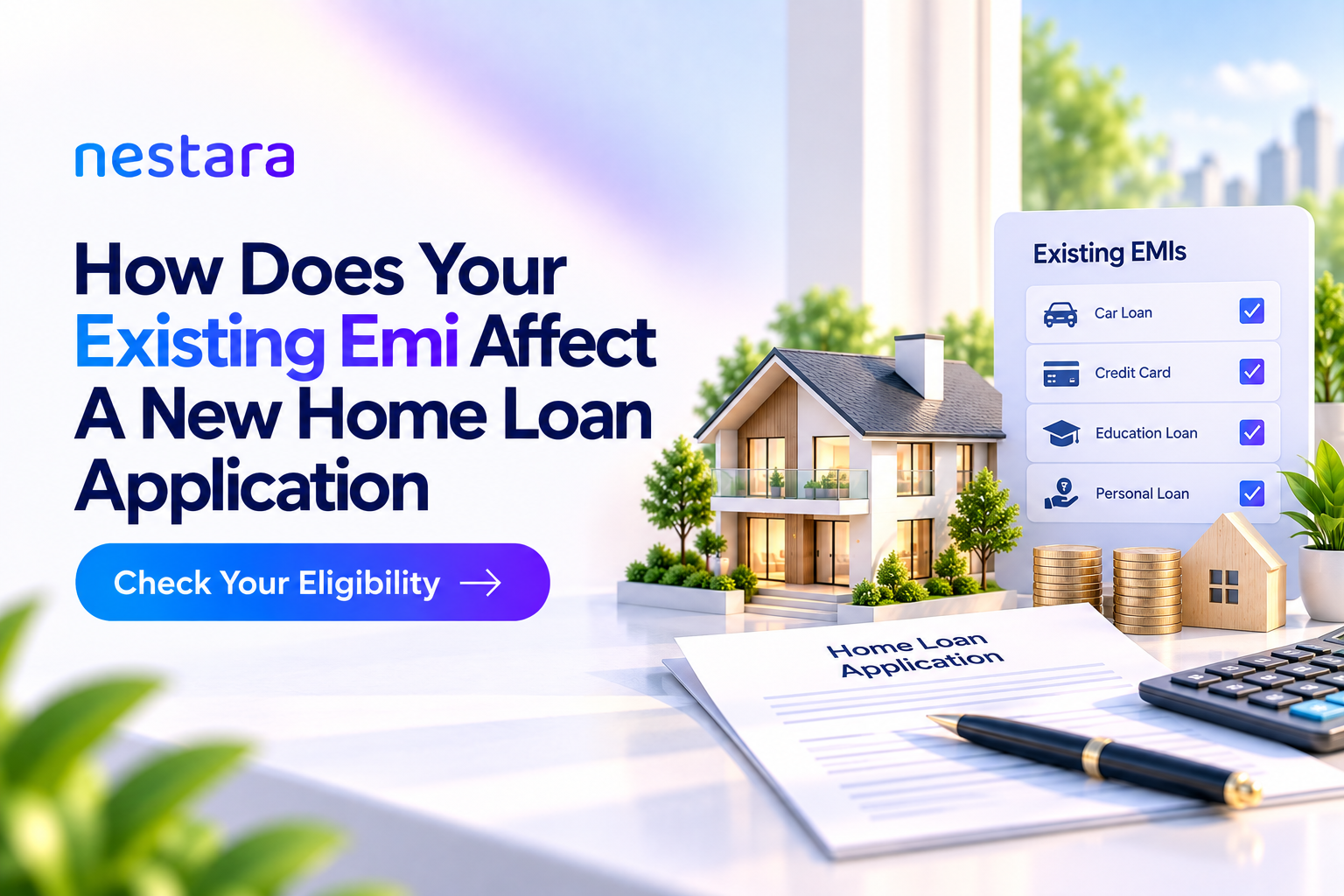
These can include:
- Personal loan EMI
- Car or vehicle loan EMI
- Education loan EMI
- Existing home-loan EMI
- Consumer-durable loan EMI
- Other reported credit obligations
Credit-card outstanding balances can also affect your overall credit assessment, even though they may not always appear as a conventional EMI.
The exact treatment varies by lender, so don’t assume that one bank’s calculation will be identical to another’s.
How Much Can a ₹20,000 Existing EMI Reduce Your Eligibility?
A ₹20,000 existing EMI can materially reduce your potential home-loan amount, but there is no fixed ₹-for-₹ reduction in eligibility.
The impact depends on:
- Monthly income
- Interest rate on the proposed home loan
- Proposed loan tenure
- Existing loan tenure and outstanding balance
- Lender’s income-to-obligation criteria
- Other monthly expenses
- Credit profile
For illustration, imagine a lender is comfortable with a total monthly loan obligation of ₹50,000 for a particular borrower.
If the borrower already pays ₹20,000:
Available capacity for the new home loan ≈ ₹50,000 − ₹20,000 = ₹30,000
If the borrower had no existing EMI, the full ₹50,000 could potentially be available for the proposed home loan.
The actual calculation will vary by lender and borrower profile.
Does Closing an Existing Loan Increase Home Loan Eligibility?
Yes, closing an existing loan can increase home-loan eligibility if it removes a significant monthly EMI from your obligations.
For example:
Before closure
- Income: ₹1,00,000
- Existing personal-loan EMI: ₹15,000
- New home-loan EMI capacity: Lower
After closure
- Income: ₹1,00,000
- Existing personal-loan EMI: ₹0
- More monthly repayment capacity available
However, don’t close a loan purely to improve eligibility without considering the cost of doing so. Check the outstanding principal, foreclosure charges if applicable, and the cash you would need to use.
If closing the loan would consume most of your emergency savings, the higher home-loan eligibility may not be worth the loss of financial flexibility.
Should You Pay Off Your Existing Loan Before Applying for a Home Loan?
Paying off an existing loan before applying can make sense when the EMI is significantly reducing your borrowing capacity and you have enough funds to close it without weakening your finances.
Before doing so, compare:
- Outstanding loan balance
- Foreclosure or prepayment charges, if applicable
- Interest remaining on the existing loan
- Increase in potential home-loan eligibility
- Emergency savings left after repayment
The goal should not simply be to show zero existing EMIs. You should remain financially secure after paying off the loan.
Can a Personal Loan Affect Home Loan Eligibility?
Yes, a personal-loan EMI can reduce home-loan eligibility because it is an existing monthly debt obligation.
Personal loans can have relatively high EMIs compared with some other forms of borrowing. If you are planning to apply for a home loan soon, taking a new personal loan shortly beforehand can therefore work against your borrowing capacity.
For example:
- Monthly income: ₹80,000
- Existing EMI: ₹10,000
- New personal-loan EMI: ₹12,000
- Total existing EMIs: ₹22,000
The lender may assess the new home-loan application after accounting for the ₹22,000 already committed each month.
Does a Car Loan Affect New Home Loan Eligibility?
Yes, a car-loan EMI can reduce new home-loan eligibility because the lender considers the repayment obligation when assessing your available income.
Suppose you earn ₹1.2 lakh per month and have a ₹15,000 car EMI. Your potential home-loan eligibility will generally be lower than that of another borrower earning the same ₹1.2 lakh with no existing EMI, all else being equal.
This doesn’t mean you should avoid buying a car simply because you plan to buy a house. It means both EMIs should be considered together when planning your budget.
Can a Joint Home Loan Offset Existing EMI Obligations?
A joint home loan can potentially improve eligibility if the co-applicant adds sufficient eligible income, but the co-applicant’s existing EMIs will also matter.
For example:
Applicant
- Income: ₹80,000
- Existing EMI: ₹10,000
Co-applicant
- Income: ₹60,000
- Existing EMI: ₹5,000
The lender may consider the eligible combined income while also accounting for the borrowers’ combined obligations.
So adding a co-applicant isn’t automatically beneficial. The complete financial profile of both borrowers matters.
Does Existing EMI Affect Your Home Loan Interest Rate Too?
Existing EMI primarily affects eligibility and repayment capacity, but it can also influence the lender’s overall assessment of your risk profile.
A borrower with substantial existing debt may not necessarily receive the same loan terms as someone with a stronger overall financial profile. However, interest rates are determined using multiple factors, including the lender’s pricing policy, borrower profile, credit history, loan amount and other applicable criteria.
Therefore, don’t assume that paying off one EMI will automatically result in a lower home-loan interest rate.
Can a Longer Home Loan Tenure Compensate for Existing EMI?
A longer tenure can potentially increase your eligible home-loan amount because it reduces the monthly EMI for a given loan amount. However, it does not remove the existing EMI from your obligations.
For example, a ₹50 lakh loan might have a lower EMI over 25 years than over 15 years. This could make the proposed loan more manageable within your available repayment capacity.
But a longer tenure generally means paying interest for more years.
RBI has also cautioned lenders that extending the repayment period to keep EMI unchanged should still be supported by the borrower’s repayment capacity over the entire extended period.
So, don’t choose the longest possible tenure solely to maximise eligibility.
What Should You Do Before Applying for a New Home Loan?
The best approach is to calculate your existing obligations first and then determine how much additional EMI you can realistically afford.
Follow these steps:
- List every existing EMI.
- Check your outstanding loan balances.
- Calculate your monthly take-home income.
- Review essential monthly expenses.
- Identify loans that could reasonably be closed before applying.
- Calculate the proposed home-loan EMI.
- Compare lenders instead of assuming every lender will assess you identically.
Nestara’s New Home Loan eligibility checker can help you understand your potential borrowing capacity based on your financial profile before you formally apply.
Can You Still Get a Home Loan With Existing EMIs?
Yes, you can still get a home loan while repaying other loans if your income and overall financial profile support the additional repayment.
An existing EMI isn’t an automatic rejection reason. What matters is whether the lender believes you can comfortably handle the proposed home-loan repayment along with your existing obligations.
For example, someone earning ₹1.5 lakh with a ₹10,000 existing EMI may have a stronger application than someone earning ₹1 lakh with no EMI, depending on their complete financial profiles.
This is why checking eligibility based only on salary can give a misleading picture.
Conclusion
Your existing EMI directly affects new home-loan eligibility because it reduces the portion of your income available for another loan repayment. The impact depends on your income, existing obligations, proposed loan amount, interest rate, tenure and the lender’s assessment method.
If an existing loan is significantly limiting your eligibility, closing it may help—but only if you can do so without draining your savings. A joint application or suitable tenure can also change the calculation, but neither should be used simply to borrow more than you can comfortably repay.
Before applying, check your existing obligations and compare your potential loan options. Use Nestara’s New Home Loan eligibility checker to understand how your current EMIs affect your borrowing capacity and explore suitable lender options before you apply.
FAQs
Does an existing EMI reduce home loan eligibility?
Yes. An existing EMI is a financial obligation that reduces the income available for a new home-loan repayment. The larger the existing obligation, the greater its potential impact on eligibility.
How much existing EMI is too much for a home loan?
There is no universal EMI limit that applies to every borrower and lender. Banks assess repayment capacity based on income, expenses, existing liabilities and other factors. RBI’s consumer guidance notes that banks typically assess monthly disposable or surplus income when determining eligibility.
Can I get a home loan if I already have a personal loan?
Yes. Having a personal loan does not automatically prevent you from getting a home loan. However, the personal-loan EMI will generally be considered when assessing your repayment capacity.
Should I close my personal loan before applying for a home loan?
It can help if the personal-loan EMI is significantly reducing your eligibility, but you should compare the benefits with the cost of foreclosure and the amount of savings you would use to close the loan.
Does a car EMI affect home loan eligibility?
Yes. A car-loan EMI is an existing financial obligation and can reduce the amount of additional EMI a lender considers affordable.
Can a co-applicant increase home loan eligibility if I already have EMIs?
Potentially. A co-applicant with stable, eligible income can increase combined repayment capacity. However, the co-applicant’s own existing EMIs and liabilities will also be considered.
Does closing an existing EMI guarantee a higher home loan?
No. Removing an EMI can improve repayment capacity, but the final loan amount also depends on income, credit profile, age, tenure, interest rate, property and lender-specific criteria.
Can a longer tenure help if I already have an EMI?
Yes, a longer tenure can reduce the EMI of the proposed home loan and may improve calculated eligibility. However, it generally increases total interest paid, so it should not be chosen solely to maximise the loan amount.