


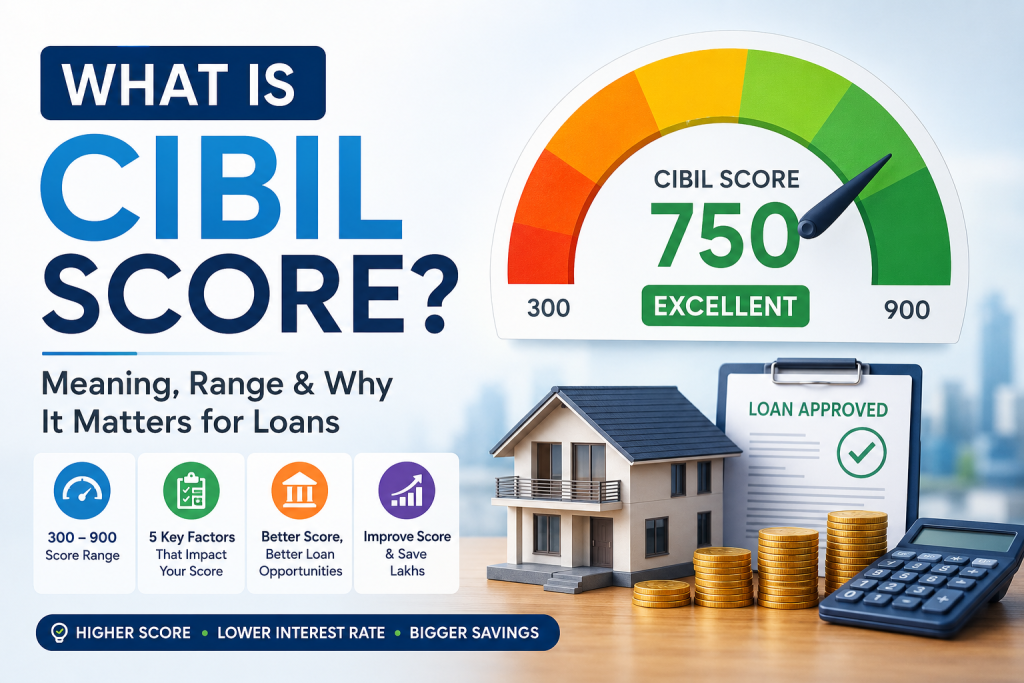
A CIBIL score is a 3-digit number between 300 and 900 that summarises your credit history and tells lenders how reliably you repay debt. In this guide, you’ll learn what your CIBIL score actually means, how it’s calculated, what range you need for a home loan, and how to improve it — so you can secure better interest rates and avoid costly rejections.
Quick Summary
- CIBIL score ranges from 300 to 900; anything above 750 is considered excellent by most Indian lenders.
- It’s calculated based on your repayment history (35%), credit utilisation (30%), credit age (15%), credit mix (10%), and new enquiries (10%).
- A higher score can reduce your home loan interest rate by 0.25%–0.75%, saving lakhs over a 20-year tenure.
- You can check your CIBIL score for free once a year at cibil.com or through most finance apps such as Loan Network.
- Late payments, high credit card balances, and multiple loan applications hurt your score the most.
What Is CIBIL Score?
What does it mean?
CIBIL score is a credit rating issued by TransUnion CIBIL, India’s oldest and most widely used credit bureau. It reflects your borrowing and repayment behaviour across all loans and credit cards over the past 24–36 months. Lenders use this score as the first filter when reviewing your home loan, personal loan, or credit card application — a higher number signals lower risk and a better borrower profile.
How does it work?
Every time you take a loan or use a credit card, the lender reports your activity to CIBIL each month. CIBIL aggregates this data — payments, defaults, balances, enquiries — and runs it through a statistical model to produce your score. A score of 750+ generally guarantees fast approval at the best rates, while scores below 650 often face rejection or much higher interest rates and stricter terms.
Key Factors You Should Know
What are the important factors to consider?
Your CIBIL score is shaped by five factors that collectively decide your creditworthiness. Repayment history carries the most weight — even one missed EMI can drop your score by 50–100 points. Credit utilisation (the percentage of your credit limit you’re using), how long you’ve held credit, the mix of secured and unsecured loans, and how often you apply for new credit also feed into the calculation.
How do these factors impact your decision?
These factors directly determine whether you qualify for a home loan and at what interest rate. A score of 800 versus 700 can mean a 0.5% lower rate — on a ₹50 lakh loan over 20 years, that’s about ₹6 lakh saved. They also affect loan amount eligibility, processing fees, and whether the lender insists on a co-applicant or higher down payment.
- Payment History — 35% weightage; on-time EMI and bill payments
- Credit Utilisation — 30% weightage; keep below 30% of total limit
- Credit Age — 15% weightage; older accounts boost your score
- Credit Mix — 10% weightage; balance of secured and unsecured loans
- New Enquiries — 10% weightage; too many applications hurt
Options / Scenarios Explained
What are the available options?
CIBIL scores fall into broad bands that lenders use to categorise risk: Excellent (750–900), Good (700–749), Fair (650–699), Poor (550–649), and Very Poor (300–549). Each band determines not just approval odds but also the interest rate slab, processing fees, and the maximum loan amount you can secure. Other bureaus like Experian, Equifax, and CRIF High Mark also issue scores, but CIBIL remains the most referenced.
How do different scenarios affect outcomes?
Your score band changes the entire economics of your loan. A 750+ borrower may get an 8.5% rate, while a 650 borrower at the same bank might be offered 10.5% — a 2% gap that translates to lakhs in extra interest. Some banks won’t even process applications below 650, while NBFCs may approve them at much higher rates with stricter conditions.
| Score Range | Lender View | What to Expect |
| 750–900 | Excellent | Lowest rates, fast approval, higher loan amount |
| 700–749 | Good | Approval likely, slightly higher rate |
| 650–699 | Fair | Approval possible, higher rate and stricter terms |
| 550–649 | Poor | Likely rejection or very high interest |
| Below 550 | Very Poor | Rejection from most banks; NBFC at premium rates |
Which Option Is Right for You?
When should you focus on improving your score?
Focus on improving your CIBIL score if it’s below 750 and you’re planning a home loan, car loan, or business loan in the next 6–12 months. The bigger the loan, the more critical the score. Even a 30-point improvement can shift your rate slab. Clear credit card dues, settle small overdues, avoid new credit applications, and let on-time payments accumulate for 3–6 months.
When should you apply now without waiting?
Apply now if your score is already 750+, your income is stable, and the property opportunity is time-sensitive. Waiting to push a score from 770 to 800 yields diminishing returns — most banks treat anything above 750 as the same tier. Similarly, if you have urgent funding needs and a co-applicant with strong credit, you can apply jointly without waiting to fix your own score.
Practical Tips to Make the Best Decision
- Check your CIBIL report for free at least once a year and dispute any errors immediately.
- Pay your credit card bill in full and before the due date — even a one-day delay can be reported.
- Keep credit utilisation below 30% of your total limit; below 10% is ideal for top-tier scores.
- Avoid closing your oldest credit card; longer credit history boosts your score.
- Don’t apply for multiple loans or cards within a 30-day window — each enquiry shaves a few points.
Common Mistakes to Avoid
- Assuming a “no loan history” score is good — having no credit at all often results in a lower or NA score, not a perfect one.
- Settling a defaulted loan instead of paying it in full — settlements stay on your report for 7 years and signal risk to future lenders.
- Co-signing or guaranteeing someone else’s loan without realising their default will hit your score too.
Conclusion
Your CIBIL score is the single most important number when applying for a home loan in India. Aim for 750 or above, build it patiently over 6–12 months by paying every EMI on time and keeping utilisation low, and check your report regularly for errors. A strong score doesn’t just get you approved — it saves you lakhs in interest and gives you negotiating power with every lender.
FAQ Section
What is a good CIBIL score for a home loan in India?
A score of 750 or above is considered excellent and qualifies you for the lowest home loan interest rates from most major banks. Scores between 700 and 749 are generally acceptable but may attract a slightly higher rate. Below 700, approval becomes harder and interest rates start climbing — below 650, most banks decline applications outright unless you bring a strong co-applicant.
How can I check my CIBIL score for free?
You can check your CIBIL score once a year for free directly at cibil.com by registering with your PAN. Many banking apps like Loan Network, HDFC, ICICI, Paytm, CRED, and BankBazaar also offer free score checks every month. These are “soft enquiries” and do not affect your score, unlike the hard enquiries triggered when a lender pulls your report for a loan application.
How long does it take to improve a CIBIL score?
Improving your CIBIL score is a gradual process — typically 4 to 12 months of disciplined repayment behaviour. If your score dropped due to a missed payment, paying on time for the next 6 months can recover 30–60 points. If your utilisation is too high, bringing it under 30% may show results within 1–2 monthly reporting cycles. Serious defaults take 24+ months to fade.
Does checking my own CIBIL score reduce it?
No, checking your own CIBIL score is classified as a “soft enquiry” and does not affect your score in any way. You can check it as many times as you want. Only “hard enquiries” — which happen when a bank or NBFC pulls your report after you formally apply for a loan or credit card — temporarily lower your score by a few points each.
Can I get a home loan with a CIBIL score below 650?
Yes, but it’s significantly harder. Most major banks reject home loan applications below 650, but some NBFCs and smaller HFCs may approve at much higher interest rates (often 11%–14%), with stricter conditions like a larger down payment, shorter tenure, or a co-applicant with stronger credit. It’s usually wiser to spend 6 months rebuilding your score before applying.